
Premier calls for particle testing progress
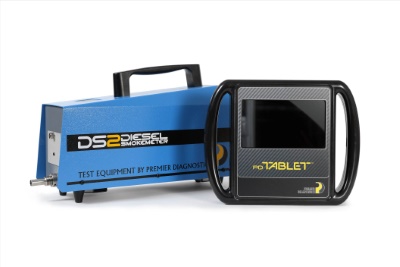
Premier Diagnostics’ opacity tester
Premier Diagnostics, which provides diesel smoke meter testing equipment, has outlined the potential benefits for UK fleets of particle number (PN) counting, a practice which has recently been introduced in a number of EU countries’ annual testing regimes to help detect potential problems with vehicle emission control systems.
“With 2024 marking 30 years since the introduction of diesel emissions testing on MOT, it is remarkable to consider that very little has changed in that time,” said Marc Tew, sales manager at Premier Diagnostics.
“Limits have reduced, in accordance with the Euro standards, however the fundamental method of testing and its technology has barely moved. We now have a far greater awareness of the effects of particle emissions and the damage they can inflict on health, especially for those already vulnerable or young.”
The current method of opacity testing has its limits and can only reliably detect particles above 200nm, explains Marc, with measurement becoming unreliable for anything below this.
“Developments in diesel technology have sought to reduce the engine emissions, often by way of ‘catch and treat’,” he continued.
“A diesel particulate filter (DPF) would catch the larger particles, before periodically burning these off through a regeneration cycle. This is highly effective when working correctly. However, a cracked or damaged DPF would allow through an astonishing number of fine particles, far smaller than 200nm – the common average is 70nm.
“In general, ambient air carries around 4,500 particles per cubic centimetre; a perfectly operating DPF system will actually clean the air the engine is using and reduce this number to near zero.
“Contrast this with a faulty DPF, emitting very little in the way of visible emissions, however silently outputting over 1 million particles per cubic centimetre – a dramatic increase. These damaged vehicles are often going undetected by the current procedures.”
The data from other EU countries where particle number counting has been introduced is already showing a large number of defects being captured and therefore rectified, says Marc.
“Whilst the obvious benefit to this is cleaner air, there are also a number of direct benefits for the vehicle operator, both private and commercial,” he explained.
“Poor diesel emissions are generally a sign of a vehicle fault; this could be a damaged DPF, or faulty injectors, even an EGR valve issue. Having this information early lets you enact proactive repairs rather than relying on a breakdown fault to trigger the works, reducing downtime and saving you money.”
In January 2023, the Department for Transport (DfT) launched a public consultation, with one of the subjects being the introduction of PN testing in MOTs for light vehicles, but which the Driver & Vehicle Standards Agency (DVSA) has said “could equally apply to heavy vehicles”.
In the consultation outcome released in January 2024, DfT said: “The responses to the consultation were broadly supportive of introducing more effective testing for diesel emissions, which would have significant air quality benefits.
“We are working closely with the DVSA on a trial of the relevant particle number machines, and estimating the impacts of an improved diesel emissions test.
“We will consider the results of those trials before deciding whether to implement this measure. A key part of this consideration will include balancing costs against benefits, as we are keen to ensure any changes to testing do not impose disproportionate costs on the motorist.”
Premier Diagnostics’ Marc Tew emphasised the “obvious importance and benefits” of introducing the improved technology.
“As a combined automotive industry, I believe the obligation is now on us to push this important issue,” he said.