
The Handbook Group: navigating fleet management in a digital world
 At the outset of the second quarter of the 21st century, the digital transport operation is no longer a ‘nice-to-have’ for the forward thinkers, according to Glen Davies, managing director of The Handbook Group. Rather, it is now the foundation of modern fleet management, incorporating faster communication, accurate data and robust reporting.
“Over the past decade, the pace of regulatory and technological change has accelerated to a point where analogue processes simply can’t keep up,” said Glen.
“Tachograph legislation has tightened, enforcement has become more data-driven, DVSA and the traffic commissioners have moved decisively to digital services, and vehicles are highly-connected machines generating data every second they operate. We can’t opt out of this; digital is the way the world works and our sector is no exception.”
Nothing demonstrates this better than the roll-out of the second-generation smart tachograph (ST2), says Glen.
“The deadlines are well behind us, and if you’re an international operator still reliant on older tachograph technology, you are already non-compliant. The ST2 is no longer about ‘records’, it’s an enforcement tool built for a digital ecosystem.
“With automatic global positioning, border-crossing logs, loading and unloading event markers and remote download capability, the tachograph has evolved into a live compliance instrument. Enforcement officers can now check data without stopping a vehicle. Gaps in record-keeping stand out instantly and ‘fudging’ data is nigh-on impossible.
“Technology has tightened the space that once existed for ambiguous interpretation, but the message is unambiguous: tachograph compliance is digital compliance. Trying to manage it manually is like managing your payroll with cash and brown envelopes – technically possible, but operationally indefensible.”
As tachographs have become smarter, says Glen, enforcement has modernised too.
“DVSA’s strategic plan commits to digitising test records, defect data, authorisations and vehicle records. The agency’s shift to cloud platforms means the expectation is now about accurate real-time visibility, not patchy retrospective documentation.
“The traffic commissioners’ environment has moved in the same direction. More interactions happen online. Applications, notifications, complaints and regulatory reviews now sit in a digital workflow. You no longer ‘send paperwork’ – you update digital records that can be viewed instantly.
“For operators, this means the standard of scrutiny has changed. Regulators increasingly expect audit-ready records, consistent data, and a demonstrable link between what the business says it does and what the data actually shows.
“Digital tools make this possible, whereas paper records can be incomplete, inconsistent, or impossible to interrogate – a paper trail often struggles to withstand scrutiny.
“In simple terms: enforcement has upgraded and operators are expected to upgrade with it.”
Modern vehicles are digital platforms on the move, says Glen: they create a constant stream of data including engine management, fuel use, emissions, safety interventions, advanced driver-assistance, and predictive maintenance warnings.
“Increasingly, manufacturers assume integration. They expect operators to plug vehicle information into fleet systems, driver-performance tools, compliance dashboards and workshop processes. The idea of a vehicle as a standalone asset is disappearing. The vehicle is part of the operational data flow.
“Digitisation is therefore not only about compliance – it’s also efficiency, asset management and good business sense. Those who embrace technology gain early visibility, better diagnostics, fewer defects and improved compliance. In a sector with tight margins, holding back on digital adoption can be costly.
“Before the pandemic, digital driver communications were considered forward-thinking. Now, they help solve real operational problems: can you prove drivers have accessible and accurate instructions? Can you demonstrate policy information has been communicated clearly and consistently? Can you show timely updates and when they’re acknowledged?
“Paper may be able to answer these questions, but the robustness, completeness, and accuracy of those answers can be uncertain. Digital solutions supply them immediately.”
The same applies to compliance communications, Glen adds – toolbox talks, safety alerts, regulatory updates.
“Gone are the days of relying on signatures, filing cabinets, and frantic hunts for the ‘latest version’. Digital systems  cut through the chaos, delivering certainty, auditability, and complete alignment.
“As regulators increasingly look for evidence that the transport manager has continuous and effective control; being able to demonstrate that information flows reliably to drivers is no longer optional. It is a cornerstone of modern operator licensing.”
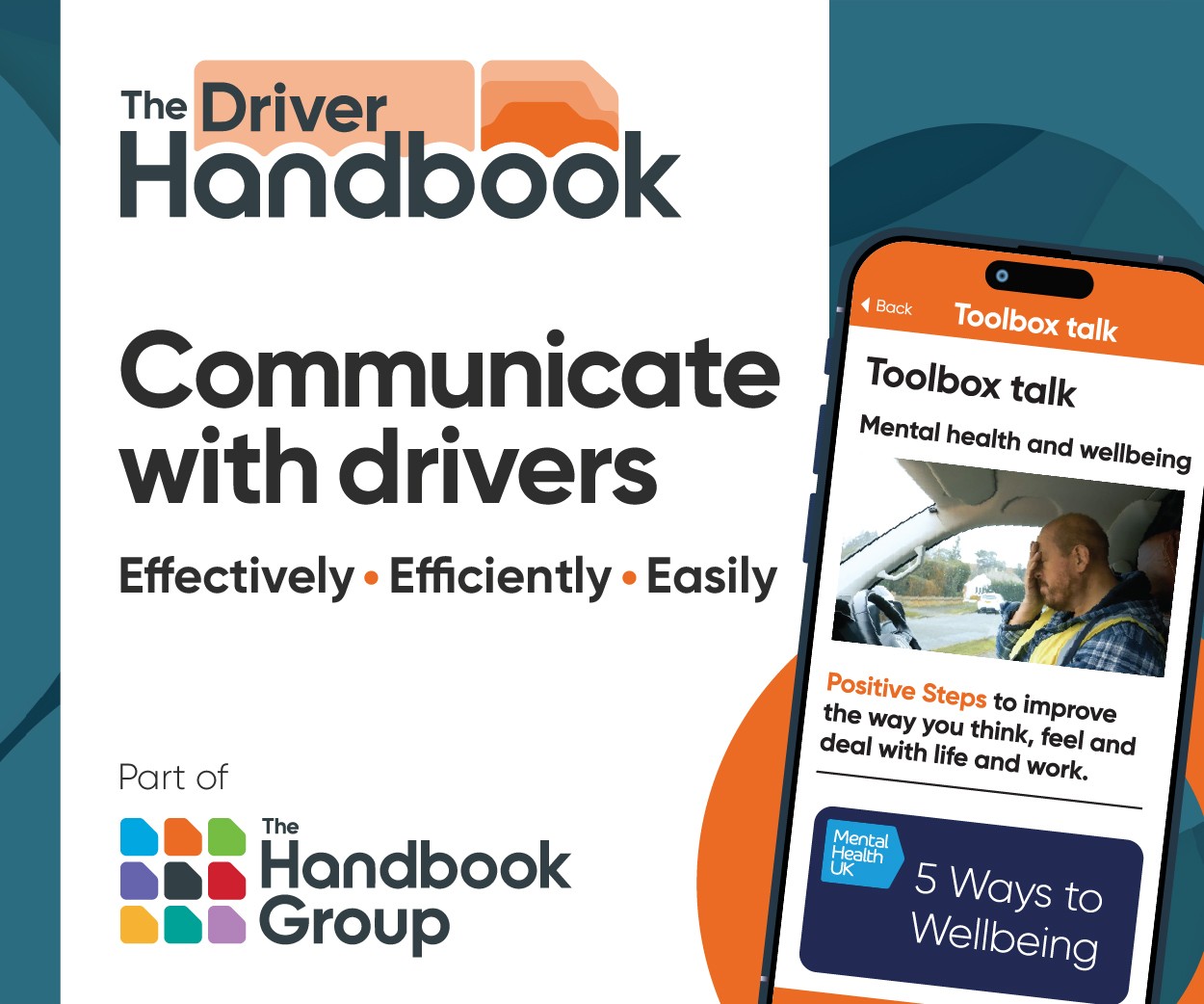
The Handbook Group’s digital approach to driver communications and training is said to be paying dividends for fleets like Abbey Logistics, one of the UK’s leading road tanker operators, which adopted The Driver Handbook in 2024 to modernise communication with its 450‑plus drivers.
The company’s driver training manager sought “a driver communication and training solution in one”, and quickly saw that the system “ticked every box”.
Abbey Logistics now uses a bespoke version of the company’s platform and app to share policies, procedures, updates and vacancies in real time, with full reporting and audit trails. They have also been working with The Handbook Group team to develop Driver CPC eLearning, to help reduce classroom hours and improve flexibility in learning.
Meanwhile, abnormal loads specialist Insight Trans Logistics adopted The Driver Handbook to overcome the challenge of training and communicating with drivers spread across Europe. The mobile-first platform centralised updates, policies and training, replacing fragmented emails and reducing the need for classroom training.
 Built‑in quizzes proved driver understanding, and preparing for the FORS Bronze audit became far easier, with instant access to policies, records and time‑stamped evidence; and the auditor was reportedly impressed by clear evidence of driver access and comprehension.
One of the most striking shifts in the past decade, says Glen Davies, is that paper-based processes have vanished from almost every industry where audit, accuracy and safety matter.
“People adapt when there’s motivation and the younger generation now expect a digital-first workplace. Clinging to paper-based systems at work isn’t just inconvenient; it’s a throwback to another era…
“What’s become clear is that digital transformation in road transport isn’t a passing trend. It underpins compliance, safety, performance, recruitment and regulation. The technology is ready, legislation has caught up, and regulators have modernised. Paper is on its way out.
“Beyond compliance and improved performance, operators who fully embrace digital cut admin, streamline communication, and stay audit-ready – building a stronger safety culture along the way. They gain visibility, resilience, and control. Those who resist risk falling behind.
“Digitisation isn’t the future of fleet management – it’s the present. The operators who thrive will be the ones who seize it and run with it.”