
ISN Garage Assist: a closer look at lifting strategy
 For transport operators, says garage equipment specialist ISN Garage Assist, workshop lifts are no longer a background purchase; they are infrastructure decisions that directly affect fleet availability, workshop throughput and long-term operational resilience.
“As fleets become more complex and downtime becomes more expensive, the way workshops are designed and equipped has a measurable impact on maintenance efficiency,” said the company.
“At ISN Garage Assist, we are seeing a clear shift in the way operators approach workshop investment. The conversation has moved beyond ‘what lift do we need?’ to ‘how should our workshop be structured to support the fleet five years from now?’
“Every hour a vehicle is off the road has a cost. For many operators, the most frustrating delays are not caused by parts availability, but by workshop bottlenecks. Limited bay access, poor workflow and under-specified lifting equipment can all extend turnaround times.”
For commercial vehicle servicing, says ISN Garage Assist, dedicated heavy-duty lifting remains a core requirement.
“High-capacity four post commercial vehicle lifts continue to be widely used for their stability and suitability for long wheelbase vehicles. In many fleet workshops they form the backbone of inspection and servicing routines, particularly where repeatable lifting and consistent access are required.
“Within ISN Garage Assist’s commercial lift range, high-capacity four post solutions including 13 tonne and 20 tonne options are available for workshops supporting heavier vehicle profiles.”
In practice, it says, efficiency depends on how bays are structured, how vehicles move through the facility, and how quickly technicians can access the work area.
“A workshop that relies on a single lift type across every bay often ends up compromising. Mixed fleets need mixed capability.”
A common approach in transport workshops is to separate workstreams, says the firm – for example, a heavy-duty bay with a commercial vehicle lift for trucks and long wheelbase vehicles; a dedicated LCV bay using two post lifts for vans and light commercial servicing; a rapid maintenance area where scissor lifts can support fast turnaround work; or a flexible lifting zone using mobile column lifts where the vehicle mix changes.
“This is often more productive than trying to force every job through one type of lifting solution.
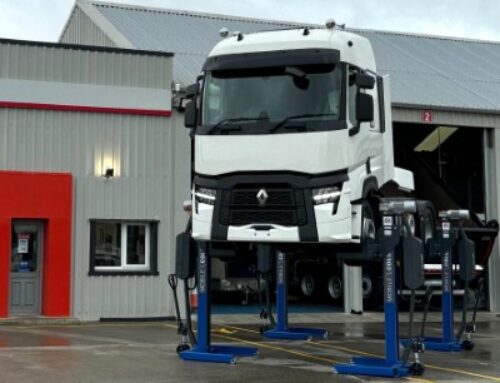
“Fleet workshops are increasingly expected to handle more than one vehicle profile. This is where mobile column lifts continue to gain traction.
“For operators servicing mixed fleets, mobile column systems allow lifting capability to be deployed where it is needed, rather than being locked into a single bay layout. That flexibility can be valuable for larger facilities, shared workshops, or operations where the fleet mix is changing.”
 Lifts sit at the centre of workshop safety, says ISN Garage Assist.
“The right lifting equipment improves access and visibility, reduces physical strain and lowers the risk of workplace incidents. For transport operators, that supports both compliance and consistency, particularly where inspection quality is critical.
“There is also a workforce dimension. In an industry facing technician shortages, workshop ergonomics and safe working conditions are increasingly linked to retention. Better equipment reduces fatigue and improves day-to-day workflow for technicians, especially in high-volume environments.
“As electric and alternative fuel vehicles enter commercial fleets, workshop infrastructure must evolve.
“Many newer platforms introduce additional vehicle weight and different service access requirements. This makes lift capacity, platform stability and clearance more important, especially in facilities planning for future fleet changes.
“Forward-thinking operators are now specifying lifting equipment with a view to future vehicle weights, not just current fleet profiles.”
In practice, says the firm, a complete lifting strategy often includes four post commercial vehicle lifts for stable heavy-duty servicing; mobile column lifts for flexible lifting across different vehicle formats; two post lifts for cars, vans and general workshop servicing; and scissor lifts for rapid service bays and space-conscious installations.
“The goal is to support the widest range of jobs while maintaining safety, efficiency and workflow continuity,” said ISN Garage Assist.
“For transport operators reviewing capital investment, lifts should not be viewed as isolated purchases.
“They influence fleet availability and downtime reduction; workshop throughput and bay utilisation; technician efficiency and working conditions; inspection quality and safety compliance; and long-term adaptability as fleets evolve.
“When lifting is treated as infrastructure, it becomes part of the wider performance strategy for the fleet.”