
Supertracker: helping workshops lift their game
 Workshop equipment provider Supertracker has outlined the rationale behind its new workshop lifting range, and offered insights into the future of lifting technology.
The company recently announced the launch of several additions to its portfolio, which it says bring a deliberately simplified, specification-led approach to the market.
“Workshops are under growing pressure from changing vehicle types, weights and operating demands,” said Andrew Bates, managing director at Supertracker.
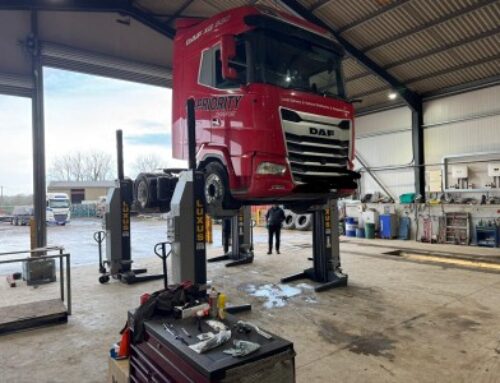
“Many workshops that were originally set up for cars are now trying to accommodate commercial vehicles in limited space, while still needing equipment that can safely handle higher capacities.
“Supertracker identified a clear need for stronger, higher-capacity lifts – particularly in the 4- to 5-tonne-plus range – to support the realities of modern fleets and commercial workshops.”
Andrew advocates a ‘keeping it simple’ approach to lift selection.
“It means designing lifts to do their core job reliably – lifting vehicles safely, evenly and consistently – without unnecessary electronics or complex control systems.
“Modern equipment often introduces advanced sensors and complicated electronics to solve straightforward mechanical tasks. While these ‘bells and whistles’ may look impressive, they increase the number of components that can fail and make repairs slower and more uncertain.
“By using proven, straightforward systems, we can reduce downtime, improve first-time fix rates for engineers and allow faults to be diagnosed and repaired quickly using practical engineering skill rather than guesswork or software diagnostics. The result is more reliable equipment that keeps workshops productive.”
According to Andrew, real-world technician experience was central to the design process for the new lifts.
“Many imported lifts are built to dimensions that don’t suit European workshops or the height of typical technicians. So, we took a European-market approach, adjusting lift height so taller technicians can work comfortably and safely underneath vehicles.
“Beyond height, feedback influenced footprint size, workshop clearance needs, safety requirements across different European standards and practical positioning of lift arms.
“The goal was equipment that fits real workshops, supports real vehicles and works efficiently in often tight spaces – not generic one-size-fits-all designs.”
The long-term value, he says, comes from reliability, serviceability and reduced downtime.
“Simpler systems mean fewer breakdowns and far higher chances that repairs can be completed in a single visit. Every avoided delay saves labour hours, lost workshop capacity and operational disruption.
“Fleet operators increasingly weigh repair cost against replacement cost – and modern equipment is often replaced sooner than in the past. Supertracker’s approach focuses on providing strong value for money – robust, compliant equipment that performs reliably throughout its working life without expensive, complex failures.
“The emphasis isn’t just on purchase price, but on keeping workshops running efficiently and predictably. Supertracker is entirely customer-driven, offering everything from simple unit delivery for self-installation to a complete end-to-end service covering delivery, installation and lifetime servicing and upkeep.”
Electric vehicle (EV) adoption has played a big part in shifting lift capacity, Andrew adds.
“Battery and hybrid vehicles are often heavier than their internal-combustion equivalents, driving the need for higher-capacity lifts capable of safely handling increased loads.
“Alongside this, we’ve introduced dedicated battery handling systems – electrically operated tools designed to safely remove, transport and reinstall EV batteries. These feature adjustable locating points and tiltable work platforms in multiple directions, allowing precise positioning and improved safety during battery servicing.
“This ensures workshops are equipped to lift EVs and work on them efficiently and safely.”
On the evolution of workshop equipment in the coming years, he said: “The industry will probably continue pushing towards more digital, sensor-driven and feature-heavy equipment – often driven by competition and margin rather than real operational need.
“Supertracker’s philosophy is to resist unnecessary complexity and stay focused on reliability, usability and value. The priority is equipment that performs its core function exceptionally well over time, rather than systems overloaded with electronics that add cost and long-term failure risk.
 “Just as workshops don’t really need compressors that generate data graphs and network connections, they don’t need lifts packed with electronics to do a mechanical job.
“The future, in Supertracker’s view, is about robust, straightforward equipment that technicians trust – built for longevity, ease of repair and consistent performance in real workshop environments.”
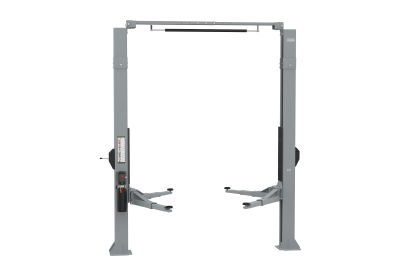
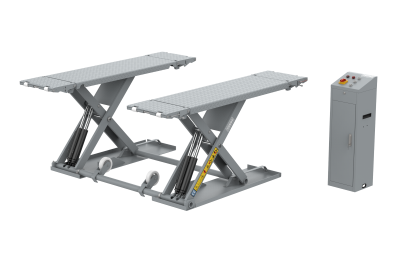
The new range includes the 4t capacity JLC509 two-post lift for LCVs and cars; a 4.5t capacity JCL410 two-post lift for larger LCVs; transportable JMR08 3.5t capacity medium rise scissor lifts for tyre bays (1ph); a fixed 3.5t capacity FFR08L full height surface mounted scissor lift; and a 1.5t capacity JEV033 powered engine / battery lifting trolley.
“The reality is that the quality, specification and value coming from the Far East is now very much aligned with European expectations,” said Andrew.
“Customer cost pressures are real, and we identified a clear gap in our portfolio for equipment at this level. The key was finding the right partner, one willing to build to our specification, not just supply off-the-shelf products.”
During development, says Supertracker, dozens of manufacturers were evaluated before selecting a partner capable of adapting designs to meet European technician requirements.
For example, the company’s 4.5-tonne two-post lift has been engineered to raise vehicles to 2.0 metres, significantly higher than the 1.8 metres typically offered, which it says will address the practical needs of taller technicians and improve day-to-day working comfort.
All lifts are UKCA and CE certified and conform to BS EN 1493:2022. Cash-and-carry pricing is available from Supertracker’s Worksop warehouse, with delivery and installation offered as optional extras. Products come with a two-year parts warranty against defective manufacture. Supertracker recommends all lift installation should be to BS7980 by GEA-affiliated engineers.