
Renault Group to take control of van developer Flexis
 Renault Group aims to take full control of electric van developer Flexis: ending its joint venture with Volvo Group and CMA CGM. The Renault and Volvo Groups each own 45 per cent of Flexis, with the remaining 10 per cent held by transport specialist CMA CGM.
Subject to approval by the competition authorities, Renault Group will acquire the stakes that Volvo Group and CMA CGM Group hold in Flexis in the first half of this year.
Renault Group will be the sole overseer of development of the new, fully electric, Flexis range of light commercial vehicles. Production is expected to begin by the end of 2026, as initially planned.
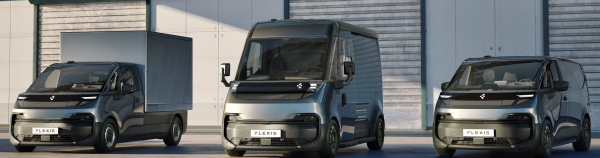
Flexis was launched in 2024, and the technologies developed: a skateboard platform, 800V motor, and Software Defined Vehicle (SDV) architecture developed by Renault’s Ampere division; are designed for urban logistics.
The initial line-up consists of three models: the Cargo van, Panel van and Step-in van.
Renault said the change in governance “does not alter either the product ambition or the original industrial plan” which aims to provide “breakthrough products and services in the electric medium van range.”
Volvo Group, through its Renault Trucks subsidiary, will distribute Flexis vehicles from 2027, just as it does now with Renault-branded vans.
Meanwhile Ampere, the EV and software division of Renault Group, has entered into a Joint Development Agreement with Basquevolt, to accelerate the development and validation of lithium metal-based batteries for future electric vehicles.
Basquevolt’s lithium metal-based battery technology is said to offer a transformative leap in energy density compared to today’s liquid-electrolyte lithium-ion batteries.
By combining the advantages of polymer electrolyte with advanced anodes, the technology has the potential to produce compact, lightweight battery packs with superior thermal stability and fast-charging capabilities.
“After more than 12 months of collaboration, Basquevolt is already demonstrating that its technology can achieve very high energy density while significantly reducing the overall battery pack costs,” said Renault Group.