
Keeping it clean with Stertil-Koni Washbay Skylift
 Stertil-Koni has detailed the features and benefits of its Washbay Skylift, and offered its perspective on the key role vehicle lifts can play in vehicle maintenance.
Keeping commercial vehicles clean is about more than appearances, says the lifting equipment specialist: regular, thorough cleaning helps maintain safety, prolong component life, and reduce corrosion-related repairs.
“Yet, for fleet operators, cleaning is often one of the most challenging aspects of vehicle care, particularly when it comes to accessing the underbody and working efficiently in harsh washbay environments,” said Stertil-Koni.
“Washbays are among the toughest environments in any transport operation. High volumes of water, detergents, and chemicals are in daily use, and all of them can take their toll on equipment. Over time, moisture and cleaning agents attack steel and electrical components, accelerating corrosion and leading to higher maintenance costs if equipment isn’t suitably protected.
“Seasonal factors make the situation worse. During winter, grit, salt, and heavier road grime build up quickly, clinging to chassis frames, suspension components, and hydraulic lines. If not removed properly, these deposits can trigger rust, premature wear, and expensive downtime. Add to that the pressure to keep vehicles moving during peak periods, and it’s easy to see why cleaning operations can become a bottleneck for many fleets.”
For technicians to do the job properly, says the firm, full access beneath the vehicle is essential – not just for appearance, but for safety and performance.
“Yet many washbays still rely on ground-level cleaning or equipment that was never designed for constant exposure to water.
“Conventional heavy-duty lifts are typically built for workshop use, where dry conditions prevail. In a washbay, however, that same equipment can deteriorate rapidly. Unprotected components are vulnerable to corrosion, and electrical systems can suffer from water ingress or chemical attack.
“In wet environments, slip risks are higher, and surface coatings can degrade more quickly, compromising safety as well as reliability.
“That’s why washbays demand something different – lifting equipment engineered specifically for wet conditions. Purpose-built washbay lifts not only withstand the environment but also allow for fast, safe vehicle access that helps operators maintain high throughput without compromising quality.”
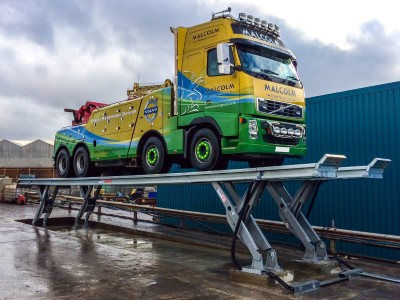
In 2009, Stertil-Koni introduced its dedicated Washbay Skylift.
“Built around a robust, open-platform design, the Washbay Skylift combines high performance with exceptional resistance to corrosion.
“Each unit features hot-dip galvanised platforms, marine-grade coated lifting legs, and a stainless steel control box, ensuring long-term durability even under continuous exposure to water and cleaning agents.
“The electro-hydraulic system lifts up to 35 tonnes to a height of 1.75 metres in around 90 seconds, providing full, unobstructed access for underbody cleaning and inspection. Multiple configurations – including surface-mounted or recessed installations – allow the system to be tailored to different vehicle types and bay layouts, from municipal fleets to commercial logistics operators.”
Safety is built into the Skylift as standard, adds the firm.
“Each lift incorporates independent mechanical interlocks, overload protection, and a stable, space-efficient design. Technicians can also operate the lift through Stertil-Koni’s ebright Smart Control System – an advanced touchscreen interface that delivers clear status information and secure, intuitive control, even when wearing gloves.
“Optional features such as anti-slip coatings further enhance safety in wet conditions, reducing the risk of slips and falls.”
For fleet managers, Stertil-Koni contends, the business case is straightforward.
“By enabling thorough, efficient cleaning, a dedicated washbay lift reduces corrosion, extends vehicle lifespan, and helps maintain compliance with regulatory requirements. In turn, fewer repairs and less downtime translate into measurable cost savings and higher vehicle availability, all contributing to a faster return on investment.
“In high-throughput environments, the Skylift’s rapid cycle times and drive-through configuration also improve workflow efficiency, allowing more vehicles to be processed in less time.”