
Why the time is now for electric trucks
 Roger Clarke, head of electromobility and advanced customer solutions at Renault Trucks UK & Ireland, offers his perspective on progress along the road to electrification
The direction of travel towards zero-emission road transport is no longer up for debate. What has changed – decisively – is the pace.
The UK government’s £1 billion investment in zero-emission transport, spanning vehicle grants and depot charging, marks a clear turning point. By reducing upfront vehicle cost and supporting charging infrastructure, it addresses two of the most persistent barriers to adoption.
Under the Zero Emission Truck and Van Grant, operators can access up to £81,000 for the heaviest vehicles, alongside funding for depot charging. The grants accelerate the business case and make it easier for operators to move from evaluation to action.
Electric trucks are working in real operations today
For a large proportion of applications, particularly back-to-base regional work, electric vehicles already make operational sense. Analyse routes, mileage and dwell times and the picture becomes clearer: a significant share of vehicles could transition without compromising service levels. Renault Trucks estimates that over 80 per cent of trucks could already be electrified under the right conditions.
That is borne out in practice. Renault Trucks customers have been running E-Tech vehicles since 2021, collectively covering more than 111 million electric kilometres across the UK and Europe. Across urban and regional operations, pallet networks, municipal fleets and construction applications such as mixers, electric trucks are already delivering successfully in real fleets – and are ideally suited to predictable, return-to-depot work where the technology fits.
Long-haul is moving forward at pace. Renault Trucks is now pushing electric into the core 6×2 tractor segment with new E-Tech models built around an integrated e-axle. Here, the electric motors and transmission are positioned at the rear axle, allowing battery capacity to be distributed along the chassis more efficiently.
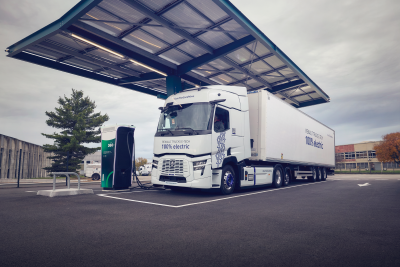 The line-up includes the E-Tech T585 6×2, offering up to 460km of range, and the E-Tech T780 6×2, extending that to up to 600km, alongside the E-Tech T540 4×2 for regional work.
Charging capability is evolving alongside the vehicles. Renault Trucks’ latest E-Tech models are equipped for Megawatt Charging System capability of up to 720kW, with CCS charging available up to 350kW. Depot charging, supported by government funding, remains central for many operators today.
Getting started
Crucially, operators do not have to navigate the transition alone. Renault Trucks works with customers across the full process – from analysing operations and specifying the right vehicle, to supporting access to grants, working with bodybuilders, advising on charging and funding, and backing that up with aftersales support focused on uptime and efficiency.
For operators looking to cut through the noise, Renault Trucks’ Zeroing In video series – delivered by our team of electromobility experts – takes a practical, straight-talking look at how to get started, with insights from our specialists and from customers already running electric in their fleet. It is designed to help operators understand what they can do now, and how to move forward.
Momentum is building
The combination of government funding, advancing vehicle technology, and growing operational experience is creating genuine momentum.
Operators entering the transition today are establishing capability. They are learning how electric vehicles perform in their networks, how drivers interact with them, and how infrastructure integrates into daily operations.
Those insights will compound over time.
And crucially, the industry has reached a point where waiting carries its own risk.
The vehicles are available. The support is in place. The technology is proven in an increasing number of applications. The question is no longer whether electrification will happen, but how quickly operators choose to engage with it. The momentum is there. Now is the time to act.