
Allye upgrades Max300 battery energy storage system
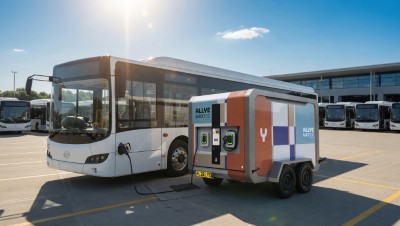 Allye Energy has upgraded its Max300 battery energy storage system, which it says offers a capable and cost-effective solution for fleet operators electrifying their depots as the closing date approaches for the government’s Depot Charging Scheme application window on 30 June 2026.
Delivering up to 400kW of DC fast charging from any standard grid connection, the Max300 is said to enable fleet operators to install more charge points and charge at higher power than their existing grid connection would otherwise allow, without the cost and delay of a grid upgrade.
Jonathan Carrier, founder and CEO at Allye Energy, said: “The Depot Charging Scheme is a real opportunity for fleet operators, but only if the technology can actually solve the grid constraint problem. The Max300 does that, at a price point that makes the economics work, in a package that also generates revenue when it isn’t charging. We handle the full integration and we can support operators through the application. For any fleet operator who needs to electrify and hasn’t found an infrastructure solution that works yet – this is it.”
The Max300 is equally effective as a permanent depot charging hub or a fully mobile unit, says Allye Energy, and the development is underpinned by three engineering innovations designed and built entirely in-house.
Robert Carter, CTO at Allye Energy, said: “A fleet operator shouldn’t have to wait months for a grid upgrade before they can charge their vehicles. The Max300 means they don’t have to. Plug into 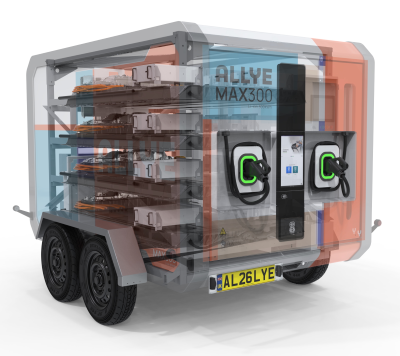 an existing connection and you have up to 400kW of DC fast charging available immediately.
“Equally, you can recharge this system on-the-go from a public DC fast charger. The engineering behind that is genuinely complex – the experience for the operator is genuinely simple. With over 300kWh of storage, it keeps going long after competing systems have run out of energy. And when it isn’t charging vehicles, that same storage capacity is earning money from grid services. It is a fundamentally different proposition from anything else on the market.”
The Max300’s 300kW output is made possible by integrating 800V battery architecture into the system for the first time. Running at higher voltage reduces electrical losses and increases the rate at which power can be transferred, says Allye, enabling DC fast charging at a level previously impossible in a system of this size and price. The firm’s proprietary platform architecture manages battery packs of different voltages and chemistries independently within a single system, with an isolated converter for each pack enabling independent power balancing. This protects the efficiency of each battery whilst providing the flexibility to source second-life packs from the broadest possible supply chain.
The second innovation is structural. The company says its specialist engineering partners have undertaken a full structural and trailer system re-optimisation, replacing the conventional approach of mounting a battery system onto a standard trailer with a purpose-designed, lightweight chassis architecture. The axle and A-frame are integrated directly into the load-bearing structure of the system, with component placement carefully defined relative to the axle group and hitch point to ensure stable towing characteristics and appropriate load transfer. Structural performance has been validated through a combination of analytical calculations and finite element analysis. The result is a saving of 380kg, keeping the system below the 3.5-tonne threshold that allows any standard vehicle to tow it on a standard licence.
The third is Allye’s integrated rapid DC charging system, custom engineered in-house using proven hardware from leading suppliers in the fast-charging industry. Built on a direct DC-to-DC architecture that minimises energy losses in transfer from the Max300’s battery to the vehicle, it supports charging voltages from 200V to 1,000V and is available in both CCS and NACS standards.
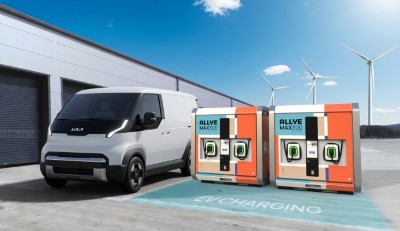 It operates in single or dual gun configuration, with switchable power allocation between guns, and includes RFID card reader, card payment terminal, and user touchscreen as standard, with remote monitoring over OCPP. Industry-leading DC isolation monitoring protects both the unit and the vehicle being charged. Isolated AC charging of the battery as standard means the Max300 operates seamlessly whether connected to the grid or fully off-grid, says the firm.
Grid capacity is the most common barrier to depot electrification, adds Allye: most depots already have a three-phase connection, but the capacity available is not enough to support the number of charge points a growing electric fleet demands. Upgrading the connection means a DNO application, civil works, months of waiting, and costs that frequently run to six figures before a single vehicle has charged, the company warns – and many operators discover this only after committing to fleet electrification.
“The Max300 changes the calculation entirely,” it said.
“By storing and buffering energy from an existing connection throughout the day, it makes that connection work far harder than it otherwise could – boosting the effective charging capacity available at the depot and enabling more charge points to operate simultaneously than the grid connection alone would support. That stored energy is available on demand at up to 400kW, with no grid upgrade, no DNO negotiation, and no months-long wait. With over 300kWh of energy storage, the Max300 keeps delivering high-power DC throughout the working day, long after other systems have fallen back to slow grid-speed charging…
“The cost of some standalone DC fast chargers at this power level are not dissimilar but without any battery and still require a substantial grid connection to function. The Max300 replaces both the charger and the grid infrastructure requirement in a single package, at a price that makes the Depot Charging Scheme’s 70 per cent funding contribution go significantly further.
“When not actively charging vehicles, the Max300 can participate in grid services – frequency response and demand flexibility that the electricity network pays for. This capability improves the financial return on the system over its working life and is available to any operator regardless of site type or grid connection. Allye handles the full integration from procurement through to commissioning, providing a single point of accountability for the entire solution.”