
Veloris highlights practical solutions to battery problems
 Battery distributor Veloris has outlined its perspective on mitigating the impact of vibration, which it highlights as an ongoing issue for commercial vehicles (CVs) made worse by the need to mount the batteries at the end of the chassis.
The firm says that quality battery manufacturers such as Exide have responded with batteries with extremely high resistance to vibration, providing a solution to the problem.
Veloris is also Exide’s primary UK distribution partner and is able to deliver its range nationwide. Exide, which has been supplying lead acid batteries to vehicle manufacturers (VMs) for more than 135 years, introduced high vibration resistance batteries for CVs in 2008.
“In addition to the inherent vibration that affects batteries mounted at the rear of the chassis, the condition of the UK road network is putting extra strain on an already demanding situation,” said Veloris.
“VMs, however, trust the quality of Exide products and the brand’s commitment to excellence. So, for Euro 5/6 vehicles with these rear chassis battery installations, their robust and high vibration resistant design makes them almost mandatory fitment for fleet managers actively seeking to minimise the possibilities of breakdowns.”
Being unable to deliver products because of a breakdown is a costly problem for operators, Veloris points out, which is why the total cost of ownership is something that should be considered when batteries need replacing.
“The original batteries in many of these Euro 5/6 vehicles are reaching their end of life and with the problems associated with vibration, it would be foolhardy to consider replacing them with cheaper SLI batteries, when there is an obvious requirement for something far more robust and better able to face the vibration problem.
“Alongside the vibration issues, operators face two further challenges, the first being onboard energy demands from power hungry electrical equipment when vehicles are parked up, and second, the linked requirement to recharge the battery quickly on start up to maximise the life of the battery and ensure the reliability of the vehicle.
“The Exide EFB Pro series provides an excellent solution that effectively balances quality and reliability with cost, and the EE 1403 and EE 1853 together cater for many Mercedes and MAN applications. Although both have a similar case size, one has a 140 Ah capacity, whereas the other provides an even greater 185 Ah capacity.
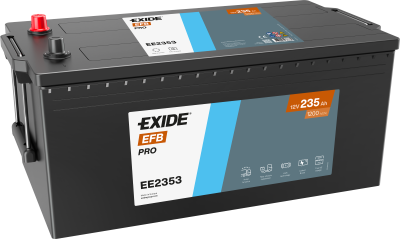
“For higher capacity requirements however, the 235 Ah EE 2353 provides an even more powerful option, but understandably, it does have a slightly larger footprint.
“All share the unique carbon based formula of negative active mass, which enhances rechargeability and charge acceptance. In addition, the high vibration resistant technology allows them to pass the extreme vibration tests under European V4 standard (EN50342-1:2015).”
The EFB Pro series encompasses several design features that allow them to perform to such high standards, says Veloris.
“These include a reinforced container with additional ribs for better strength, a labyrinth integrated into the lid with a flame arrester and central degassing outlet for maximum safety and hot melt application over the plate group, which locks the cells together.
“Incorporating Carbon Boost, Exide’s patented technology for fast charging and improved cycling and with heavy duty polythene polyurethane separator and glass mat for homogeneous compression on the positive grids, the outcome is a battery series that is fit for purpose and delivers for fleet and owner operators…
“The more robust and durable the battery means a reduced cost over its service life, which means less replacements over the life of the vehicle and a reduced risk of unexpected or premature battery failure.”