
Morris Lubricants puts oil quality in the spotlight

Owen Lloyd of Morris Lubricants
Given the uncertainty and volatility currently impacting the manufacture and supply of engine oils, it can be challenging times for buyers and users of these essential products. But regardless of world events, maintaining high quality is important when formulating and manufacturing engine oils for commercial vehicles, according to Owen Lloyd, chief operating officer of Morris Lubricants.
“At Morris Lubricants, we only work with carefully selected and trusted supply partners with whom we can collaborate on a long-term basis,” said Owen.
“This helps us to ensure we can source the exact base oils and additive chemistry needed for the specific product formulations for the commercial vehicle industry. These top-tier suppliers, with their own precise quality systems, provide us with the assurances that the quality of the incoming raw materials meets our own strict quality control standards and ultimately the original equipment manufacturer (OEM) specifications that need to be satisfied. This insistence on high quality extends throughout the supply chain and includes product packaging and other materials used throughout the manufacturing process.
“Recent events in the Middle East have demonstrated the strength of our supply chain. Thanks to our policy of developing long standing relationships with our raw material suppliers, we have been able to maintain production, continue manufacturing and consistently supply our customers with what they need. In today’s world, it is also important to partner with suppliers that provide raw materials that have been sourced responsibly and ethically.”
He continued: “The quality journey does not stop at just selecting high-quality raw materials. How these are used and which validated formulations are followed also form part of the high-quality manufacturing process. Validated formulations are composed of base oils and tailored additive chemistry. Depending on the performance level to be achieved, a variety of base oils can be employed and can be derived from mineral sources (crude oil), or synthetic sources (chemical synthesis). Base oil choice depends on the attributes demanded by the OEM. These base oils are enhanced with additive chemistry that provides active functionality to the finished lubricant. Once again, this is fine-tuned to meet the demands of the OEM. Common additive chemistry includes anti-wear agents, friction modifiers, antioxidants, corrosion inhibitors, detergents and dispersants, plus many more.”
In a competitive market, there can be a race to achieve the lowest price, and some lubricant suppliers may take the choice to select cheaper raw materials to help lower the retail price of their finished goods. But this could lead to lubricant quality becoming compromised, Morris Lubricants warns: if cheaper additive chemistry is used, it is difficult to ensure that the extensive bench testing, rig testing and field trials have been conducted, processes it says are essential for balancing base oil and additive chemistry.
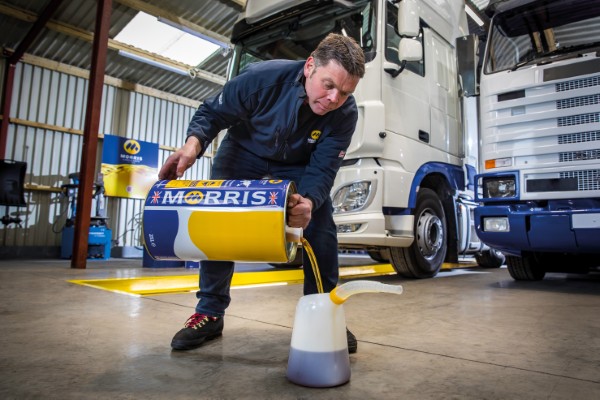 “Missing out these steps could result in inferior quality engine oils and other lubricants making their way into commercial vehicles with the potential to cause a reduction in performance or worse, severe damage to the vehicle,” said Owen.
“At Morris Lubricants, we invested over £5 million into our manufacturing facility throughout 2024 and 2025. This included the installation of a stainless-steel tank farm, a network of stainless-steel pipework, a pigging system, as well as an additional 37,000 litre bulk production tank with ultrasonic blending capabilities. This investment has helped to increase the production capacity, improve the levels of flexibility and sustainability in the production processes, reduce waste and of course maintain a high-quality finished lubricant.
“Quality samples are systematically taken and tested in our onsite Quality Control Laboratory that is equipped with the latest and arguably some of the best testing equipment available. Samples are taken throughout the manufacturing process, from receipt of raw materials, through to manufacturing and final product filling. This is supported by full batch traceability, providing assurances that the finished lubricant complies with the OEM specifications claimed and it is fit for purpose. Physical samples of finished product are kept for two years, and computerised quality control records are kept indefinitely to provide full traceability.”
Documentation called a Candidate Data Package (CDP) should also be available upon request from a lubricants manufacturer, Owen explains; this details all the development work carried out and validates the performance claims made on the lubricant.
“If a CDP is required for a Morris Lubricants’ product, this information, along with support and guidance, can be provided by our dedicated Technical Services Department.”
Morris Lubricants’ Versimax range of heavy-duty diesel engine oils is designed for the commercial vehicle sector and are suitable for use in a wide variety of engines from leading manufacturers, including Volvo, MAN, Mack, Scania, Cummins, Caterpillar, Mercedes Benz, DAF, Renault and more.