
Shock absorbers: keeping suspension stress under control
 Diesel Technic examines the role of shock absorbers and how to handle them
A truck’s suspension has a hard life. Poor road surfaces, heavy loads, off-road deliveries and demanding duty cycles all feed stress into the chassis, while the shock absorbers help keep that movement under control. By damping vibration and helping the tyres maintain consistent contact with the road, they support vehicle stability, steering response, tyre life and the service life of surrounding axle and suspension components.
That practical link between shock absorbers, vehicle control and wider suspension performance is explored in Diesel Technic’s latest PS Tips video, produced by its Parts Specialists team. The video highlights the fault signs operators and maintenance teams should be aware of, the installation details that can affect component life, and why a failed unit should prompt a closer look at the surrounding axle, steering and suspension system.
More than a comfort issue
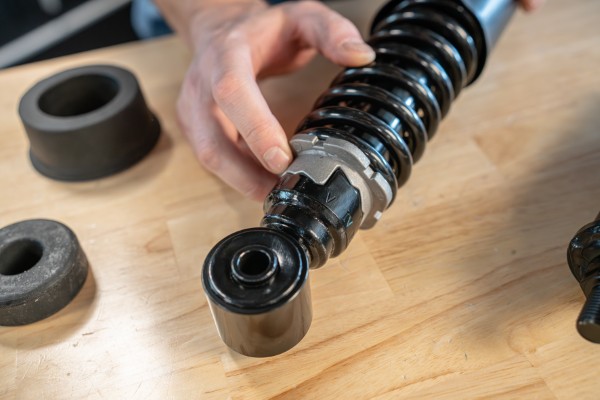
Shock absorbers are often associated with ride comfort, but their influence goes much further. They help control movement between the chassis and suspension, damping the vibrations that would otherwise pass through the vehicle.
When that control starts to deteriorate, the symptoms can show up in several ways. Operators and workshops may see irregular tyre wear, saw-tooth wear patterns, oil leakage from the shock absorber, worn rubber bushes, knocking noises, unstable handling or steering that feels less precise.
None of these signs should be dismissed as minor. A vehicle that is not being properly damped can place additional stress on surrounding suspension and axle components. It can also reduce tyre life, affect driver confidence and create another avoidable reason for a vehicle to be pulled into the workshop.
For fleets under pressure to keep vehicles available, the commercial point is straightforward. A shock absorber fault is not just a parts replacement job. It is a chance to ask why the part has failed and whether the wider suspension set-up is contributing to the problem.
Poor roads, high loads and hidden stress
Diesel Technic’s Parts Specialists highlight poor road conditions as one of the most common causes of shock absorber defects. Repeated impact and vibration can lead to thermal overload inside the shock absorber, damaging internal components over time.
That will sound familiar to many UK operators. Vehicles may be moving between motorway work, urban delivery routes, industrial estates, construction sites and poorly maintained local roads, often within the same week. Each duty cycle puts different demands on the suspension.
This is why correct product selection matters. If the wrong shock absorber is fitted, or if the suspension settings are not right, the part can be forced to work beyond its intended range. That may mean the shock absorber is over-extended, compressed too aggressively or subjected to internal impacts that shorten its service life.
In practical terms, workshops should check that the correct replacement has been identified for the vehicle application and reference, rather than treating similar-looking parts as interchangeable.
Look around the failure
One of the most useful messages from the PS Tips video is that a shock absorber should not simply be removed and replaced without checking the surrounding components.
Before fitting a new part, workshops should inspect attachment points, axle components, washers, bushes, fixings and related suspension parts. If these areas are worn or damaged, the new shock absorber may be put under the same stress as the old one and the fault can return.
On vehicles with air suspension, the suspension must also be properly calibrated. Ride height has a direct impact on how the shock absorber works. If the chassis is not correctly adjusted, the replacement component may not operate through its intended range.
Installation tension is another issue. Shock absorbers should be installed without being preloaded or twisted into position. Self-locking nuts should be replaced during repair and fixings must be tightened to the correct torque only when the vehicle is at driving level. Tightening while the vehicle is lifted can preload the bushes, accelerating wear once the vehicle is lowered and returned to service.
These are small workshop details, but they have a direct influence on component life.
 Why hands-on checks are not enough
A useful point from Diesel Technic’s testing team is that shock absorbers cannot be properly checked by hand. Even if a new unit appears to have little resistance straight from the box, that does not necessarily mean it is defective.
Shock absorbers are usually transported lying flat, which can allow the oil inside to disperse. The recommendation is to stand the unit upright and move it several times to restore damping pressure.
Proper testing requires controlled conditions. Diesel Technic tests shock absorbers on its own test benches at its Kirchdorf headquarters, using different speed levels to measure damping behaviour. Smaller units for van and cab applications are tested separately from heavier truck suspension shock absorbers, where higher forces are required.
For operators, the takeaway is that workshop judgement matters, but so does knowing the limits of a visual or manual check. Some issues can only be confirmed on the vehicle or through proper test equipment.
Support beyond the part
For workshops, the job is not only choosing a replacement shock absorber, but making sure it is correctly specified, installed and checked against the wider axle, steering and suspension system.
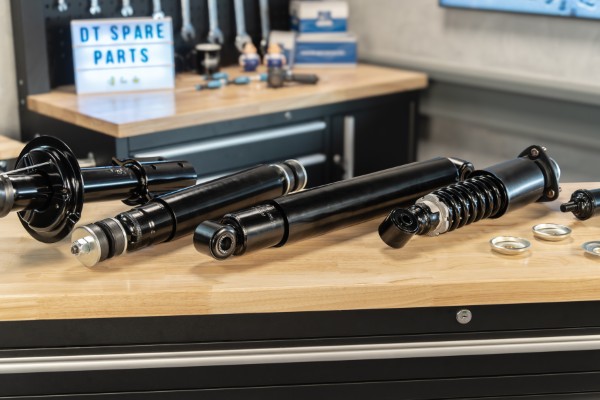
DT Spare Parts offers more than 600 shock absorber-related products, including struts, repair kits and shock absorbers for chassis, cab and driver’s seat applications, covering major commercial vehicle brands including DAF, Ford, Iveco, MAN, Mercedes-Benz, Renault, Scania, Volvo and VW. Diesel Technic’s Parts Specialists also provide technical support through the HelpDesk and are now available via the PS App for iOS and Android, allowing workshops to send enquiries directly from a smartphone.
For operators, that support matters because repeat suspension issues are rarely solved by replacing the failed part alone. The right component, fitted correctly and checked alongside the surrounding system, can help reduce repeat defects, protect tyre life and keep vehicles performing predictably on the road.