
Show and tell: IAA truck roundup
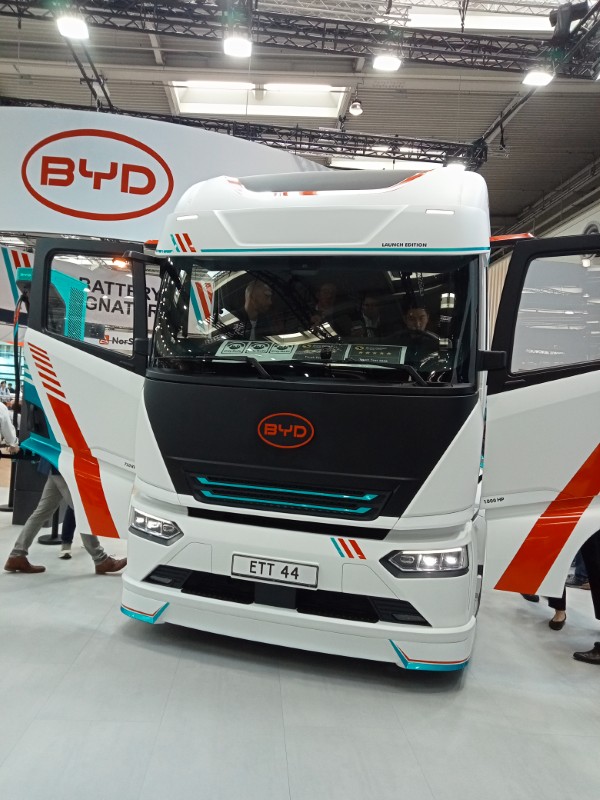
BYD’s ETT 44
Visitors to the vast IAA Transportation show in Hannover, Germany were left open-mouthed by the number of Chinese truck manufacturers present, and the size of their stands. BYD, FAW, JAC, Sinotruk and Dongfeng were all there, along with a host of other manufacturers with names that most westerners will frankly never have heard of – and they clearly mean business.
BYD is now familiar to UK operators, thanks to increased activity in the car market and its long-standing presence in the bus market.
It is emphasising the speed with which its Blade truck traction batteries can be recharged under the Flash Charging banner. “With 1.5MW of charging power it can charge from 20 per cent to 80 per cent in about 20 minutes, adding up to 248 miles of range,” says executive vice president, Stella Li.
Exhibits included the ETT 44 4×2 high-roof sleeper-cab tractor unit with up to 1,000hp on tap and equipped with a 651kWh Blade LFP (Lithium Iron Phosphate) battery backed by a ten year/1.2km warranty. Available too are 4×2 and 6×2 rigids.
BYD hopes to start selling trucks in the UK in 2027, says Domenico Gostoli, head of its European commercial vehicle operation. “I see huge potential there, and it’s one of my priorities,” he comments.
The company is likely to concentrate on the refuse collection and waste recycling market initially, he says.
He appreciates that UK operators favour 6×2 rather than 4×2 tractor units. “Remember though that a 4×2 could handle 60 to 70 per cent of the work they do,” he observes.
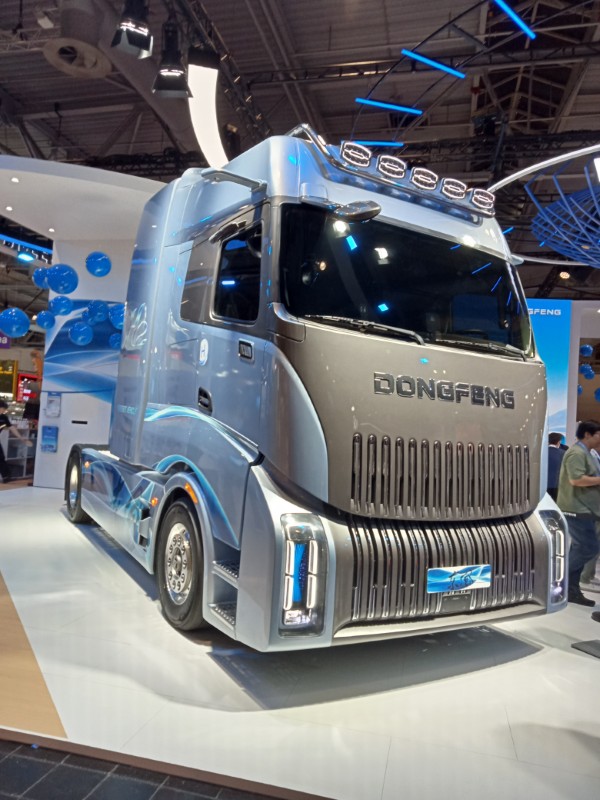
Chinese manufacturer Dongfeng was extolling the virtues of hydrogen
Elsewhere, Dongfeng was energetically promoting the virtues of hydrogen and promising a 33,000-hour fuel cell stack life, while Skyworth Auto was stressing the potential of electric autonomous trucks. It launched the Z9, with a 400kWh battery, a dual-motor power train generating 610kW, and engineered for Level 4 autonomous driving in locations such as ports, steel mills and railway yards.
European truck manufacturers must start treating the challenge posed by the Chinese seriously, says Renault Trucks president, Antoine Duclaux.
“Some of them are still a bit in denial,” he remarks. “We are not.”
Renault Trucks and most of its fellow European manufacturers were, of course, also prominently exhibiting at IAA.
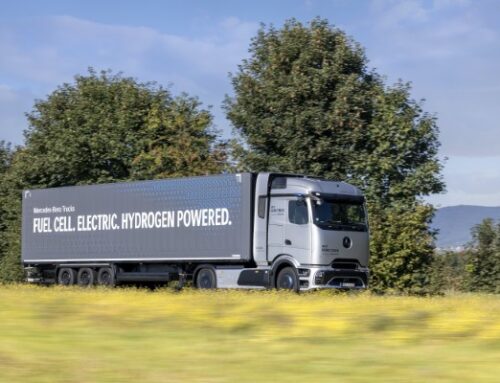
MAN chose this year’s event to launch its new electric eTGX long-haul tractor unit, said to be capable of a range of up to 720km/450 miles between recharges. That’s if you opt for the 6×2 version which is on its way and can be equipped with seven batteries with a total capacity of 644kWh.
The newcomer’s batteries boast as much as 10 per cent more useable energy thanks to improvements in cell chemistry and 20 per cent more powerful recuperation than their predecessors, says MAN. Combined with a more aerodynamic cab extended forwards by 120mm in line with the latest European Union regulations governing permitted dimensions, they mean that the latest eTGX is up to three per cent more efficient than its predecessor, says the manufacturer.
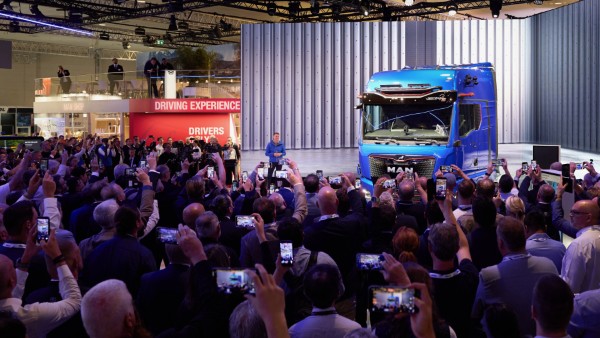
The new MAN electric eTGX is launched
Charging power of up to 750kW means that batteries can be replenished in roughly 30 minutes, MAN says. A lowered windscreen among other visibility improvements, including a lowered dashboard, means that the driver should have a better direct view of other road users, it adds. Top power output is now 440kW.
“With the new eTGX we are taking the next big step on the road to the decarbonisation of long-distance transport,” says MAN executive board chairman, Alexander Vlaskamp. “The combination of a new generation of batteries, an even longer range, megawatt charging and a vehicle that is designed for efficiency creates tangible economic added value for our customers in daily use.
“At the same time we are improving direct visibility and thus safety for all road users,” he adds.
Another manufacturer which has been busy working on cab improvements is Scania.
It has updated its R- and S-Series with the new Dynamic cab. Unveiled at Hannover, it is said to be capable of cutting energy consumption by around two per cent thanks to better aerodynamics.
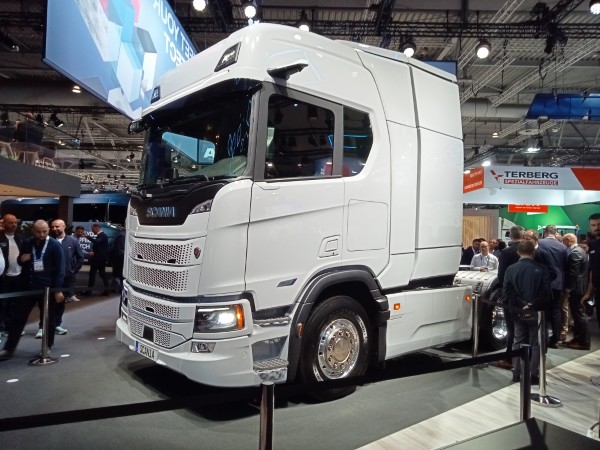
Scania’s Dynamic cab was unveiled at IAA
Changes that should reduce air drag include the use of digital exterior rear view mirrors, side skirt extensions, redesigned A-pillars and new door handles. It too gets a fashionable slightly-protruding front as well as an improved interior.
Scania too is concentrating on increasing the range of its electric models, and says that ranges of up to 720km/450 miles are now possible.
While senior truck industry executives are constantly banging the zero-emission drum, they are equally conscious that the diesel engine will not go away any time soon – so they are hedging their bets.
Pointing out that 97 per cent of the European truck parc remains diesel-powered, Renault Trucks was showcasing the new DE13 R diesel engine.
Power outputs go up to 540hp, with 2,800Nm of torque on tap. Paired with the latest Optidriver transmission it can achieve fuel savings of up to four per cent compared with its precursor, says Renault.
The new powertrain is being installed in the T, T High, C and K ranges for the 2027 model year.
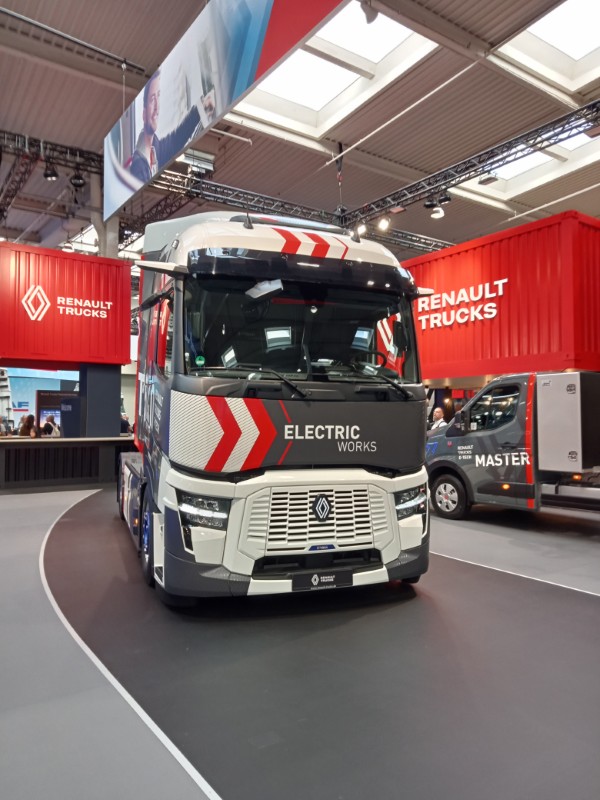
The Renault Trucks E-Tech T 780
Not that Renault is neglecting electric traction – far from it. Equipped with an electric axle, its new E-Tech T 780 tractor unit is said to offer a maximum 660km/more-than-410-mile range.
Sister brand Volvo’s commitment to battery technology has won it the International Truck of the Year award for 2027 for its electric range.
The jury praised the way Volvo has developed its electric portfolio beyond a single vehicle or application, allowing trucks to be tailored to a variety of different duty cycles.
Daimler Truck is another manufacturer that is continuing to develop diesel drivelines alongside zero-emission technology. With an eye to cutting fuel usage by up to four per cent compared with predecessor vehicles, its new Powerliner driveline includes enhanced OM 470 and OM 471 engines with outputs of up to 455hp and up to 550hp (a new peak) respectively.
Powerliner will be available from next April.
At the same time it was using the IAA exhibition to promote the new, electric, eActros Lowliner. Produced as a 4×2 tractor unit, and designed to haul big box or curtainsider trailers filled with bulky loads, it can achieve a range of around 500km/over 310 miles in eActros 600 Lowliner guise, Daimler Truck says.
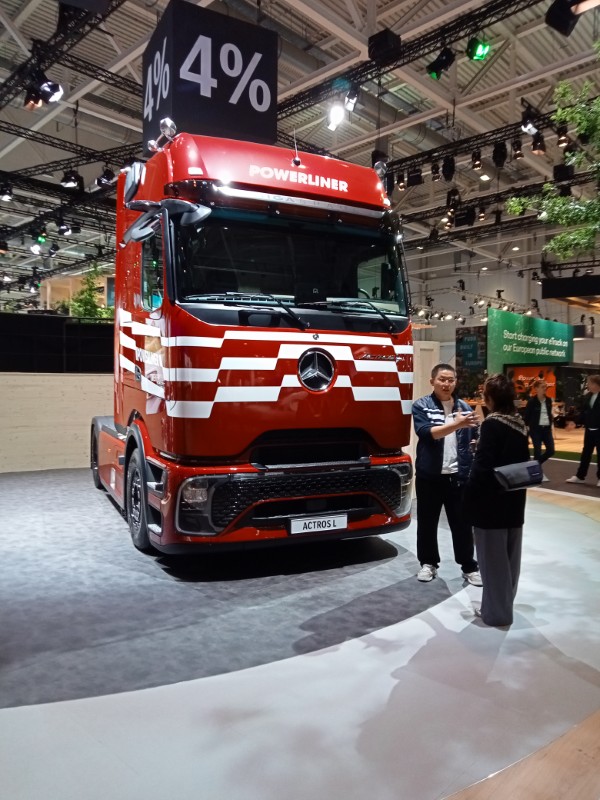
The Mercedes-Benz Powerliner on the Daimler Truck stand
It has an installed battery capacity of 621kWh while its eActros 400 Lowliner stable-mate has a 414kWh capacity. The batteries are mounted longitudinally along the chassis frame rather than transversely in both cases to achieve a low fifth-wheel height.
Series production will start in the second quarter of 2027.
DAF was setting out a host of detailed improvements to its products, with 6×2 electric tractor units offered with steered pusher or trailing axles for greater manoeuvrability, a 90cm-wide bed for sleeper cabs, and improved storage for XF, XG and XG+ units. Chassis designed for car transporters are now available, with cabs engineered in such a way that cars can be loaded above them.