
First annual report on zero-emission truck demonstrator programme released
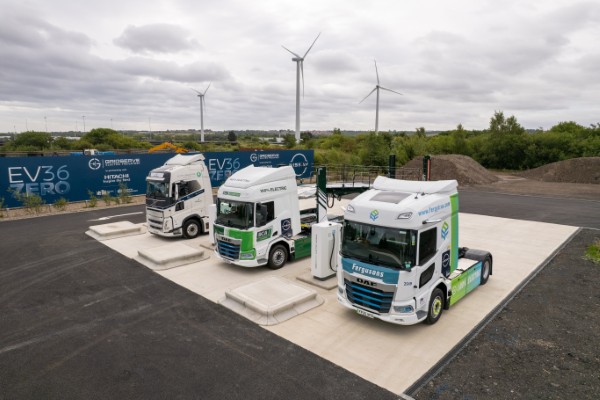 Innovate UK has published the first annual report on the government-funded Zero Emission HGV and Infrastructure Demonstration (ZEHID) programme, which has been trialling heavy electric trucks on UK roads.
As a result of the programme, battery-electric HGVs up to 44 tonnes are now operating on commercial routes across the UK, serviced by an expanding network of charging infrastructure at depots, shared sites and public locations.
Published in conjunction with WSP, the technical evaluator for ZEHID, the report estimates that the programme has achieved an 81 per cent reduction in greenhouse gas emissions compared with equivalent diesel operations.
But it also highlights key challenges the programme has faced, not least surrounding charging infrastructure, which it says has been “a key bottleneck for establishing ZEHID sites”.
Site-specific issues had been “costly, time-consuming and dependent on coordination and cooperation with landowners and distribution network operators (DNOs)”, it said – but the experience gained from the programme in these areas would help truck and chargepoint operators, as well as policymakers and the power sector, plan for effective infrastructure deployment in the future.
On the performance of the vehicles, while the data sample was small, initial indications suggested that the monitored electric trucks were achieving lower average utilisation than diesel vehicles, being driven at lower speeds on average, and accruing shorter average daily mileage.
However, “it should be noted that initial deployments will include training and testing, and routes that can be supported by the infrastructure available today,” said the report.
But it said that, with grants and effective utilisation over an eight-year period, a favourable total cost of ownership (TCO) was already possible for an electric HGV. Without subsidy however, TCO is “currently typically higher than diesel due to high upfront costs”, which remains a significant barrier to accelerated adoption.
Nonetheless, total cost parity or savings could be achieved “in some use cases with support”.
Further disincentives for fleets to switch to electric included payload and axle load constraints, which could reduce revenue on weight-sensitive routes, and limited availability of charging infrastructure.
Fleets reported generally positive experience with the vehicles, however, with drivers citing quieter, smoother operation and improved acceleration.
The ZEHID programme had also set out to monitor the efficacy of hydrogen fuel cell HGVs, which the report said may offer potential advantages in terms of range, payload and short refuelling times.
But it added that progress with fuel cell vehicles had been limited “due to low demand, supply chain immaturity, high costs, and challenges in aligning stakeholders”.
One of ZEHID’s component projects, HyHaul, which had been focused specifically on hydrogen fuel cell vehicles and green hydrogen supply, was terminated last December “after failing to secure binding customer or fleet leasing agreements within the ZEHID funding timeframe”.
Nonetheless, the report said the challenges around hydrogen may be mitigated as the market develops, and added that three pilot hydrogen HGVs were set to enter service within ZENFreight, one of the programme’s component projects, shortly.
It would appear that the vehicles in question are being put into service by Scottish logistics operator John G Russell (Transport) Ltd, in a collaboration with Scania announced by the truck manufacturer last week.
The Glasgow-based operator has taken ownership of three prototype hydrogen fuel cell electric vehicles as part of ZENFreight. It will be among the first fleets to put fuel cell HGVs into daily operations on UK roads.
ZENFreight and ZEHID’s two other active projects – Electric Freightway and eFreight 2030 – have between them deployed more than 240 zero-emission trucks, and established over 40 infrastructure sites across the country. These figures are expected to reach 300 and 70 respectively by the end of this year. Monitoring has so far recorded more than 85,000 trips hauling 550,000 tonnes of freight.
The programme has now entered a five-year monitoring and evaluation phase, which is set to see detailed evidence produced on vehicle performance, use of infrastructure, costs, emissions and operational impacts.
Claire Spooner, director of the Innovation Service at Innovate UK, said: “Zero-emission HGVs are already demonstrating their potential in real-world freight operations across the UK. This first annual report marks an important milestone for the ZEHID programme, providing valuable insight into what is working, where challenges remain and what will be needed to support the wider transition to zero-emission freight.”
Sofia Amaral, business director for sustainable transport at WSP, said: “This first annual report marks an important milestone for the UK’s transition to zero-emission freight.
“Through our role as independent evaluator, WSP is helping to generate robust, real-world evidence on the performance of zero-emission HGVs and supporting infrastructure at unprecedented scale. These insights will help industry, investors and policymakers make informed decisions about the future of freight decarbonisation.”
The full report is available at the Innovate UK Business Connect website.