
Report: uncertainty over used electric truck values may hamper EV transition
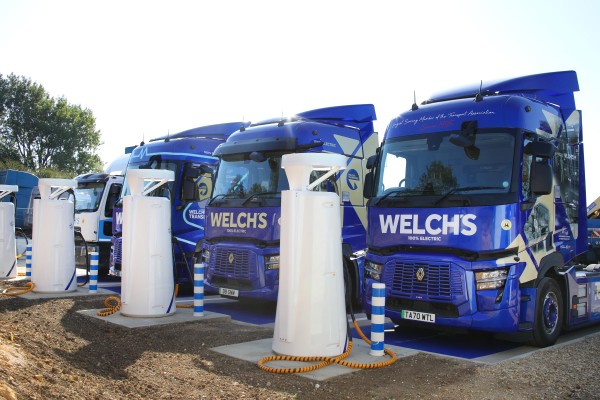
Welch Group battery-electric trucks on charge at the depot hub. Image: Welch Group
A new report by freight electrification body TwentyForty has warned that the UK’s transition to electric HGVs may be hampered by the difficulty of ascertaining resale values for used vehicles.
The study – What’s It Worth? Secondary Market and Residual Values – is part of TwentyForty’s ’12 Pillars of Change’ series of reports on road transport decarbonisation.
Because manufacturers are retaining control of their electric trucks, the report contends, nobody knows their true worth. This deters independent lenders from taking on risk when it comes to financing used vehicles, and leaves small operators at a disadvantage, as the promised ‘cascade’ of used electric trucks fails to emerge.
The report draws on interviews with manufacturers, finance providers, battery specialists and academics, among others.
It suggests that the major truck makers are keeping used electric trucks inside their own networks – for example, through long-term leasing arrangements with compulsory maintenance packages or guaranteed buyback schemes. Leasing is arranged via ‘captives’ – the manufacturers’ in-house finance arms – which have access to vehicle information that independent lenders do not, so are better placed to shoulder risk.
Meanwhile, independent operators are re-renting or repowering vehicles inside their own fleets.
While these approaches are sensible ones for individual manufacturers and fleets to take, says TwentyForty, the upshot is that used electric trucks are not reaching auction, nor independent dealers, meaning real-world resale prices remain elusive.
The report explains how residual values – the predicted value of a truck at a lease’s end – are central to how diesel trucks are financed, and based on years of real-world sales data. But for electric trucks, without this sales history, manufacturers instead rely on diesel proxies, capital-cost formulas or the new lease price when setting prices for used vehicles.
While independent lenders will finance electric trucks on a hire purchase basis – so that the operator owns the vehicle at the end of the process and shoulders any loss if it is worth less than anticipated – they will not write residual-based leases due to an inability to price the risk.
“Much of an electric truck’s value sits in the battery, and a buyer can’t read the battery’s condition,” states the report.
“The [government] grant is paid on the new truck, which is the price the used one is anchored to. And the trucks aren’t changing hands, so there are no resales and the loop doesn’t close.”
Yet government policy on decarbonisation relies on the assumption that used electric trucks will cascade from their initial purchasers – invariably large fleets – to smaller operators, as vehicles meeting each new Euro diesel emissions standard have.
It warns that for each standard, it took between 8.4 and 10 years after mandate for a majority of used vehicles to become compliant – and this was in the context of open used markets, auctions and export routes. Electric trucks, TwentyForty points out, are not currently being subjected to these mechanisms.
The report proposes a number of steps that it says could help remedy the problem. It advises that the Department for Transport should separate its statistics on vehicle keepers by fuel, so that the numbers of used electric trucks changing hands each year are transparent, and publish its battery variability study if it exists.
In addition, the report argues that the Office for Zero Emission Vehicles (OZEV) should publish the monitoring of used electric truck values it committed to in the subsidy assessment for the Zero Emission Truck Grant.
It also calls on the government to adopt for Great Britain rules that already apply in Northern Ireland, which enable the purchaser of a battery to read its state of health, and suggests that stricter conditions should be attached to public money being used to subsidise electric truck leasing.
“Public money that touches a residual buys a realised value on the record, with battery data attached, from a truck that has left the manufacturer’s hands,” the report advocates.
Its lead recommendation is “a structured long lease across a book of trucks big enough to pool the risk”. It suggests Scotland’s new Zero Emission Truck Fund as a means of testing this.
Jamie Sands, founder of TwentyForty and head of solutions at haulier Welch Group, said: “We run battery-electric artics every day. Ask me what one’s worth used and I can’t tell you. Nobody can, and the people who’d need to prove that wrong told us first.
“Everyone says the data will sort it out. But the trucks never change hands, so the data never gets made. That’s not any one company’s fault. Every manufacturer is doing the sensible thing. Add it up and the number stays hidden, while the smallest operators wait on a cascade that hasn’t started.”
Of the report’s recommendations, he added: “We’re not asking government to underwrite the number. We’re asking it to pay for the number to exist. Three of the asks cost nothing. Start there.”