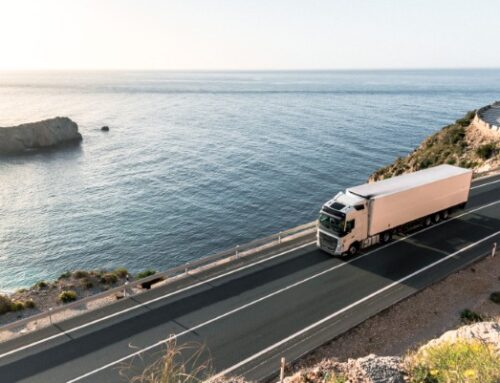

Denby prepares for trailer combi trial
 Trailer manufacturer Don-Bur has reported that the Department for Transport (DfT) is planning to issue a Section 44 permit to allow trials of Denby Transport’s ‘25.25’ Ecolink artic trailer combination, amidst ongoing discussion around the possibility of a wider trial of such concepts.
The Lincoln-based haulier’s Dick Denby has been lobbying government to allow the use of his B-Double trailer combination for more than 20 years.
The first 16m long trailer was developed by Don-Bur in 1999 in association with Silvertip Design featuring an active Steering Correction Mechanism (SCM). A video of this 8+16m combination system (pictured) can be viewed at: youtu.be/skN1fpoG63U
The current Denby Ecolink system comprises a primary trailer of 7.82m length, with an extended chassis ‘tail’ which supports a set-back tandem axle bogie and a secondary fifth wheel. A standard 13.6m long tri-axle trailer is then coupled to the additional fifth wheel, extending the combination to a full 25.25m length.
The additional ‘link’ trailer requires two positive steer axles to follow a similar swing radius as the tractor unit, Don-Bur explains, so that the rear trailer unit swings clear of the inner 5.3m turning circle limit, as defined by regulations.
Dick Denby told Transport Operator it was hoped that the DfT would permit a full 60-tonne gross vehicle weight (GVW) in the trials.
Since an additional trailer is likely to add around seven to eight tonnes of tare weight, explains Don-Bur, a lower postulated limit of 50 tonnes GVW would be insufficient to realise the concept’s true potential, meaning the operator would have to reduce payload weight as compared to a standard 13.6m trailer.
“If the trial is successful, an Ecolink single deck combination could carry an additional eight tonnes,” said Don-Bur.
“That extra weight could comprise 14 extra UK pallets on a single deck or 28 on a double deck. In total, one combination could transport an impressive 80 pallets.”
In addition, the company says Ecolinks would arguably reduce impact to road surfaces.
“Supported by eight axles, the combination doesn’t apply any more pressure to the road surface than a standard artic,” said the firm.
“Although the tractor drive axle is likely to apply more torque friction to the asphalt, the holistic impact of reducing three individual journeys to two (to move the same payload) is likely to reduce surface wear and tear.”
Don-Bur says the benefits of B-Double combinations, which are already commonly used in other parts of Europe such as the Netherlands, Spain and Scandinavia, would be undeniable: “Although a 60-tonne combination will consume more fuel than a 44 tonne current equivalent, the overall effect of using Ecolinks could cut journeys by up to 33 per cent which will have a large positive impact both on fuel and CO2 output per tonne kilometre.
“From our point of view, the Ecolink combination is another logical step forward to becoming carbon neutral and, as already well demonstrated by academics, greater cube and permissible weight are still the easiest and cheapest way to achieving greater efficiency.”
On potential wider trials, Dick Denby added: “The trials which we have proposed are for 3,000 vehicles over an extended period, similar to the birth of the longer semis.
“We proposed free circulation on motorways and trunk roads, then for other highways an operator request to the relevant highway authority, in a manner similar to that currently used to control Cat 1 STGO. This system is well known… to operators and highway authorities and works well.”