
Truck makers: governments must lead charge on HGV electrification
 In the wake of their announcement that production of fossil-fuelled trucks would need to end by 2040, Europe’s truck makers have thrown down a challenge to the European Commission – to set binding charging infrastructure targets on EU member states in order to electrify the continent’s highways – while in the UK, the Road Haulage Association (RHA) has called for the British government to develop its own national decarbonisation roadmap.
A joint letter from ACEA, which represents Europe’s truck makers, and the campaign group Transport & Environment (T&E), demands the installation of 11,000 charging points for trucks and coaches across the EU by 2025, rising to 42,000 by 2030. These target figures cover both public and destination charging (e.g. at logistics hubs, distribution centres etc), but exclude overnight public charging.
When the UK is also factored in, the organisations estimate the number of heavy-duty charging points needed by 2030 is around 50,000 across the 28 nations, suggesting a figure of 8,000 would be required for the UK alone (in comparison to 14,350 for Germany and 5,800 for France).
“However, there are diverging views on the number of battery electric trucks in the fleet that could operate with such a network,” says the letter.
“According to ACEA’s use-case calculation method, the corresponding fleet of battery-electric trucks in 2030 would be 270,000 units in 2030 (all trucks above 3.5t, EU27+UK), whereas T&E scenarios indicate up to 520,000 units in 2030.”
Additionally, the letter recommends, some 300 hydrogen refuelling points for heavy-duty vehicles need to be in place by 2025, rising to around 1,000 no later than 2030. This infrastructure will be needed if the goals of the European Green Deal are to be achieved, the two groups say.
Late last year, ACEA declared that all new trucks sold would need to be fossil-free by 2040 in order to reach the goal of carbon neutrality by 2050.
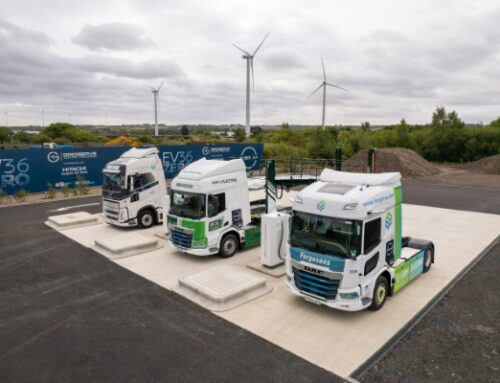
ACEA and T&E admit the charging infrastructure targets are ambitious, given there are “currently close to zero truck-specific charging stations”. The small number of electric trucks currently operational in Europe are entirely dependent upon charging at their home depots, ruling out their use for anything much more ambitious than local collection and distribution tasks.
However, the organisations say, the need for the infrastructure must be included in the expected forthcoming review of Europe’s Alternative Fuels Infrastructure Directive (AFID), with binding agreements imposed on member states to ensure the seamless operation of international freight across borders.
ACEA and T&E say: “This is urgent and crucial to encourage professional transport operators to make a swift transition to zero-emission vehicles.
“Electric and hydrogen-pow-ered trucks require specific charging and refuelling infra-structure because of their high power and energy demand, as well as space, parking and access requirements.
“The European Commission must address these specific needs in the AFID review, ensuring charging and refuelling is possible at truck depots, at logistics hubs (when loading and unloading), at public sites in urban areas and along highway corridors.”
Martin Daum, ACEA commercial vehicle board chair and CEO of Daimler Truck AG, said: “Our industry is fully committed to the Green Deal and therefore carbon-neutral road freight transport by 2050 at the latest. To that end, we are investing massively in CO2-neutral trucks. However, our customers will not invest in these vehicles unless they can charge and refuel them easily as they deliver goods from one country to another. The upcoming AFID review is a golden opportunity to make sure that infrastructure rollout and the deployment of zero-emission vehicles go hand-in-hand.”
William Todts, executive director at Transport & Env-ironment, added: “The future is electric, even for trucks. The transition to zero-emission trucks is happening and it is time for the European Commission to wake up. We need to build 10,000 truck charging points in the next four years, in truck depots, logistics hub and along every main highway in Europe.”
Meanwhile, the RHA’s new policy paper, entitled ‘Eliminate – Minimise – Offset’, lays out its vision for decarbonising the UK’s CV fleet, focusing on the need to consider operators in any future action taken. The paper’s title reflects what the RHA says is a sustainable hierarchy against which actions should be considered.
“In simple terms, this means that where we can, we should eliminate carbon emissions from commercial transport,” said the association.
“But, where this is not practicable we should minimise carbon emissions, and finally we should offset any remaining emissions that have not been eliminated.
“Offsetting needs to be both priority and viable solution for commercial vehicles while more permanent low carbon/no carbon solutions are developed.”
The report acknowledges the UK government’s ten-point plan for a ‘green industrial revolution’, which includes a £20m investment in a zero emission road freight trial this year, and a consultation on phasing out new diesel HGVs. The National Infrastructure Commission has already advised that sales of diesel lorries should be banned in the UK from 2040.
In its call for a new government roadmap, the RHA said it must “create a level of certainty so commercial vehicle operators (lorries, vans and coaches) can make the required investments in low carbon and no carbon solutions.”
RHA says that the biggest risk it sees in the delivery of ‘net zero’ is that of the ‘stranded asset’ – whereby a vehicle’s life-cycle is prematurely limited or ended when new regulations are applied part-way through it. Regulatory certainty is required to avoid this, it contends. For HGVs, average lifespan was 12 years, it pointed out, and substantially longer for coaches; and these vehicle life-cycles “must be respected”.
“With a coherent framework in place, vehicle makers, vehicle purchasers, supply chains, people and policy makers can then make decisions and invest with confidence,” said the RHA.
On local initiatives, it warned: “Devolved, regional and local authority initiatives must align with the central roadmap. Failure to work within cohesive national and international standards will undermine investment, add cost, bureaucratic burdens and confusion resulting in poorer, counter-productive outcomes.
“Inadequately-evidenced, clumsy or dogmatically-designed decarbonisation policies have the potential to destroy asset values across industry sectors with harmful economic, social and environmental consequences.
“A subsequent recourse to public funds via highly wasteful, expensive and inefficient scrappage schemes must also be avoided. The UK government’s damaging clean air zone policy must not be repeated.”
It highlighted a range of technical areas that needed to be addressed as part of the transition to net zero, including vehicle technologies and standards, alternative fuels, improved efficiency measures in the movement of goods and people, and infrastructure standards and management.
RHA chief executive Richard Burnett said: “Both the political ambition and technological pot-ential to reduce UK CO2 emissions is clear. However, sustainable and predictable implementation is less so…
“It’s unfortunate that as the UK recovers from the devastating impact of Covid-19 the political debate is currently unbalanced and threatens to alienate any goodwill that exists “to do the right thing”.
“Politicians know that succ-essful environmental outcomes depend on a healthy, mobile economy that generates the tax revenue needed to invest in lowering emissions. But they must also understand that a healthy economy depends on the cost-effective and efficient transportation of people and goods.
“A more inclusive approach to decarbonisation, one that takes account of the need for business to have confidence to invest in new equipment, is essential as the drive to net zero continues.”