
BPW gears up for LSTs with LL Self-Steering Axle
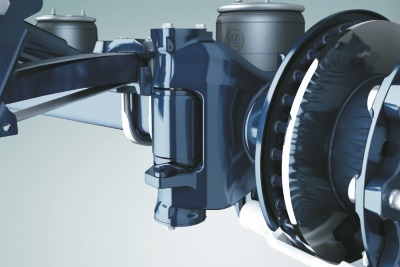 Technology provider BPW has outlined details of its LL Self-Steering Axle, which is compliant with the Department for Transport’s new longer semi-trailer (LST) regulations.
The new rules, which widened the ability of fleets to use LSTs (Transport Operator 117), were introduced on 31 May, and permit LST combinations with a maximum length of 18.55 metres on roads in Great Britain – 2.05 metres longer than the standard size.
The move follows an 11-year trial, which confirmed the benefits of LSTs in terms of increased capacity, reduced costs, significant CO2 savings and a reduced number of trailers on the road.
“After an active involvement in supporting the trials, BPW welcomes the approval which demonstrates the improvement in transport efficiency that can be achieved with the right technology,” said the company.
“With its unique capabilities, the BPW LL Self-Steering Axle not only enables compliance with the new LST regulations but also delivers substantial environmental and economic advantages, providing an advanced and intuitive system that offers unparalleled benefits to the industry.
“The simple steering components enable automatic, load dependent control. The traditional benefits of BPW’s self-steer axle have been well documented: these include excellent manoeuvrability, lower fuel consumption, lower tyre costs, and reduced stress on the chassis.
“The benefits are simply achieved: BPW’s self-steering axle operates without the need for power-assisted stabilisers. It is automatically controlled according to the load being carried, and because the design itself is so simple, the number of individual components required is low.
“This saves weight and reduced installation and maintenance costs.”
To simplify installation, BPW has developed a double-cranked trailing arm. This allows the trailer builder to fit a BPW self-steering axle to a standard chassis without the need to reduce the width of the chassis in the area of the steer axle, says the company.
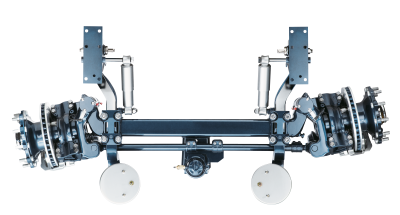 “Conventional steering axle designs require steering stabilisers powered from an external source – this is not the case with the BPW self-steering axle,” it continued.
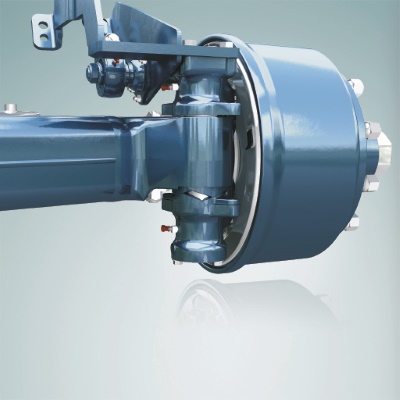
“The axle beam and axle stub are connected to corrugated thrust bearings mounted under the kingpin assemblies. When driving straight (zero position), the corrugations in the thrust washers keep the wheels on track, while the vehicle’s weight is used to keep the washers in contact providing load sensitive damping and ensuring optimal performance.
“LL stands for ‘load-dependent steering stabilisation’ and it describes the unique functional principle of the BPW self-steering axle.
“BPW’s LL steering axle has been designed with a self-locking facility when reversing. Unlike other systems, as soon as the trailer begins to move backwards, the steering mechanism is locked in the straight-ahead position.
“The trailer corners better and follows the same path as the tractor unit. Forces acting on the tyres when cornering are distributed more evenly.
“As a result, it has been shown that the life of the tyres on the front axle increases by up to 50 per cent, while those of the rear axle can increase by as much as 70 per cent.”
The LL self-steering axle shows off its strengths particularly when tight manoeuvring is required in delivery and distribution haulage, says BPW.
“Thanks to its greater manoeuvrability on corners and when making turns, you benefit from more straightforward vehicle handling, less tyre wear and lower fuel consumption – over a distance of 100,000 kilometres that adds up to as much as 1,000 litres of fuel saving and more than four tyres per vehicle.”
 According to the DfT, operators will be legally required to ensure the implementation of appropriate route plans and risk assessments that account for the unique specifications of LSTs, BPW points out.
“Alongside these newly imposed legal requirements, operators will also be expected to conduct extra safety checks including driver training and scheduling, record keeping, training for transport managers, and proper loading practices of LSTs.
“With the ever-increasing demands placed on fleet managers, it is essential to have a solution that optimises efficiency and prioritises safety and sustainability. BPW LL Self-Steering Axles provides a reliable and efficient solution, ensuring compliance with new laws governing longer semi-trailers.
“By incorporating these axles into their fleets, managers can optimise their operations and maximise load capacity while remaining fully compliant.”
The BPW LL self-steering axle is available with maximum steering angles of between 12 and 27 degrees, with the latter being ideal for longer semi-trailers, the company explains.
“Based on the proven beneficial principles of their existing self-steer, this additional angle of steer enables allocated licence holders of 15.65-metre trailers to consider a self-steer axle, with no sacrifice of payload capability, against a more costly and heavier command steer system on their trailers,” it concluded.