
Samsara data demonstrates telematics safety benefits

Ryan Yu of Samsara
Telematics specialist Samsara has highlighted the government’s recent recognition of the role technology and vehicle data use can play in driving up road safety.
In her introduction to the government’s new Road Safety Strategy, the transport secretary Heidi Alexander acknowledged the “rapid progress of technology and data analytics” in helping to improve road and vehicle safety.
“Used well, they can be gamechangers,” she wrote.
“Automated vehicles and Advanced Driver Assistance Systems (ADAS) are transforming how we navigate roads. Better collection of vehicle data helps us learn from past collisions and focus on future prevention. A more connected transport network is a golden opportunity to reduce collisions and save lives.”
Samsara also cites a recent report by the Parliamentary Advisory Council for Transport Safety (PACTS), which called for the greater use of technology to improve road safety, and recognised the role that real-time data and AI technologies had to play.
“In terms of public policy, this is a significant breakthrough,” said Ryan Yu, VP, product at Samsara.
“There is a clear correlation between the implementation of advanced telematics and improved road safety. What’s more, we have proof.
“The 2025 Samsara Safety Report explores how commercial fleets of all sizes are using data and artificial intelligence (AI) to reduce road risk.
“Based on anonymised, aggregated data from thousands of fleets worldwide, the research found that those fleets that implemented modern telematics solutions such as dual-facing AI dash cams, in-cab alerts and coaching saw crash rates fall by 37 per cent in the first six months and 73 per cent at 30 months.
“A deeper dive into the data found that harsh events decreased by 48 per cent at six months and 69 per cent at 30 months. Similarly, speeding fell by four per cent in six months and 23 per cent at 30 months.
“Perhaps the most dramatic improvement of all is mobile usage – one of the ‘fatal five’ – which fell by 84 per cent at six months and an astonishing 96 per cent at 30 months.”
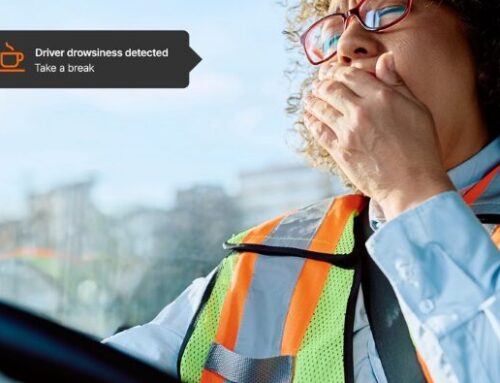
What’s clear from the data analysis, says Ryan, is that visibility – including using telematics and video-based solutions to detect unsafe driving behaviour out on the road, such as distraction and drowsiness – is a cornerstone of success.
“Not only does it work in real-time by cutting speeding or mobile phone use, for example, but when combined with coaching and a long-term cultural shift, it also becomes a virtuous circle of improvement.
“For instance, the report found that the initial deployment of a new technology often sees a spike in newfound awareness and affirmative action. Drivers experience a ‘penny-dropping’ moment regarding their behind-the-wheel behaviour that often leads to swift and significant change.”
By harnessing data from on-board diagnostics and connectivity, says Ryan, the government can shift from reactive “lagging” indicators (fatalities/injuries) to “leading” indicators that identify near-misses and safety-related traffic patterns.
Trans Proxim Froid – a refrigerated transport company based in France, cited in the report – used dash cams and advanced telematics to support the real-time tracking of vehicles, monitoring of refrigerated temperatures and AI-powered driver coaching to improve road safety.
“The safety of our drivers is an absolute priority,” said Julien Normand, director of Trans Proxim Froid.
“In-vehicle technologies such as dash cams now make it possible to act very effectively to reduce the number of road accidents and protect drivers, and we believe that it would be irresponsible not to use this tool.”
Other companies highlighted include global transportation and logistics firm DHL, which used drowsiness detection alerts and lane departure warnings to help support tired drivers.
“At our scale, safety has a huge ripple effect,” said Fred Matthews, senior project manager, safety programs, at DHL. “It doesn’t just impact our employees and their families – it benefits the general public.”