
Dr Air Brake: don’t treat trailers as an afterthought
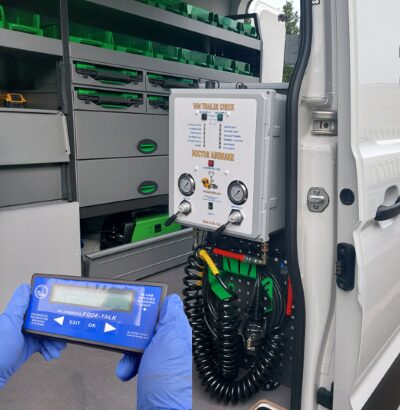 Diagnostics solutions provider Doctor Air Brake has explained how its Van Trailer Check Premium and Code Talk II systems are changing the way operators find trailer faults before they reach the road.
The air brake specialist, which manufactures a variety of truck and trailer diagnostics equipment, safety systems and ADAS calibration equipment, warns of the dangers of treating trailers as an afterthought when it comes to fleet safety.
“The trailer covers every mile the truck does. It is time it was treated like it does,” said Doctor Air Brake.
The company highlights consistently concerning rates of braking defects for commercial trailers inspected during enforcement initiatives by the Driver & Vehicle Standards Agency (DVSA).
“The very asset that carries the goods, that every supply chain depends upon, rolling out of yards across the country with faults that should have been caught before the first wheel turned.
“That is not acceptable. And it is a position the industry can no longer afford to defend.”
Doctor Air Brake also emphasises tightened DVSA expectations around braking performance assessments for trailers, including that they should take place at every safety inspection. Where EBPMS is not used, DVSA expects that there will be a minimum of four laden brake tests spread evenly across the year.
“It is a decision that goes beyond compliance – one that will directly influence the efficiency, safety and cost-effectiveness of how fleets are run,” the company said.
“The operators who will navigate this well are not the ones scrambling to meet each inspection deadline. They are the ones who have already built systematic trailer checking into daily operations – finding faults before they become a roadside breakdown or worse a death in the making.”
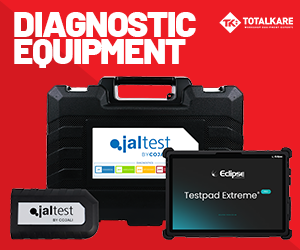
Doctor Air Brake says its Van Trailer Check Premium (VTC) and Code Talk II address this challenge head-on.
“The combination of the two represents a genuine leap forward from anything previously available at this level.
“Any transport manager who has run a proper trailer inspection knows the traditional routine: one person at the back checking lights and brake response, one at the front, one in the cab of a connected tractor unit. Three people tied up, the truck has to be on site and hooked up throughout, and if that unit is needed on a run, the check waits. It is slow, it eats resource, and it pulls a revenue-earning tractor out of operation every time it happens.
“The VTC eliminates all of that. It is a compact, self-contained unit that replicates the complete electrical and air supply of a connected tractor unit – meaning no truck is required at all. One technician connects it directly to the trailer’s air and electrical lines and conducts a comprehensive assessment of lighting systems, ABS-EBS-CAN circuits and all air brake systems in a single operation.
“It runs from the technician’s vehicle batteries on 24V, or from mains supply at 110V or 240V, so it works wherever the trailer sits – yard, workshop or out in the field. The optional wired or wireless remote control allows that same solo operator to safely activate the brakes and measure chamber pressures from beside the axles, observing engagement and wear in real time, without a second pair of hands anywhere on site.”
A process that previously needed three people and a connected tractor unit now needs one person and a van, says Doctor Air Brake.
“Trailers can be checked faster, more frequently and completely independently of the tractor fleet. That is not just a compliance gain – it is a direct operational and commercial advantage.
“Code Talk II completes the picture. This upgraded handheld fault code reader – dongle-free, connecting directly via breakout lead through the EBS socket – covers all major trailer ECU systems including Wabco, Haldex and Knorr-Bremse.
“It reads and clears fault codes, displays live air pressures, wheel speeds, system voltages and ride height, and operates as the remote control for the VTC – integrating both tools into a single seamless workflow.
“That dual capability is a significant advance on what was previously possible from either a standalone reader or a trailer test unit alone, bringing together complete physical and electronic diagnosis in one visit, one session, one operator.
“Early fault detection prevents expensive repairs, reduces roadside breakdowns and keeps operators firmly on the right side of compliance.”