
Report: ringfence grant funding for smaller fleets to aid EV transition
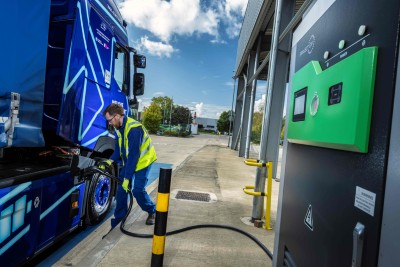
Image: TwentyForty
Obstacles preventing the electrification of the UK’s truck parc have been outlined by the progressive operator group TwentyForty in a report, Making the Numbers Work: The Commercial Case For Electric Freight.
The report draws upon the real-life experience of early adopters of battery electric trucks taking part in its 12 Pillars of Change workshops, to identify both the positive outcomes of their use and the difficulties to be overcome in progressing further with the technology.
It points out that UK zero-emission registrations are making up a relatively low percentage of the market – 1 per cent in the first half of 2025 – compared to 4.5 per cent in Germany and 14 per cent in the Netherlands. In particular, it highlights the Road Haulage Association’s (RHA) finding that 70 per cent of its members surveyed said they have no plans to introduce zero-emission vehicles.
“That figure doesn’t tell you that operators don’t want to electrify,” Jamie Sands, the founder of TwentyForty and head of solutions at Welch Group, told Transport Operator.
“It tells you that too many of them have looked at the upfront cost, the grid question, and the uncertainty around residuals, and decided the risk isn’t theirs to carry alone. Fix those three things and that number moves fast.”
The report warns that the current structure of the government’s Plug-In Truck Grant allows large operators placing bulk orders to absorb the available allocation, and calls upon government to ringfence at least 40 per cent of annual grant funding for operators with fewer than 50 vehicles.
“The grant structure favours large operators placing volume orders. Over half of UK HGVs sit in fleets of 10 or fewer, and there’s no ringfencing to protect their access. If SMEs can’t join the transition, it doesn’t happen,” the report warned.
According to Jamie Sands: “The grant structure has been doing most of its work for the operators who needed it least.
“If you’re placing a volume order, you know how to navigate an application process. If you’re running eight trucks out of a yard in Lincolnshire, you probably don’t. Ringfencing isn’t a subsidy for small operators, it’s just a correction.”
Operators should not bank on electricity getting cheaper; the report says there is little prospect of prices falling below 20p/kWh, but even so fuel costs are 15-25 per cent lower than the diesel equivalent. Depot charging should always be cheaper than charging on the road, but here the report identifies some key faults in the electric truck model.
“Over 100 trials confirmed that virtually no operator has enough grid capacity,” it said.
“Connections cost £5,000 to £5 million and take up to three years. The [government] Depot Charging Scheme still doesn’t cover DNO (distribution network operator) upgrade costs, which is the single biggest infrastructure expense most operators face.”
Jamie Sands told us: “We talk about electric trucks like the barrier is the truck. It isn’t. It’s the grid connection behind your depot. We’ve got operators who want to move but are sitting on three-year DNO upgrade timelines. The vehicles exist. The willingness exists. The infrastructure doesn’t.”
Currently operators suggest that insurance costs are unchanged when switching from diesel to electric, the report notes – but it warns of insurers’ and loss adjusters’ lack of knowledge around assessing EV battery damage, which it says is leading to repairable vehicles being written off. The high cost of replacement high-voltage battery packs compounds the problem.

The report is the result of a workshop session held in March which brought together fleet operators, charging infrastructure providers and others. Image: TwentyForty
Residual values are difficult to calculate for electric trucks as there is no used market yet, which means finance providers are ‘pricing blind’. The report points out that a government-backed Residual Value Guarantee scheme had been designed and published, but was never implemented.
The higher front-end price of electric vehicles means many buyers are planning a 15-to-20-year vehicle life in contrast with the five-year replacement cycles standard on new diesel trucks, it adds.
Many are confident that they can run a new electric truck for 10 years, do a mid-life refurbishment including battery renewal, and then run the truck on for another five to 10 years. Experience in the bus sector indicates that this is attainable, with vehicles running for nine years so far without a single battery cell failure being reported.
The price gap, which was a hurdle in the earliest years of electric trucks, is diminishing rapidly. With grant support, electric tractor units can be leased at diesel equivalent rates, and the report anticipates the arrival of Chinese electric trucks that will undercut the prices of European-built vehicles by a third or more.
“European OEMs are offering capable vehicles at prices that work with grant support. Chinese manufacturers are offering vehicles at prices that might work without it,” it claims.
An alternative route might be to repower and refurbish diesel trucks with electric drivelines, as is already happening with citybuses and (to a lesser extent) municipal vehicles.
Long-haul presents a difficult case for electrification because of the high cost of charging. The report points out that at the current Zapmap average of 76p/kWh the economics don’t work, and new business models will be required before they do.
Electric trucks should be cheaper to maintain than diesels, the report claims, in part because they don’t have troublesome emissions control systems or require AdBlue. It cites European modelling that places electric truck maintenance at 28-33 per cent below diesel vehicles for long-haul and regional operations, and UK bus data that suggests maintenance costs are nearly 50 per cent lower than for diesel equivalents.
However, users report tyre wear increase of up to 20 per cent thanks to the increased torque and weight of electric trucks. In addition, there are comparatively few technicians (currently only around a quarter) qualified to work on electric vehicles, in an industry where there is already a shortage of workshop skills.
The report concludes with three recommendations for government policy changes that it says would boost the uptake of electric trucks.
“First, the Depot Charging Scheme needs to cover DNO grid upgrades. It’s the most obvious gap in current policy and the simplest to fix. Second, government should implement the Residual Value Guarantee that’s already been designed, modelled, and published. £10 million in reserves could mobilise over £228 million in private capital. Third, grant funding needs ringfencing for smaller operators. Without it, the 70 per cent of the industry that most needs support will never start.”
The report’s advice for operators includes honest modelling of energy costs, and the interrogation of telematics data to help establish which of their routes are electrifiable. It also advocates sharing charging infrastructure; the aggregation of buying power, such as through pallet networks or trade groups, to gain volume discounts; and planning for longer-term vehicle ownership.
“If you’re still modelling a five-year replacement cycle, you’re overstating the cost of electric and understating the cost of diesel,” it said.
The report can be downloaded at: https://twentyforty.uk/