
Your driver is your best ambassador
 Transport training specialist Novadata explains the benefits of embracing a training culture
“Your driver is your best ambassador,” says Su Winch, managing director of Novadata.
“When your drivers feel respected and valued, they go the extra mile with your customers and take more seriously the administrative and training obligations they have to follow. When your business culture embraces training instead of just ticking a box for compliance reasons, your whole team, drivers, office, and warehouse staff, thrives. This means productivity, staff retention, and business growth are all in a day’s work.”
Transport Manager CPC
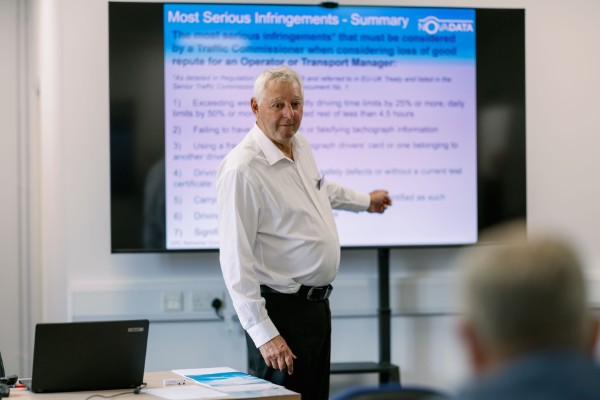
When it comes to training, every transport business should make sure their transport managers attend a Transport Manager CPC Refresher course within five years of first qualifying, or their last refresher course, to keep pace with changes in transport legislation and best practice. As both company directors and transport managers are answerable to the traffic commissioner for compliance, directors should be aware that you can’t delegate your compliance to your transport manager, you can only share it.
As a rule, the Certificate of Professional Competence for transport managers (Transport Manager CPC) is the qualification required for road haulage transport management. The Level 3 qualification covers both national and international road haulage operations and is typically offered as a ten-day course, preparing candidates to sit the CILT (Chartered Institute of Logistics and Transport) examinations. You can study for it independently, but the advantage of taking some dedicated time to attend a course, meeting and networking with industry experts and other transport managers proves invaluable for many candidates.
This is only really the beginning of their training, and this is why a culture of learning and embracing best practice in your business will encourage your transport manager to keep up with changes in transport legislation and best practice over time. Some transport managers choose to attend Transport Manager CPC Refresher training every two or three years. Novadata strongly advises attending at least every five years to stay up to date and make sure that you know how to protect your O-licence. UK traffic commissioners also recommend this.
 OLAT (Operator Licence Awareness Training)
Transport businesses must hold an operator licence if they transport goods for hire or reward using a vehicle over 3.5 tonnes or use vehicles in excess of 2.5 tonnes for international haulage. If you have been granted a restricted operator licence, you have agreed to the same legally binding operator undertakings and have all the same responsibilities as a standard operator licence holder, even though you may be new to the transport industry.
As the director signing the application for any O-licence, you have personally taken on a number of legal responsibilities. It is essential that you understand and comply with all your licence undertakings and that you maintain a healthy Operator Compliance Risk Score (OCRS). The best way to ensure that you are up to date and compliant is to attend O-licence training every few years.
In most circumstances, it is the company director who will attend OLAT courses, and it should be refreshed within five years. OLAT courses are strongly advised for holders of restricted operator licences. They are particularly appropriate for those whose organisation’s primary purpose is something other than transport and logistics.
Driver CPC
All professional LGV drivers must complete 35 hours of periodic training every five years to maintain their Driver Certificate of Professional Competence (CPC). There can be a tendency for some drivers to leave their 35 hours of Driver CPC training to the last minute and Novadata works hard to encourage drivers to do a day of training once a year instead. With a broad spectrum of courses, the intention is to ensure drivers are properly educated and informed. The type of courses on offer at reputable training centres, like Novadata, could include Drivers’ Hours and Law & Tachographs, First Aid, Driving Standards and Road Safety, and Actions after a Breakdown or Incident.
 ADR
ADR
ADR refers to the European agreement which also enacts the UK’s regulations on the carriage of dangerous goods by road. Any driver who transports dangerous goods must hold a vocational training certificate issued by DVSA. ADR courses provide drivers with the knowledge they need to be aware of the hazards inherent in carrying dangerous goods, how to protect themselves, and those around them. Courses should be approved by the Department for Transport and offer both ADR Class 1 Explosives courses and ADR Class 7 Radioactives courses. Exams are taken online and results issued the same day so that your ADR licence can be issued promptly.
Dangerous Goods Awareness Training
A dangerous goods safety advisor (DGSA) is a legal requirement for businesses transporting dangerous goods. DGSAs are responsible for checking that the dangerous goods regulations are adhered to at all times; and for helping prevent potential and damaging consequences to people, property and the environment, stemming from the risks inherent in transporting dangerous goods. Many businesses are choosing to outsource this consultancy service, and as a provider, it’s something Novadata is seeing more and more via our own DGSA consultancy service.
Su closes by saying, “We believe it is also vital to build a relationship with a training organisation like Novadata. It means we learn about your drivers and your requirements; you feel supported to meet your compliance goals. When you see your training provider as a key business partner, with a vested interest in your success, you will both move forward together. Most importantly, it means you always stay ahead of the game when it comes to fulfilling your training obligations to meet all traffic commissioner requirements, giving you a peace of mind and a long-lasting reputation. In the end, we want to help business owners and transport managers see the value of training as something that’s enjoyable and makes you better at your job, not just a necessary evil.”