
Cutting tacho compliance risk
 Fleet management specialist Fleetclear offers its perspective on the pitfalls of relying on manual tachograph downloads
Picture the scene. There’s a DVSA compliance check under way, and the traffic examiner’s sat across the desk from you asking a simple question: when was this vehicle’s tachograph data last downloaded? You already have a bad feeling about the answer.
Turns out it’s been over five weeks since that driver’s card was pulled, and past 90 days since anyone downloaded the vehicle unit itself – well beyond the legal windows you’re required to hit, no exceptions made for a busy site or a driver on leave. What felt like a small administrative slip now has a name, and it’s a fine, with a note against your operator’s licence to go with it.
You know exactly why it happened. Nobody stopped caring – it’s that pulling data from a fleet spread across depots and drivers relies on someone remembering to do it, every time, for every vehicle, with nothing in place to catch it when they don’t. This time, nobody did.
And now you’re the one explaining that, not to a colleague who’ll let it go, but to an examiner with a clipboard, a fine book, and your operator’s licence in front of them.
How frustrating, to know exactly what should have happened, and to be sat here anyway explaining why it didn’t. If only there was another way.
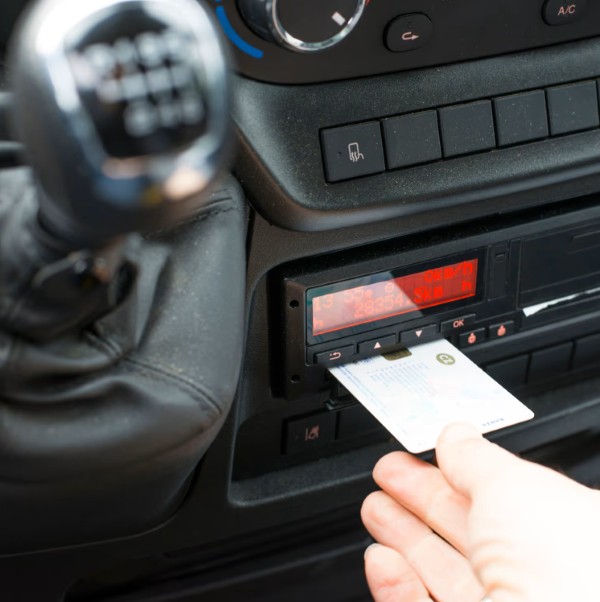
And it’s not just when the DVSA comes knocking that this is annoying – managing tachograph data manually is time-consuming, inefficient and prone to error, even when it’s just part of normal day-to-day activity. Fleet managers are left relying on someone remembering to download the data, or physically visiting each vehicle to complete manual driver card downloads one by one.
Even with the best processes in the world, we’re only human! So many variables creep in: a vehicle gets missed off the round, a fumble with the buttons deletes something you needed, someone drops the USB stick down a drain on the way back to the office.
Again, if only there was another way…
Here’s the thing: under UK and EU rules, you’re legally required to download driver card data at least every 28 calendar days, and vehicle unit data at least every 90 calendar days – whether or not anything’s gone wrong. That’s not a ‘nice to have’ schedule, it’s the law, and DVSA fines are the sharp end of getting it wrong.
So this isn’t an occasional job you can afford to do badly. It’s a fixed, recurring, non-negotiable part of running a compliant fleet. And yet, for a lot of operators, the process for meeting that legal deadline still comes down to one person, a USB stick, and hoping nothing gets forgotten.
Telematics gave us vehicle location in real time years ago. Cameras give us footage on demand. So why is one of the most heavily regulated, most useful data sets a fleet holds still being collected the same way it was a decade ago?
There’s a better way, and it’s exactly what it sounds like: tachograph data that downloads itself, on a schedule you set, without anyone needing to remember, drive anywhere, or go near a USB port.
That means driver card and vehicle unit data pulled automatically, on a cycle that comfortably clears the 28- and 90-day deadlines, with drivers matched to their journeys via their cards. No recalling vehicles mid-shift. No fumbled downloads. No missed vehicles, no dropped drives, no hopeful Post-it note on the depot wall reminding someone it’s due. Just data, arriving when it’s supposed to, ready for immediate analysis or upload.
Human error isn’t reduced here – it’s eliminated, because the manual step it relied on is eliminated. The vehicle stays on the road, the data lands where you need it, and next time there’s a he-says-she-says on the yard, the answer is already there waiting for you, not stuck in the back of a vehicle three hours away.
This is, in fact, exactly what Fleetclear’s Remote Tachograph Download solution does. It schedules automatic delivery of your vehicles’ tachograph data at a time convenient to you, so it arrives ready for immediate analysis or upload – no site visits, no manual downloads, no waiting.
And if you recognised yourself in that incident-day scenario earlier, it’s worth knowing our DMS camera systems are built the same way – footage and driving data both landing where you need them, without anyone having to chase a vehicle down to get it.
It’s backed by over 15 years of experience, with in-house engineers handling installation and after-sales support – because automating the data is only half the job. The other half is making sure it keeps working.
If manual tachograph downloads are still eating into someone’s week, it might be worth finding out what a scheduled one looks like.