
Secure truck stop rollout could help supercharge shift to EVs
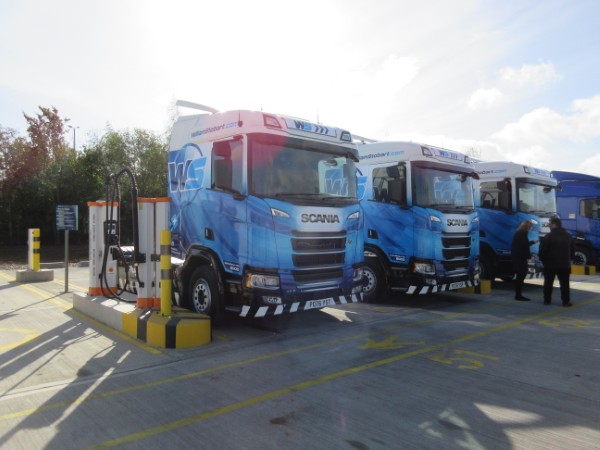 Bosch Road Services and Keoma Energy have set up a £24m truck charging centre in Leicestershire, with 32 charging points plus some 180 secure truck parking spaces. Backed by investor Guardian Smart Infrastructure Management (GSIM), the 22,500m2 Electroway site is located at Marq Logistics on the Magna Park logistics park near Lutterworth.
The biggest location of its type in Britain, the Bittesby Way centre sits close to the M1, M6 and M69 – the so-called ‘Golden Triangle’ – and adjacent to some of the UK’s biggest distribution complexes, with more than 50 warehouses on its doorstep.
Within four hours of 85 per cent of the country’s population, it has been developed without recourse to government funding. It demonstrates the ability of private capital and commercial partnerships to deliver major charging infrastructure and secure parking projects, according to Keoma Energy.
Its establishment is only the first step in a £1bn programme that will see some 30 Electroway centres under construction across the country within the next two-and-a-half years, says Keoma’s chief executive officer, Tylor Hartwell.
“We’ve just fired the starting gun,” he states. “We want to give fleets the confidence to accelerate their transition to electric vehicles.”
Comments GSIM president and managing partner, Robert Mah: “We believe this scalable model can be deployed across the UK, accelerating the electrification of freight while delivering durable infrastructure assets for decades to come.”
Each of the Magna Park site’s charging points can deliver up to 400kW says Hartwell.
“We could have 80 charging points in place there in the future,” he adds. “We’re ready to do so, and we’re ready for Megawatt charging too.”
Charging a truck costs 39p per kWh if the operator has an agreement in place with Electroway. “That goes up to 47p per kWh if the truck just shows up,” he says.
Users can reserve a specific charger with guaranteed charging capacity.
“Electroway is about removing one of the biggest practical barriers to electrifying road freight,” says Hartwell.
“Operators need to know that when a truck arrives, a charger will be available, it will deliver the power promised, and the economics will work.
“Remember that for more than a century hauliers have been used to filling their vehicles at a pump,” he says.
“Now we’re asking them to do something completely different, but if the infrastructure isn’t in place, they won’t make the change.”
Diesel or gas-powered trucks whose owners simply want to make use of the security the centre affords are as welcome as their electric counterparts. “Parking overnight costs £38 which includes a £10 voucher for the driver,” he says.
A consolidated monthly invoice provides hauliers with an overview of their bookings and transactions.
Fencing envelops the well-lit Magna Park centre, which is watched over remotely round-the-clock, 365 days a year, by almost 80 CCTV cameras. Access is controlled, with turnstiles, QR codes. and ANPR (automatic number plate recognition) and the premises have been designed to meet TAPA (Transported Asset Protection Association) Level 2 Parking Security Requirements.
Driver facilities include toilets, washrooms, showers, the ability to get clothes laundered, food and drink dispensing machines, a lounge with a gaming area, site-wide Wi-Fi, and a truck wash. The microwave ovens that have been installed can read QR codes on a ready meal automatically and ensure it is cooked to the correct temperature.
Bosch is delivering the technical expertise required to maintain and run the new site and the anticipated network, including the access control and security infrastructure. It is the first time it has been directly involved in operating this type of facility in the UK.
In doing so it is combining its internal company expertise in road freight services with that of Protec Fire and Security Group, its specialised UK fire and security business.
Bosch Road Services is responsible for the Bosch Secure Truck Parking platform. It provides operators with access to more than 30,000 secure truck parking spaces which they can reserve digitally at upwards of 600 parking areas in a dozen European countries.
There are over 50 British sites on the platform, but Electroway is the first to offer both electric vehicle charging and parking.
The platform can be accessed through a mobile app or a web portal. It can also be integrated into existing fleet and transport management systems through Bosch L.OS, the open logistics operating system the company has developed.
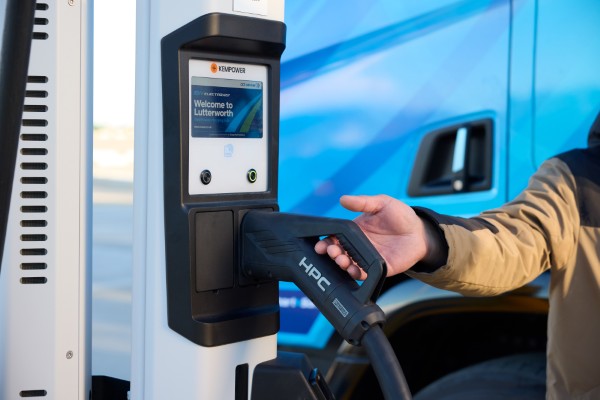
Image: Electroway
Parking can be planned before a truck departs from its home base. Available spaces can be selected based on location, leaving time, route duration and the driver’s remaining driving time.
Digital advance booking can cut the time spent hunting for a parking space, says Bosch. This means fewer unnecessary detours leading to fuel being wasted, and supports compliance with the drivers’ hours rules.
Says Dr Jan-Philipp Weers, head of Bosch Road Services: “Electroway is a flagship project for us. Our goal is to provide drivers with the safe, dignified environment they deserve while giving operators peace of mind that their cargo is secure.”
Remarks a Bosch executive: “Locations like this are likely to make driver recruitment and retention a lot easier.
“Drivers are far less willing than they used to be to spend the night alone in a lay-by without washing and toilet facilities, and while some male drivers may be prepared to put up with the inconvenience and discomfort, women drivers certainly won’t,” he adds.
“Nor should they be expected to.
“Using Electroway centres is also likely to help logistics companies win business because it makes it less likely that goods entrusted to their care will be stolen,” he contends.
The 30 Electroway sites scheduled to be rolled out will cover an average 40,000m2 each, says Hartwell. Obtaining planning permission is unlikely to be a serious obstacle to the network’s rollout, he suggests, given the contribution the centres will make to cutting overall emissions.
The locations he has in mind are close to trunk routes but are unsuitable for the construction of warehousing or other commercial buildings for one reason or another. There could be a tunnel or cables running underneath, for example, which make it impossible to sink deep foundations.
As a consequence they may remain idle unless they are used for vehicle charging and parking.
“We’ve got to be sure we have a good grid connection though,” Hartwell says. “That’s the biggest risk to our plans.”
The centres will not rely on hauliers using the chargers in order to make money. The security they offer will ensure they are profitable, he says, and biogas and HVO (hydrotreated vegetable oil) pumps may be in place at some locations.
Hydrogen is definitely off the menu, he stresses.
“We’ve seen hydrogen promoted time and time again, and it’s just not going to work,” he opines.
“So far as I can see it’s just a bump in the road.”
Hartwell declined to go on the record when it came to disclosing where the next UK Electroway centres are likely to be located. Logic would suggest however that they will be on other major logistics estates close to key motorway junctions.
Similar locations to Lutterworth could be established across Europe, he predicts. “I know Bosch would love to see them in Germany,” he observes.
France and Spain are other likely homes.
Better security for trucks when they are parked up overnight has to be welcomed.
The National Vehicle Crime Intelligence Service points out that in 2025 there were nine incidents of truck-related crime in the UK every day, with 27 per cent of thefts from trailers involving curtain slashing. Losses accruing from criminal activity totalled £65.1m.
The Electroway project addresses Britain’s dire shortage of secure truck parking and its paucity of accessible truck charging points. Yet while the provision of truck chargers is clearly important, and could help encourage some hauliers to go electric, many operators may take the view that the security Electroway offers matters more at present.
After all, there are far more diesels in service than electric models as things stand; and thieves never seem to sleep.