
Helping workshops go greener
 Nigel Bottom, managing director of lubricant supplier Witham Group, offers his take on how commercial vehicle workshops can boost their environmental credentials
Going green in a workshop is always a team effort, and when formulating an environmental policy it’s important to look at the full package – not only at the measures most commonly associated with sustainability, but also right back to your supply chain, and the products and services you procure.
Energy
Reviewing whether efficiencies can be found in areas such as lighting, heating, ventilation, cooling systems, insulation opportunities, water use and pollution control is a key way of improving a workshop’s environmental credentials.
Ideas may include installing solar panels on workshop roofs and depots – they often cover a wide surface area and can help generate new power to heat and light buildings, and power machinery and equipment. You could also install passive infrared (PIR) lighting, so that no lights are on unless they need to be.
Consider harvesting rainwater from the roofs and collecting in intermediate bulk containers (IBCs). Using this to wash vehicles and other equipment means thousands of litres of water can be saved each year.
 Products
Workshops and garages traditionally use chemicals and fossil-based products like engine oil, which are essential to their business. These are not usually environmentally friendly products, but there are ways you can identify and promote a greener culture by working a little smarter.
The choice of lubricants that a workshop uses are wide and varied, but a prudent choice of suppliers can help you achieve your greener goals.
Consider whether they offer biodegradable alternatives, such as Prolan Lubricants – an award-winning range of corrosion-busting, rust-prohibiting, multi-purpose products which uses sheep’s lanolin as a strong, natural lubricant. This has been captured and blended to produce a range of five viscosity oils, from chain and maintenance oils to restoration rust preventers and anti-seize greases, which are not only biodegradable but also non-toxic.
Other alternatives such as biodegradable chain oils and hydraulic and tipping oils are extremely popular and give comparable performance to more traditional mineral counterparts.
Lowering CO2 emissions and improving fuel economy is high on the agenda of all fleet owners. Swapping lubricants to a fuel-efficient approved alternative can save more than 1.5 – 2.5 per cent in fuel if carried out correctly. Lower viscosity lubricant sales are on the rise and engine oil can make a real difference to emissions and carbon impact.
Packaging
Consider lubricant suppliers that offer recyclable or recycled packaging. Container plastic packing from some suppliers is now made from at least 30 per cent recycled materials. Recycling schemes are also available for bulk 200-litre barrels. You may also be able to partner with local recycling and waste suppliers – many schemes are available nationwide.
 Bulk storage tanks
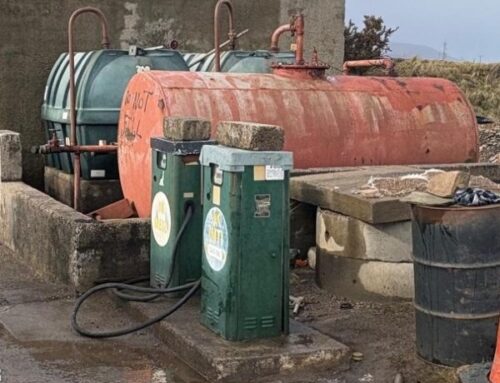
Workshops and garages tend to use a lot of the same lubricant products, and can have piles of used plastic containers lying around the place. Consider installing bulk storage tanks. Your lubricant supplier can advise on the best way to achieve this.
Lubricants are filled up in the colour-coded tanks as required; and the tanks have sight gauges, taps or pumps, and come labelled with the different product names and their application.
Using bulk storage tanks across all the workshops and garages in the UK saves thousands and thousands of plastic and metal containers being sent to landfill, as well as saving on waste collection costs and administration.
They also provide important health and safety benefits for lubricant storage. Simple, clean and easy to use, these tanks help keep your working space ship-shape, and avoid spills from containers and oil contamination.
Manufacturing technology
Use a supplier where greener technologies and processes are at the fore. The way lubricants are manufactured is changing, and this alone can be among the most beneficial savings to a workshop environment.
Witham Group manufactures its lubricants in a 100 per cent carbon neutral way. It has developed a new manufacturing process which uses ultrasound, deploying a high-speed micro-cinematographic sequence of laser-induced cavitations near to a solid surface.
Blendtek, as the new process is called, removes the need for base oils and product formulas to be heated up for long periods of time using traditional gas energy.
Instead, high-quality workshop oils can be made using solar panels and a simple 13-amp plug, with no need for heat or agitation, saving time, energy and drastically reducing the carbon footprint: whereas a traditional process would generate a footprint of 1,962 kW per 10,000-litre blend, using the Blendtek system, with no need for heat or agitation, this is reduced to just 6 kW per blend.
The desire to improve environmental credentials and the rewards being given by government to support this are encouraging. Ultimately, if everyone looked at their business to see how improvements could be easily made within their business, from what they buy and from who, workshops and garages could collectively make a huge success of going green.
More information on Witham and the environment can be found at the website.