
DPF Recovery: build cleaning into service plans
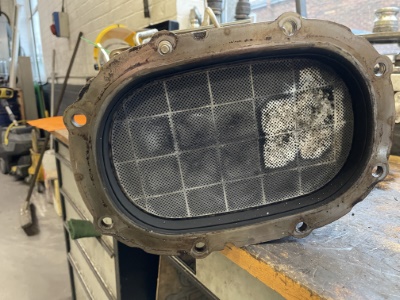
A melted DPF as a result of too many forced regenerations
DPF Recovery has highlighted the financial and vehicle uptime benefits of proactively building diesel particulate filter (DPF) cleaning processes into fleets’ service schedules, rather than taking a purely reactive approach.
“Many fleet operators only tend to their emissions systems once something goes wrong, such as when fault codes appear and limp modes are entered,” said the company, which has been in the DPF cleaning sector for more than 10 years.
“Unfortunately, once these codes are present, there is a high chance that costly damage is already done.
“To potentially save thousands of pounds and minimise your fleet’s downtime, we are recommending fleet operators to build a proper, off-vehicle DPF clean by a specialist such as ourselves, into their service intervals.”
Explaining the rationale, DPF Recovery said: “Forced regenerations do not work on higher mileage vehicles. We are seeing vehicles with higher and higher mileage these days, as a direct result of longer lifespans of fleet vehicles due to cost pressures and component shortages for new vehicles.
“Once your vehicle gets to over 100,000 miles (and sometimes earlier in many cases), the ash content of the DPF is so high that a force regeneration no longer works. Force regenerations work by burning off particulate matter in the DPF, turning it to ash. Ash cannot be burnt off in the same way as particulate matter, as something that has already been burnt cannot be burnt again.
“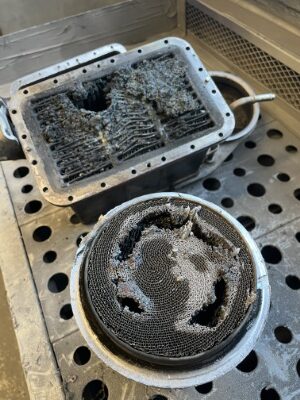 In this case, force regenerations can actually melt the DPF, causing thousands of pounds of damage to the filter, which then requires replacing.”
A proactive approach will prevent costly issues from occurring later down the line, the company contends; ash build up in DPFs, which is a product of regeneration, cannot be burnt off during further regenerations as aforementioned.
“Once the ash is built up and compacted within the DPF, there is less space for the particulate matter to go, resulting in the DPF becoming ‘overfilled’. This then results in high backpressure from the DPF, which could cause damage to the vehicle’s turbocharger – a very costly component to replace.
“Furthermore, the DPF could also shift in its housing, causing the matting which mounts the DPF to get stuck in components further downstream; we have seen this countless times where the matting gets stuck in the SCR unit of commercial vehicles, which then need to be cut out and re-welded; or worse, the SCR unit needs to be replaced, which is one of the most costly components of the whole emissions system.”
Proactive cleaning can also provide an insight into whether there are any other issues with the vehicle which have not yet presented themselves, DPF Recovery contends.
 “Often, issues with vehicles only present themselves when it is too late – when they go wrong. However, part of our DPF cleaning process includes an inspection before and after the clean, where we can see if there are issues with the EGR system (orange staining on the DPF) or fuelling issues (excessively dirty DPFs or even melted DPFs).
“Premature diagnosis of these issues can result in further, costly damage from being presented.”
DPF cleaning also improves fuel economy and engine performance, the company points out: DPF blockages (either by soot or ash) can be very restrictive of a vehicle, as the exhaust gases are not exiting as they were designed to.
“This results in a loss of power and increased fuel consumption,” it said.
“Many of our customers report an increase in fuel economy after their DPF has been cleaned, with some achieving an extra 5 – 15 per cent of range on a single tank of diesel, as opposed to before having their DPF cleaned. This is a result which is very welcome in today’s climate, with fuel prices being as high as they are.”
Free, no-obligation quotes for cleaning services can be obtained by contacting DPF Recovery.