
Destination: Euro VII
 Adrian Hill, technology manager at Morris Lubricants, discusses the new standards for Euro VII compliance and how engine oils and lubricants are evolving to meet requirements
The heavy-duty diesel (HGVs and PSVs) and light-duty commercial vehicle (LCVs) sectors continue to innovate with new engine platforms and transmission systems.
The primary goal of all these improvements, particularly with internal combustion engine technology, is to further reduce emissions as we work towards carbon neutrality.
New regulations are emerging that set out challenging 50 per cent reductions in key pollutant emission limits. Engine oils have had to evolve to help Euro VI compliant engines reach today’s required emission limits, but it is safe to say that Euro VII will be a whole new challenge.
Moving from Euro V to Euro VI yielded a wealth of hardware updates, including higher fuel injection pressures, smaller displacement, scavenging loop improvements, and better after-treatment device efficiency, to name but a few.
Alongside these changes, the engine oil specifications have also had to keep pace, especially with the critical protection of after-treatment devices, such as diesel oxidation catalysts (DOCs), selective catalytic reduction systems (such as AdBlue), diesel particulate filters (DPFs) and gasoline particulate filters (GPFs).
Without the correct chemistry in the engine oil formulations, all of these devices suffer, with the potential for big repair bills. Poorly formulated engine oils will prematurely block DPFs and GPFs as well as poison catalysts. These devices are not only expensive to replace but result in downtime, which again will cost a company money.
 So, as we move closer to Euro VII (pitched to be 2025 for LCVs and 2027 for the heavy-duty sector), developments are well under way to meet a new set of demands.
In the heavy-duty sector, there’s no doubt that engine downsizing, in terms of the number of cylinders employed, will continue with the adoption of variable geometry turbochargers to give tailored boost depending on demand. Engine management system software is also being refined which allows for precise fuel injection metering depending on duty cycle. This results in fuel saving and reduced emissions.
Evolving engine oil technology
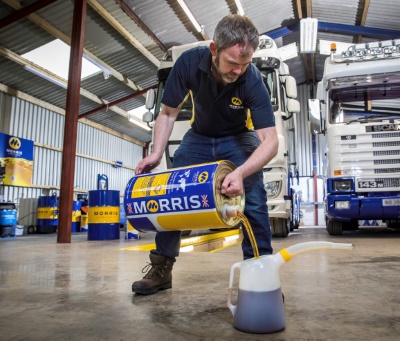
To keep pace with hardware changes, engine oil technology has also needed to evolve. Improvements in fuel efficiency can be made by using engine oils that produce thinner oil films in the bearings and the ring/liner area. Thinner oil films result in less drag and therefore more useable energy goes to the wheels.
To ensure that component integrity is not compromised, these thinner oil films are fortified with precise polymer chemistry to avoid metal-to-metal contact. Adding these polymers is essential when formulating 5W-30 and 0W-20 engine oils with the environmental benefit of fuel efficiency resulting in reduced CO2, which is one of the targets of Euro VII.
For internal combustion engines, fuel efficiency is essential, and this will be the goal of the original equipment manufacturers (OEMs) as they innovate in the direction of Euro VII compliance.
The engine oil technology developed for this new generation of heavy-duty diesel engines will not be backward compatible with previous designs. In older heavy-duty diesel engine platforms, there will be the potential for accelerated wear, leading to operational inefficiencies and possible catastrophic failure of components if the incorrect engine oil is used.
Engines present in the LCV market tend to be car derived, and as such, are already on or capable of using this next generation of thinner engine oils.
 Meeting new demands
Global lubricant specifications from ACEA and API have been developed for engine oils and lubricants to suit these new engines and their emissions demands, but the OEMs are taking it further by tailoring these standard specifications and adding their own testing sequences.
Most of the vehicle manufacturers are already factory filling new vehicles with 5W-30s or 0W-20s and will demand this grade of lubricant for service fill. This adoption of new technology engine oils will continue to drive down CO2 output even further.
There is definitely a busy time ahead for maintenance engineers, chemists and fleet operators, but there’s no doubt that the internal combustion engine still has a lot of future potential and will remain a vital powerhouse in the transport industries.
The Versimax range, for the heavy-duty sector and the Multivis range for the light commercial sector, both from Morris Lubricants, have been formulated to reduce downtime, improve fuel efficiency, and contribute to the reduction in engine emissions.
Used by fleet operators, maintenance technicians, mechanics and drivers, Versimax and Multivis engine oils help to rationalise usage where mixed fleets of vehicles and engine technologies are in operation.
Offering a range of oils that are suitable for previous and current generation of heavy-duty diesel, light duty diesel, petrol and hybrid engines, including those with aftertreatment devices, the Versimax and Multivis ranges provide users with peace of mind.
Engine oil choice should not be taken lightly, and the original equipment manufacturer’s guide should always be followed. The mixing of different types of oil must always be approached with caution, as using an inferior oil could cause damage or premature failure. As always, seek professional advice if there is any doubt.