

MAHA UK: extend play detector life with basic upkeep
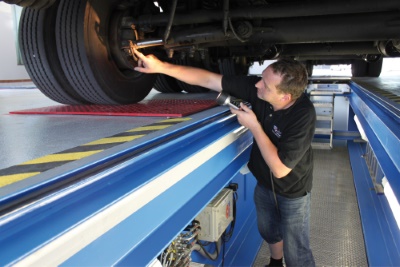 Workshop equipment supplier MAHA UK has described how operators can boost the longevity of axle play detectors by following basic maintenance procedures and advice.
The company recommends a six-monthly maintenance inspection to ensure the correct function remains constant; this can be flexible depending on the frequency with which the equipment is used, says MAHA, but at a minimum of every 12 months to remain within DVSA specifications.
“MAHA UK advises that inspections and maintenance work is undertaken by its own experienced, trained and professional service engineers, or by licenced dealers or service partners,” said the company.
“Failure to do so will be viewed as non-compliance and any existing manufacturer’s warranty will become null and void.
“That said, there are ‘housekeeping’ processes that operators should undertake to maintain functionality and longevity; for example, MAHA UK recommends that equipment is periodically cleaned and treated with a care product – not with caustic cleaning agents, high pressure washers or steam jet cleaners – while paintwork damage should be repaired immediately to prevent corrosion.
“Furthermore, operators need to relieve pressure to remove the test plates, so they either can lubricate guides with a grease gun or grease plastic sliding strips every 200 operating hours – at least every three months.
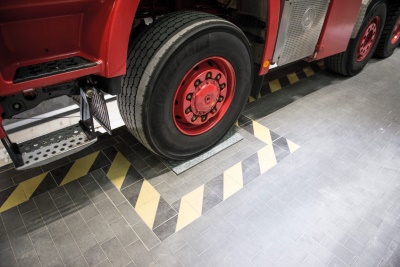 “During this particular upkeep, operators should check that all guide rods are secure and tightened if necessary and check the oil level regularly – it must sit between the two easily-identifiable marks.
“Every two years, the hydraulic oil should be changed – filling quantity and specifications can be found in the technical booklet supplied with the equipment.”
Alternatively, a guide can be found via the MAHA website (URL below).
“Axle play detectors are designed to find defects and wear in steering components, wheel bearings, shock absorbers and suspension – whether that be through lateral or longitudinal movement on the test plates,” said MAHA UK.
“They can check all components that swivel, twist or pivot – in essence, it can check everything in one action, ensuring they’re working as they should be. Using an axle play detector will also be quick and precise, as opposed to using a lever or pry bar, which MAHA UK professionals have, unfortunately, witnessed inside some workshops.
“MAHA UK’s LMS 20.0 has an in-built hydraulic drive that ensures a powerful and smooth movement of the test plates. An automatic mode, as well as other operating methods, means the aforementioned equipment is flexible, accommodating to the operator’s needs and simple to use.”