

Diesel Technic puts prop shafts in focus
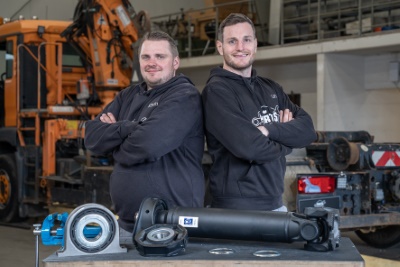 A recent workshop video released by Diesel Technic’s Parts Specialists has homed in on the propeller shaft, identifying some typical damage patterns and offering up hints and tips for operatives working with the components.
“The propeller shaft, also known as the prop shaft, drive shaft or cardan shaft, is used to transmit power in the vehicle between the engine and the drive wheels, i.e. to transmit torque between offset drive axles,” said Mark Todd, general manager at Diesel Technic UK.
“In their latest workshop video, the Diesel Technic Parts Specialists, Lars and Kevin, deal with a twisted propeller shaft that needs to be reassembled.”
Before they start work, the Parts Specialists go under the truck to take a closer a look at the propeller shaft in its installed state and explain its function.
“It starts at the front of the gearbox or output flange, continues to the first propeller shaft section via the centre bearing and the second propeller shaft half to the differential or output flange,” says Kevin.
“When the engine is running, it is even easier to see how the power is transmitted from the gearbox to the rear via the moving propeller shaft, which allows the vehicle to move,” he adds.
The propeller shaft has universal joints so that the motor and axle are not rigidly connected without suspension, explains Mark Todd, ensuring mobility during normal driving and compensating for differences in height.
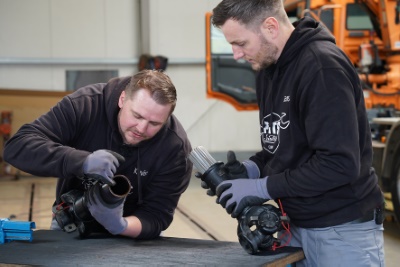 After an initial check, the Parts Specialists get to work, dismantling the short piece of propeller shaft, and then checking the joints and centre bearing in their dismantled state.
“When removing the propeller shaft, the workshop professionals recommend fixing the shaft with a jack or working with a chain hoist to prevent the two-part shaft from falling down,” Mark continued.
“These two parts should be marked accordingly beforehand so that no consequential damage occurs later due to an imbalance. The correct alignment of the universal joints ensures, among other things, that both do not become wedged or vibrate during driving.
“Lars and Kevin carefully demonstrate the correct marking on the universal joint intermediate shaft, which ensures an optimal fit during assembly.”
As well as working through the steps to dismantle and reassemble the propeller shaft, the team also presents some real-life examples of common damage patterns to look out for.
Lars says: “The needle bearings must be regularly supplied with grease via the grease nipple with the grease gun. The only exceptions are maintenance-free bearings. In other cases, thermal overload can cause the grease to gum up.
“As a result, bluish discolouration indicates that the stub is also affected. In the worst case, this results in material abrasion including detachment of the propeller shaft, which ultimately poses a danger to traffic.”
In the event of a breakdown, adds Mark Todd, the Parts Specialists have an important tip.
“If the vehicle is to be towed, it is imperative that the propeller shaft is removed beforehand, as otherwise the transmission will not be supplied with oil when the engine is not running,” he said.
“Removing the propeller shaft thus prevents damage to the engine and transmission.”
The full-length workshop video can be accessed via: youtube.com/@DieselTechnicGroup
The Diesel Technic range includes propeller shafts for commercial vehicles (trucks, buses, LCVs and other applications), centre bearings as a reinforced version for special applications as well as centre bearings with screw-on points on the sides in the product range. Repair kits for universal joints are also available.