
Ramping up supply chain resilience
 Mark James, director of administration, quality and safety at Thorworld, says ensuring agility in loading and unloading can help businesses adapt to rapid changes in the logistics sector
It is a tough time to be in the logistics sector. Between regulatory changes brought on by Brexit, the impact of the war in Ukraine on the supply of staple goods, and changes in consumer habits hastened by Covid-19 and prolonged by historically high inflation, trying to divine the requirements of customers is a tall order.
Fast and nimble?
The problem, of course, is that the British supply chain was built to be fast, not nimble. Our haulage infrastructure – from warehousing to delivery – developed over time into a sophisticated system, but one based on an essentially repetitive model.
Transport operators knew what had to be delivered, where to and by when, so their investment in facilities, equipment and personnel were relatively straightforward.
The result, in many cases, is a one-size-fits-all model, which is fine when there is only one size to fit. Yet when customers increasingly expect home delivery as standard, this changes the dynamic in terms of your fleet composition, with an increasing importance of vans, suddenly meaning your loading and unloading infrastructure has become unsuitable.
Trying to square this circle isn’t easy, especially if your capital is sunk into expensive, modern loading docks. It’s no good simply doing things as before and expecting the same results.
At best, you’ll see a drop in productivity because the process is no longer optimised; at worst, a potential health and safety nightmare. Whatever happens, you’re at risk of disappointing customers and losing your business to more agile competitors.
How then, can this circle be squared, giving logistics providers both the agility and resilience necessary not only to adapt but even thrive in the face of ever-changing pressures?
Mobile yardramps – semi-permanent, forever adaptable
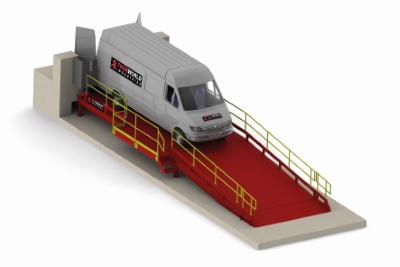
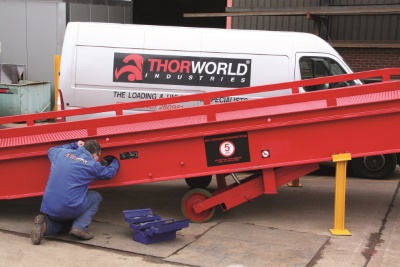 Luckily, there is an option that allows for agility in loading and unloading without significant capital expenditure: mobile yardramps.
Inherently adaptable thanks to their portability, these semi-permanent loading and unloading solutions are an increasingly valuable tool in the logistics business arsenal – allowing firms to scale their capacity up or down in line with demand which is especially useful when said demand is seasonal or unpredictable.
However, the agility that mobile yardramps provide is not tied solely to their portability but also to their customisability.
Logistics firms’ fleets are becoming more diverse than ever as home-delivery becomes an almost expected capability from consumers – this means the regular loading and unloading of a much wider range of vehicles, especially vans.
Mobile yardramps come in a variety of formats including tailored container and van options which ensure that the highest levels of safety and efficiency are maintained as a business’s vehicle fleet evolves to adapt to changing pressures. This customisability extends to a variety of safety and ergonomic features ranging from access stairs, lights, handrails, and towing adaptors.
Position to pivot
Certainty and stability have long been absent in the logistics sector and it’s clear that many firms are now having to adapt. Yet changing a nationwide supply chain architecture that has developed over nearly a century of fairly consistent demands and pressures is difficult and many firms will baulk at the idea of expensive remedial work to their facilities – especially given the unpredictability of future market conditions.
However, by ensuring that their logistics operations are as agile as possible, firms can deliver the agility today’s logistics demand. And with mobile yardramps, achieving this won’t cost the world.