
Don-Bur: steering towards the right spec for LSTs
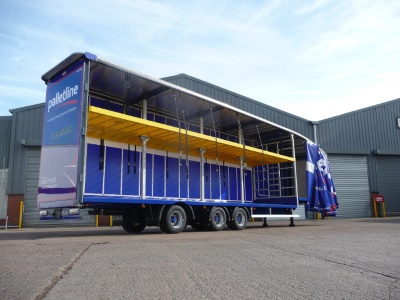 Since the Department for Transport’s decision to allow longer semi-trailers on UK roads without stringent trial conditions, trailer maker Don-Bur reports that it has seen a surge of enquiries from operators wanting to ‘stretch’ their assets for improved efficiency.
The company has outlined some factors it suggests operators should consider when an acquiring an LST, including the pros and cons for trailers that can provide up to a 60 UK pallet capacity.
“In simple terms, the new legislation that came into force on 31 May 2023 allows any operator to run trailers up to 15.65m long with a few safety caveats under a revised STGO regime,” said Don-Bur’s Richard Owens.
“In real terms, that means that up to four extra UK pallets (or up to eight extra on a double deck) can be carried in addition to the standard 26 currently achievable on a standard 13.7m long trailer. This represents a 15 per cent load footprint increase.
“Indeed, from trial data, the DfT have recorded an average eight per cent reduction in the number of journeys required to transport the same goods volume.”
Among the considerations is manoeuvrability, says Richard.
“When LSTs were first trialled, it was stipulated that the existing standard turning circle regulations must be complied with.
“In order the achieve this, the industry developed the double-bogie solution which comprised a primary tandem axle bogie, set a little further forward that a standard trailer wheelbase, coupled with a secondary single axle bogie set further back to support the weight.
“This single, rear axle, has to be steered to reduce the ‘scrub’ effect it would otherwise have. The result is a trailer that has exactly the same transit corridor characteristics as a 13.7m trailer.
“The only real minor difference is actually an increase in the ‘swing-out’ at the rear; acting in the opposite direction as the direction of steer, for which training should be provided for greater awareness.
“In reality, this has little effect out on the road but the 18.55m overall length combinations will be trickier to use in depots and you will just need more space to accommodate them.”
Richard also highlighted weight as a key factor to take into account.
“A standard 13.7m long tri-axle curtainsider is likely have an unladen weight of approximately 7 tonnes,” he said.
“If you couple that to a 6×2 tractor unit, you’re likely to achieve a payload of up to around 28.5 tonnes.
“A curtainsided 15.650m long LST will weigh approximately 1,500kgs more than a standard length trailer. As the DfT hasn’t conceded any provision for extra gross vehicle weight for LSTs over and above the 44 tonnes (on six axles), this means your potential payload weight would actually reduce to about 27 tonnes.
“Similarly, a double deck curtainsider can carry up to eight extra UK pallets but the unladen trailer weight is likely to increase by circa 2,000kgs which will have an equal negative impact on payload weight.
“If you’re an operator looking to increase the payload footprint by 15 per cent, you need to be very careful you’re not exceeding your maximum plated GVW. It’s hardly surprising then that the DfT have stipulated that all LSTs must have an on-board weighing device.
“Numerous trailer lightweighting options are available to shave off a few hundred kilos and the financial implications need to be considered.”
Richard also outlined considerations around steer axles.
“Steered axles generally fall into two categories: self-steer and positive-steer,” he continued.
“Self-steer refers to a fixed axle with wheels that can be compared to shopping trolley castor wheels. As the angle of direction changes during transit, the wheel simply steers freely to prevent any resistance. As there are relatively fewer parts, this technology is the cheapest, is available from most of the major axle manufacturers and is the most widely adopted.
“There is an advisory warning here, however. When reversing (as the wheel steering is biased to a forward direction), they would normally twist unnaturally and there would be a real risk that tyre scrub might rip the tyre off the rim.
“To counter this, the manufacturers have generally included a locking system so that, when the trailer is reversing, the angle of steer can be locked in a straight direction. The side effect of this solution is that manoeuvrability reduces and you will still experience some increased tyre scrub.
“Positive-steer axles refer to axles affixed to turntables that are automatically forced to steer in a direction; controlled by the relative angle of the tractor unit and trailer. This means that, as the tractor turns left (for instance), a positive steer axle will turn right and vice-versa.
“This technology reduces the transit corridor width and improves manoeuvrability both in a forward and reverse direction. Positive steering solutions tend to be heavier and more expensive due to the complexity and increased number of parts.”
Richard concluded: “There is no doubt that LSTs will generate significant operational cost savings but all operators should carefully consider whether or not they are suitable for their payloads, depots and routes.”