
Brigade responds to forthcoming DVS changes
 Safety technology provider Brigade has offered its perspective on the final detail of the new Progressive Safe System (PSS), which was published on the Transport for London (TfL) website last month.
The minimum star rating requirement for the Direct Vision Standard (DVS) will increase from one to three stars in October 2024, Brigade explains. This means that vehicles that fall short of the star rating will need to be equipped with extra safety equipment to obtain a permit. The new equipment requirements, the PSS, mean that some operators will need to replace their existing equipment with new technology.
“The previous safe permit required obstacle detection systems on the nearside, but the PSS requires technology that predicts collisions based on the trajectories of the vehicle and the vulnerable road user (VRU), to calculate if a collision is imminent,” advised Brigade.
“There is also a specified alarm strategy to warn the driver of the severity of the situation. For instance, if the vehicle and VRU are travelling in the same direction on a parallel path to each other, they can continue to do so for an infinite time, even if they are in close proximity. 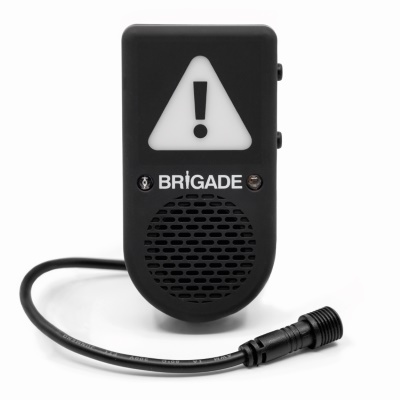 This does not constitute an imminent collision and therefore the driver would not need to receive an audible warning. If the VRU was on a collision path with the vehicle, then a more stringent audible and visual warning alarm should be sounded.
“The new predictive technology is quite unlike systems that drivers have been familiar with and will require the re-education of those who are familiar with the older VRU detection systems.”
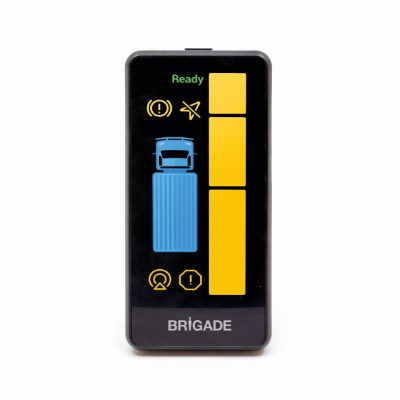
Brigade Electronics’ Sidescan Predict system uses algorithms to predict if a collision is likely by differentiating between static objects like road furniture and moving objects; whether the vehicle is turning or intending to turn; and the speed, position and direction of a VRU.
“The Brigade system doesn’t create false alerts and untrained drivers can be mistaken for thinking the system is not working,” said the company.
“This technology requires a new mindset. The specification requires blind spot information systems to warn the driver if the system is not working correctly. In the event of Sidescan Predict not working correctly, the system will provide a red LED light to warn the driver, providing reassurance.”
The PSS also requires a sensor system at the front, Brigade adds.
 “This was recommended in the [previous] safe permit, but not mandatory and so few operators fitted it. The front system requires two alarms; one when the driver detects a VRU when preparing to move off and one when the vehicle detects a VRU as it has began its forward manoeuvre.”
Brigade further advised: “Vehicles that are approved to UNECE Regulation 151 and 159 will be deemed to comply with the side detection and front sensor system, but operators must be clear that there is a difference between Reg 151 and 159 and DVS requirements. They have different detection areas.
“For instance on the side, Reg 151 allows for a gap of 0.9 metres, whereas DVS requires detection right up to the side of the vehicle. Similarly with the front: Reg 159 allow a gap of 0.8m, but DVS requires detection right up to the nose of the vehicle. The General Safety Regulations (GSR) refer to the whole vehicle homologation and not at component level. Therefore a product that meets 151 and 159 regs may not necessarily meet DVS requirements at aftermarket.”
The firm continued: “The PSS sets out specific test procedures and it is the responsibility of the DVS equipment manufacturer to confirm that products meet the requirements via a ‘sensor functionality statement’. Manufacturers such as Brigade should also provide details on how the products link with other systems and confirm that they do not adversely affect any safety critical aspects or performance of the vehicle. If a product has an E-mark it will meet these requirements.
“The document will need to be uploaded by the operator with the photographic evidence. If there are any non-compliance issues identified at a later date, it will be easily identified from the manufacture used. Fitters will also need to confirm that the sensors fitted to the vehicle are active and fitted in compliance with the technical PSS specification. Brigade Service Partners are professional auto electricians that are trained and approved to fit Brigade equipment. This will help to drive the quality of both product and installation.”