
MAHA UK: why sector is still adjusting to ‘meaningful brake test’
 A year on from the updated Guide to Maintaining Roadworthiness, which set expectations for a minimum of four laden brake tests every year, MAHA UK believes the CV sector is still adjusting. The direction of travel is clear, the company says, but it acknowledges that work is still to be done.
The updated guidance aims to ensure that brakes are assessed under realistic load conditions to reflect on-road performance. A laden roller braker test, a decelerometer with temperature readings and EBPMS are recognised methods.
MAHA UK managing director Neil Ebbs said: “Some operators have moved quickly to embrace the guidelines, while others continue to rely on established, conventional methods that, for now, still meet the required standard.”
There is demand across the sector, says the company, from major fleets to independent workshops. Some OEM networks have already progressed with orders and installations, while large fleet operators are actively exploring the technology. Early adopters are reporting operational benefits, although widespread implementation is still developing.
MAHA UK says some businesses have taken a more cautious approach, insisting that they can still achieve a meaningful brake test by using traditional methods; typically, this is by physically loading vehicles to simulate real-world conditions.
Neil said: “There are many reasons why businesses might be holding back – but experience tells us cost is likely to be factor. That’s understandable too; installing advanced brake testing systems represents a significant capital investment. If businesses already have setups in place and believe they are compliant, why would they change?”
In many scenarios, existing processes, however labour-intensive they may be, are compliant, says MAHA UK: indeed, a vehicle can be loaded, tested and passed, and from a regulatory standpoint, this is sufficient, but this may not capture the full operational picture.
Conventional load-based testing introduces operational challenges, says the company: namely, labour needed to load and unload vehicles, dependence on additional equipment, health and safety management for personnel, exposure to weather and site conditions, and flexibility in how loads are applied.
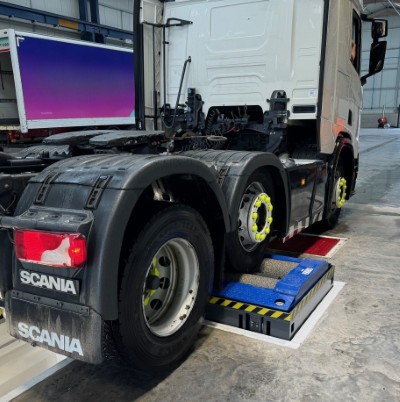 Where operators are utilising newer brake testing systems, the firm contends, they are not only considering compliance, but also bolstering efficiency.
“By applying load directly onto the axle – via a rising roller brake tester, for example – it allows users to achieve consistent, repeatable test conditions, reduce reliance on manual handling, redeploy staff to other important roles and strengthen overall workshop throughput,” said MAHA UK.
“One of the main aims of meaningful brake testing is to improve the quality and consistency of results. By applying weight through physical loading, there is always potential for inconsistencies and errors, especially if loads are not positioned identically every time. The tiniest of variations can affect brake performance readings.
“In contrast, direct axle loading enables operators to apply a consistent proportion of the vehicle’s axle weight – typically a minimum of 65 per cent – in a controlled, repeatable way.”
Neil Ebbs acknowledged: “No test method is perfect. Factors, like brake temperature and real-world operating conditions, can influence results and outcomes. Ultimately, though, the objective isn’t perfection – but improved reliability and repeatability.”
He added: “Those that choose MAHA UK will receive a proven solution, backed by technical expertise, ongoing support and a clear understanding of how CV businesses operate in the real world. It’s not just about supplying equipment; it’s about supporting customers and helping them realise the potential of their investment.”
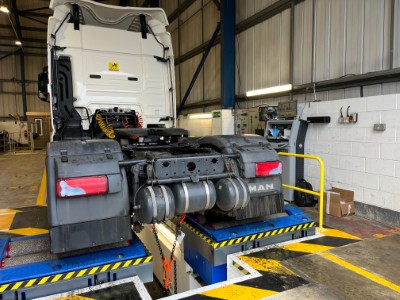
MAHA UK’s MBT 7250 brake tester, compliant with DVSA requirements, features a large roller sensor (100mm diameter) and an axle load capacity of up to 20 tonnes, providing consistent coverage across each tyre. Its robust electronic, temperature-compensated strain gauge system is designed to deliver consistent and accurate measurements across varying conditions.
The MBT 7250’s rising rollers can be lifted up to 250mm to simulate an axle load of up to 13 tonnes, which provides a reliable alternative to traditional laden testing methods, the company says. Additional equipment – such as hydraulic rams or fixed anchor points – may still be required to ensure the necessary load is applied.