
Pullman puts VMU load handling in the spotlight
 Pullman Fleet Solutions has highlighted the role that safe load handling plays within the vehicle maintenance unit (VMU) environment.
“The most useful place to start is with the route each load takes,” said Dave Jones, managing director at Pullman Fleet Solutions.
“Where does a heavy component arrive, where is it stored, and how does it reach the vehicle? This often reveals avoidable movement, poor access, or equipment that is too far from the point of use.
“The safety case is clear. HSE figures show that handling, lifting or carrying accounted for 17 per cent of employee non-fatal injuries reported under RIDDOR during 2024/25. These figures relate to the more serious categories of workplace injury that employers are required to report.
“HSE also estimates that 511,000 suffered from a work-related musculoskeletal disorder during the same period. Musculoskeletal disorders were responsible for an estimated 7.1 million lost working days.
“In a VMU, one avoidable injury can take an experienced technician away from an already stretched team for weeks. It can also leave colleagues covering additional work or delay vehicles that were expected back into operation.”
Poor handling also affects workshop flow long before anyone is injured, says Dave.
“Consider a replacement gearbox delivered before the bay is ready. Without an agreed storage point, it may be left near the work area, narrowing a shared route and making every movement around that bay more awkward. When the time comes to fit it, the correct lifting aid may be elsewhere on site. The technician waits or relies on a workaround, while the vehicle continues to occupy valuable workshop space.”
The answer, he says, is to make load movement part of workshop planning.
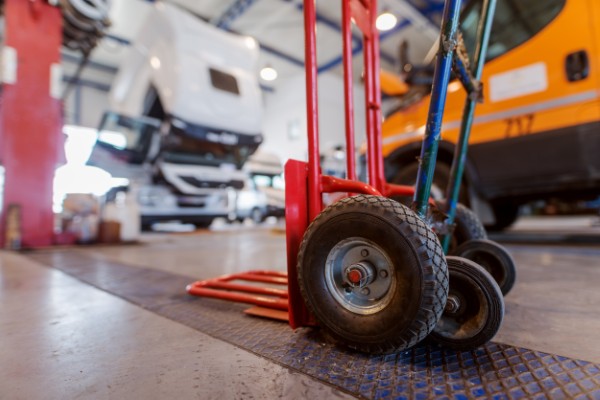
“Heavy components should have a defined route from delivery to installation. Storage needs to be close enough to reduce repeated handling without restricting access around the bay. Frequently used lifting equipment should also have an agreed location, so technicians are not searching for it when work is already under time pressure.
“Pedestrian movement deserves the same attention. A busy VMU creates regular interaction between moving vehicles and people crossing the workshop floor. Where possible, pedestrian and vehicle routes should be physically separated. Clearly maintained floor markings can reinforce the layout, although markings alone should not be relied upon where barriers or other stronger controls are reasonably practicable.
“HSE states that, on average, lift trucks are involved in about a quarter of all workplace transport accidents. The wording refers specifically to workplace transport accidents, rather than workplace accidents generally. This makes vehicle routes, visibility, and supervision particularly important anywhere forklift trucks or telehandlers operate alongside technicians.”
HSE guidance makes clear that manual handling training cannot compensate for a poorly designed task, adds Dave.
“The operation should first be made as safe as reasonably practicable. Practical training can then help technicians identify risk and use lifting aids correctly under normal workshop pressures.
“For employers ready to take this further, Pullman Academy has been developed by technicians, for technicians. Its practical course range includes manual handling. Pullman Academy also delivers accredited forklift truck and telehandler training, giving teams skills they can apply directly in the workplace.”