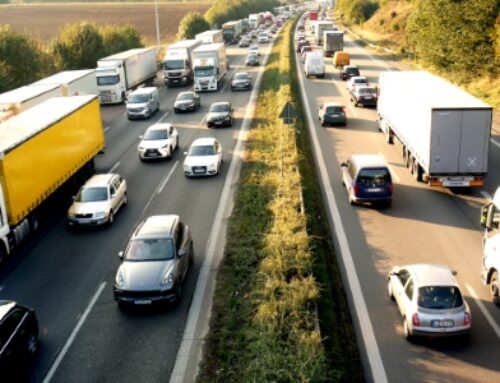

MAN boss: grid spending and policy shifts would aid EV switch
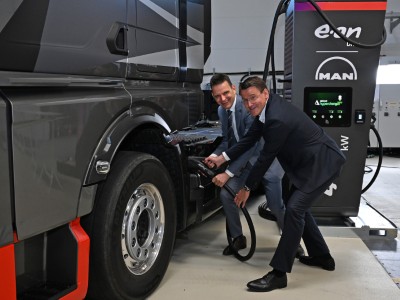
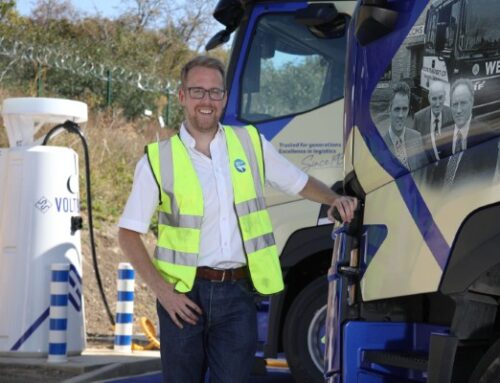
Alexander Vlaskamp (right) offered his perspective on how to aid the EV transition
The UK and other European countries must spend more on their electricity grids to aid the switch to zero-emission transport. So says Alexander Vlaskamp, global chief executive officer at MAN Truck & Bus.
“Unfortunately we’re seeing what I would describe as grid congestion in many European markets at present and there needs to be a step-change,” he told journalists at a recent conference in London. More grid capacity and wider coverage will become essential as the number of battery-powered trucks gradually grows, he believes.
That growth could be muted, however, unless governments take more action at a local and national level. “Things are moving too slowly at present, with electric trucks accounting for just 2.1 per cent of the total European market,” Vlaskamp observed.
Measures he has in mind go beyond direct financial subsidies to operators willing to abandon diesels in favour of their battery-electric counterparts.
“For example, we’re seeing some European cities banning older diesel trucks and Germany and Austria are exempting electric trucks from highway tolls.”
Germany is increasing road taxes on diesel trucks in a bid to cut CO2 emissions and tailpipe pollutants. Vlaskamp would like to see other European countries, including the UK, take the same line.
The first of MAN’s latest electric eTGL 12-tonners are now arriving in Britain. This means that the brand will have a battery-powered range extending up to the maximum permissible gross weight, including 4×2 and 6×2 tractor units as well as rigids.
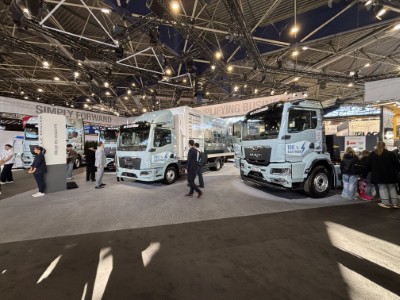 Policies governing permitted gross weights should be made even more flexible in order to favour electric models, he contends. The aim should be to ensure that battery weight does not impose excessive payload penalties and put operators on the back foot compared with rivals who are sticking with diesels.
The high front-end price of electric trucks often deters hauliers from considering them, despite the argument that it should be seen in the context of a competitive total cost of ownership.
“The price is dictated by the cost of the raw materials that go into the batteries, and that’s quite steep, so we will not see a significant fall,” Vlaskamp said.
The lack of publicly-accessible charging stations that can cater for heavy goods vehicles remains an issue, although the position is improving.
MAN is part of the Traton Group along with Scania, and Traton has been co-operating with Daimler Truck and Volvo to set up truck charging stations on key routes in Europe. The joint venture they have established is called Milence, and its first UK site is in Immingham.
MAN has also been working with E.On to install charging facilities at 170 of its service locations.
Under the Spirit-E banner, MAN is highlighting the role electric trucks can play as flexible energy storage systems, allowing them to feed power into the grid or into an operator’s premises. Companies that embrace this approach could reduce their electricity bills by up to 20 per cent, suggests the manufacturer.
MAN saw its European truck registrations suffer a modest decline of getting on for 1 per cent last year compared with the previous year’s total, from 63,655 to 63,296, he reports. The total European truck market declined by 8 per cent in 2025 however, to 336,224, Vlaskamp points out. Overall sales this year should total around 330,000, he forecasts, and MAN’s order intake is up by 35 per cent when compared with last year’s level.
Vlaskamp’s positive outlook is understandably tinged with some concern over the impact the current crisis in the Middle East may have on the global economy and the demand for vehicles.
“We are happy with the steady growth we’ve been seeing, but we’ve witnessed something of a slowdown in recent weeks,” he observed.
The manufacturer plans to increase aftersales support in Britain, says senior vice-president, head of area Europe, Roman Sitte.
“The UK is one of the markets we’re focusing on, and we aim to increase total sales of our vehicles there by 30 per cent by 2030,” he stated.
Eight service points are being added to the dealer network which will see a total aftersales investment of some £35m. It forms part of a £260m investment MAN is making in its European service network over the next four to five years.