

Report: prioritise truck depots for EV grid connections
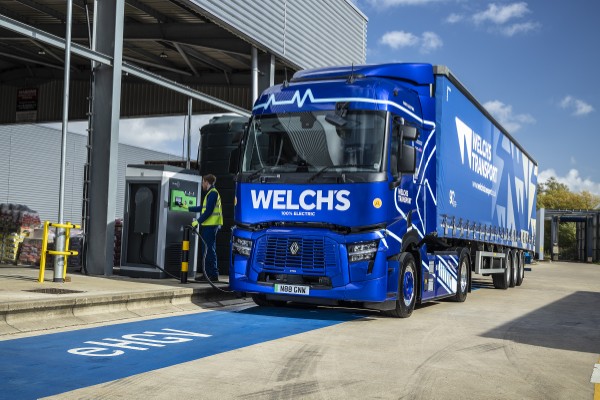 A new report from TwentyForty, the freight infrastructure body established by logistics operator Welch Group, has criticised the criteria by which it says UK grid capacity is being prioritised, warning that transport operators planning to electrify are facing near-decade-long waits for additional power.
While freight depots are being told to wait until up to 2035 for more power, says TwentyForty, data centres using less than a fifth of their capacity remain at the front of the queue.
“The report analysed more than five million half-hourly meter readings from all 96 data centres on UK Power Networks’ distribution network, which serves London, the East and South East of England,” said TwentyForty.
“The typical site drew just 18 per cent of the capacity it had reserved over three years, yet places in the connection queue are allocated on the booked figure, not the real one.
“Freight depots, whose trucks mostly charge overnight when the network is quietest, are queuing for grid upgrades behind reservations that are proven to go largely unused.”
The report acknowledges that the argument about data centre usage could also be turned around to apply to the freight sector.
“A depot connection will also run well below its rating on the meters. Trucks charge overnight, the load is seasonal, and a connection sized for the fleet’s coldest, busiest week sits quiet the rest of the year. If low utilisation were the charge, freight would be in the dock too.”
But the difference, says the report, is what the headroom is for.
“A depot’s spare capacity is a duty cycle the network can see coming: scheduled, overnight, growing on a fleet-replacement curve the operator can put a profile against. A speculative reservation is headroom for a load that may never exist.
“The ask that follows fits both: prioritise on demonstrated or committed load, and claw back what’s booked and never drawn. A depot ramping against a credible growth profile passes that test on its own meters. A paper reservation fails it. The test is the point, and freight should be glad to sit it.”
TwentyForty says that for fleet operators, the timing problem is acute: a depot grid connection takes between 18 and 36 months to build, whereas a truck procurement cycle may take a matter of months. Once the cost of running an electric HGV falls below that of diesel, the report says, a large share of the fleet could switch within one or two buying rounds.
The question that matters for the grid, it finds, is not whether the switch to EV happens, but when and how fast it does – a factor that is largely out of UK control, due to the inroads being made by the Chinese truck manufacturers.
“China’s heavy-truck market is electrifying at a pace nobody outside it has matched: battery and hybrid trucks outsold diesel there for the first time in December 2025, and more than nine in ten of the world’s electric trucks were built in China that year,” said the report.
 “Once a market that size goes predominantly electric, further growth needs export. The export product is a heavy electric truck built at scale on a battery cheaper than the European makers can match, and BYD and Sany are already moving into Europe with exactly that.
“The International Energy Agency reads it the same way: electric-truck total cost of ownership is already competitive in China on falling battery prices and is coming down everywhere else. That’s what pulls cost under diesel and sets the date.”
The report warns that infrastructure can be built before these trucks arrive, or afterwards – but that waiting will be more expensive.
In anticipation of this tipping point, TwentyForty is asking government and the regulator to require electricity networks to offer depots flexible connections, and to recognise the freight sector within the criteria by which projects are assigned strategic grid priority – as well as to give commercial tenants a statutory right to install charging where they pay for it.
The group has also published an Operators’ Guide as a companion to the report, outlining actions that operators with ambitions to electrify can take now, without awaiting policy changes. It includes a one-page summary outlining seven key steps fleets can take, before exploring each of these steps in detail on the subsequent pages.
The guide advises operators to get a budget estimate from the distribution network operator before costing chargers or ordering vehicles, “because the connection is the longest item on any electrification plan”.
The Operators’ Guide also highlights facts TwentyForty says operators may not be aware of: such as that network operators cannot legally refuse to connect a site, and that both the quote and date are negotiable. Flexible connections that make use of the network’s quiet hours can also be requested by right.
While the guide provides advice to help develop workarounds for a problematic connection process, the group says these are not a substitute for fixing the problem – and warns that some isolated sites will never be able to connect in an economically viable way.
Jamie Sands, founder of TwentyForty, said: “The grid is handing its scarcest resource to whoever asks for it first, not those that will use it. Most trucks charge overnight, when the network is quietest, but depots are waiting in a queue for increased grid connectivity behind reservations for capacity that are pure speculation.
“Government has to fix who gets the power and in what order, and the report clearly puts that case forward. However, hauliers cannot put their fleet plans on hold while Whitehall consults. The Operators’ Guide covers what hauliers can control today, while the report deals with what they can’t.”
Both the report and guide can be accessed at the TwentyForty website, here.