
Current trailer under-run protection ‘inadequate’
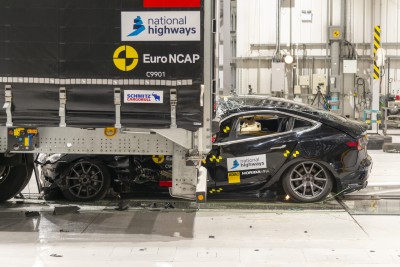
Image: Euro NCAP
Truck operators are being strongly encouraged by vehicle safety rating specialist Euro NCAP to request retrofit under-run protection solutions from trailer makers, after testing found that current European-mandated systems were ineffective in protecting passenger car occupants whose vehicles run into the rear of trailers.
Such collisions could account for around 400 road deaths a year across the EU and UK, the organisation said following the crash tests, which were initiated by National Highways – the body responsible for operating and maintaining England’s motorways and major A-roads – in partnership with Euro NCAP and other European road safety organisations.
Rear-end shunts accounted for 39 per cent of all HGV collisions in 2024, says National Highways, and were the most common type. 18 per cent of all HGV-related fatalities and serious injuries involved a vehicle hitting the back of an HGV.
In the tests, two different commonly used trailers were selected, both fitted with European-regulation UN ECE R58.03 rear underrun protection systems that are designed to protect car occupants in such collisions. In one case, the trailer bed sliced directly through the car passenger compartment, “inflicting fatal head and neck injuries to the crash test dummy”; and in the other, the rear underrun bar failed and the passenger compartment was destroyed.
“Both crash tests showed that the high-performing crash structure of the car could not deform and protect the occupants as designed due to the poor impact resistance of the rear underrun protection structure,” said Euro NCAP. “This reveals that the current R58.03 European regulation could be improved significantly and is currently not fit for purpose.”
The organisation argues that a viable engineering solution that would help prevent such crashes occurring already exists. When the same make and model car was tested against a trailer built to the American voluntary IIHS Toughguard standard, “the guard allowed the car’s safety structure to deform and protect the occupants as designed”.
An estimated 70 per cent of the new trailers delivered in the US since its introduction in 2017 have the system installed.
Euro NCAP has called on EU and UK legislators to implement changes to the R58.03 legislation in order to mirror IIHS Toughguard.
Matthew Avery, director of strategic development at Euro NCAP, said the findings represented “grave cause for concern”.
“We have spent decades improving the safety of passenger vehicles, but those structures and restraint systems are rendered inadequate in the event of a trailer rear underrun, which is why we are seeing such a high fatality rate associated with this type of accident. And that is unacceptable. The legislation behind Europe’s truck and trailer safety needs to be updated as a matter of urgency to help prevent this type of impact that can prove potentially fatal.”
Euro NCAP urged trailer manufacturers “to proactively introduce voluntary upgrades and retrofit solutions for existing fleets that could save lives”.
“Euro NCAP also strongly encourages truck fleet operators to request trailer manufacturers to install retrofit solutions for existing trailer structures to replace the thousands of inadequate, legacy guards currently operating on roads throughout the EU and UK,” said the organisation.
Sheena Hague, director of road safety at National Highways, added: “Collisions where smaller vehicles run into the back of HGVs can have devastating consequences. This testing helps build a clearer understanding of how and why they happen, so we can work with our partners to take practical steps to prevent them or reduce their impact.
“The freight industry is a vital part of our economy, and we work closely with hauliers and others to help keep all road users safe.”
Compounding the problem, separate tests conducted by Euro NCAP revealed that some older passenger car Advanced Driver Assistance Systems (ADAS) were not as good as detecting real HGV rears – such as curtainsider and skeletal trailers, as well as the impact protection vehicles used to shield personnel on live roadworks – as they were in lab tests.