
Emission accomplished
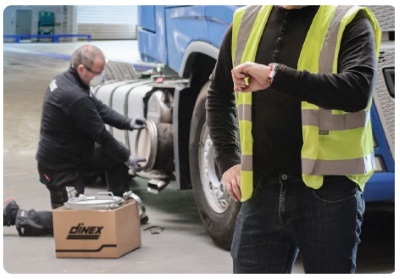 Technology provider Dinex Exhausts Ltd offers its perspective on how fleets can adopt a smart approach to maintaining aftertreatment systems
The introduction of Euro VI in 2013 was an important environmental milestone. Compared to Euro V, toxic nitrogen oxides (NOx) were reduced by 80 per cent, particulate matter by 50 per cent, and finally a limit was included for the quantity of ultra-fine particles.
Type approval procedures were extended to not only lab-tests, but also on-road and in-service conformity tests, to better reflect real-life scenarios.
Compliance called for more advanced exhaust aftertreatment systems (ATS), selective catalytic reduction (SCR) systems were significantly improved, and the introduction of diesel particulate filters (DPFs) was inevitable. Low-leakage decoupling, thermal insulation, sensors and other electronics came along, while integration with onboard diagnostics (OBD) prevented full vehicle functionality at any signs of faulty emission controls.
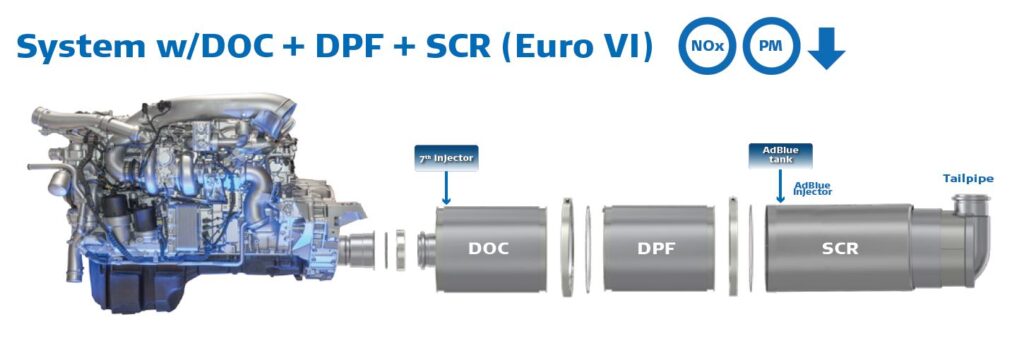 Exhaust systems had evolved from simple pipes and silencers, to miniature chemical processing plants. The technological advancements gave the OEMs an upper hand in terms of serviceability and spare parts, but the independent aftermarket is catching up, offering fleet customers many new advantages and benefits – if you know how to avoid the pitfalls.
The environmental benefits of Euro VI are inarguably one of the most important legislative actions ever taken for bettering air quality. But the new more advanced systems have inevitably also made trucking more costly and complicated for individual fleet owners and drivers. A few examples:
- A heavy-duty vehicle consumes six litres of AdBlue for every 100 litres of diesel, in order to reduce NOX via the SCR catalyst.
- DPFs need regular servicing to prevent excessive back pressure from trapped matter. It takes time, drives costs, and in case of defects the filter should be replaced.
- Diesel oxidation catalysts (DOC) and SCR-catalysts may also be subject to defects and will require replacement to restore full vehicle functionality.
- Temperature-, NOx- and pressure-sensors, commonly referred to as mechatronics, are all sensitive parts which in case of failure will indicate that there is a problem, and limit vehicle functionality.
- Higher grades of stainless steel, thermal insulation, leak-tight decoupling and more sensor connectors, have driven huge cost increases for exhaust pipes.
While it is tempting to find the cheapest way around these added expenses, it is not always advisable. Cutting corners may end up being more costly in the long run, while exposing your business to unnecessary risks.
There are many examples of independent aftermarket suppliers offering Euro VI spare parts and services without truly understanding their functionality or informing customers about the risks of downgrading the quality. As fleet owner, the legal compliance of your vehicles is ultimately your responsibility, and the long-term costs following the use of low-grade spare parts and services will land on your table.
Dinex is a leading global innovator, producer, and supplier to both the independent aftermarket and to some of the world’s leading OEMs – with in-house competences covering all individual components of modern exhaust systems, from catalysts, filters, insulation, decoupling and sensors, to the more regular steel components.
Many of the technical solutions used by OEMs were originally developed and produced by Dinex, but through our aftermarket heritage we also understand the dynamics and cost sensitivities affecting truck owners.
We have developed a range of product programs and services that help Euro VI vehicle owners to achieve substantial cost reductions and reduce vehicle downtime, without compromising quality or performance.
Replacing malfunctioning sensors
A single sensor-failure can cause the vehicle to enter emergency mode due to lack of emission control monitoring. Dinex maintains stock of a wide range of quality sensors for temperature-, NOx- and back pressure measurements. Fast delivery, full compatibility with the OEM’s OBD system and a competitive price level compared to OE, will quickly get you back on the road.
Keeping your SCR system well-functioning, using quality sensors from Dinex and proper grade AdBlue, ensures high performance and increases the lifetime of the whole aftertreatment system.
DPF reconditioning
When it is time to service your DPF, a simple clean will always be the cheapest choice. But it often comes with a price of 24-48 hours of downtime, and even a well-performed professional two-step clean will not remove all glazes of hardened ash that cover the filter’s catalytic coating. This affects the filter’s ability to regenerate and ultimately reduces time between service intervals.
A reconditioned filter is chemically cleaned in a third step, which restores the filters’ regenerative ability. You get longer service intervals, and the process of simply swapping out your old filter with a reconditioned one can be done in less than an hour.
Dinex offers a full range of reconditioned, type-approved filters at an attractive price, and even offers cashback for any returned filters in need of cleaning, as long as they are functional and type approved.
 Consider remanufacturing before buying new
A Euro VI silencer contains lots of expensive technology so in case of failure, replacing the whole unit is a costly affair. Dinex offers its own growing range of aftermarket Euro VI silencers, based on our own type-approved filters and catalysts, with similar quality and performance as originals, but at a competitive price.
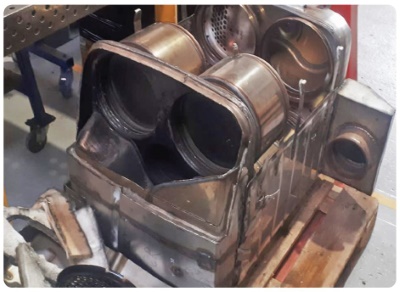
But there are also alternatives. A faulty Euro VI silencer is often the result of a defective SCR substrate or DOC. Most units are not designed to enable the replacement of these elements, but more and more providers of remanufacturing services are offering to cut open, replace the defective substrate, and weld it back together.
Dinex supports the remanufacturing agenda with our full range of type approved substrates and technical guidance for workshops. We are also an active member of remanufacturing bodies, and we welcome this much-needed alternative to always buying new, as a sensible step towards a more sustainable utilisation of our planet’s resources.