
The road to risk reduction
 Richard Kent, president of global sales at VisionTrack, describes how AI video telematics is evolving to transform road safety
Fleet safety and risk remains a huge challenge, with growing pressures on transport operators to prevent collisions and protect vulnerable road users.
Vehicle cameras have been used to good effect for some time, but now with advances in artificial intelligence (AI), there are growing opportunities to further improve driver performance, support duty of care and cut costs.
In the broadest sense, AI is about using machines to perform tasks that would typically have required some form of human intervention and demonstrate behaviours associated with human intelligence. There are two types of technology – edge-and cloud-based – which will see AI become increasingly embedded in video telematics hardware and software.
For edge-based solutions the processing takes place close to the data source, such as a connected camera device, to provide real-time insight, whereas cloud-based solutions collect and process information in a centralised data centre for powerful post analysis.
Advanced AI camera technology
AI-powered vehicle cameras, using Advanced Driver Assist System (ADAS), Driver Status Monitoring (DSM) and Blind Spot Detection (BSD) technologies, are already enabling merchants to maintain safety levels for both their drivers and other road users.
By automatically monitoring hazards on the road and high-risk behaviours, these devices make it possible to provide real-time feedback straight to the driver.
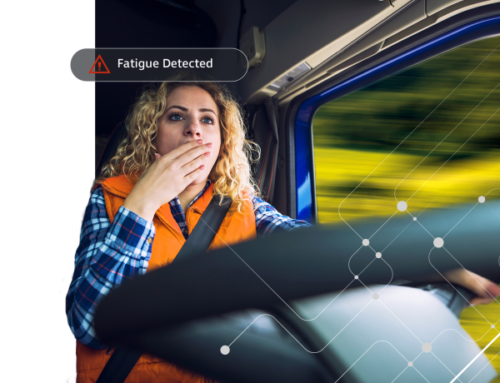
Distractions such as mobile phone use, eyes away from road, smoking, eating and drinking, can be detected alongside other fleet risks, such as fatigue, tailgating and nearby vulnerable road users, so drivers can be encouraged to change potentially dangerous habits.
In fact, in one international deployment of AI-powered video telematics, installed across 16,000 vehicles, there was a reduction in risky driver behaviour of over 80 per cent within the first three months.
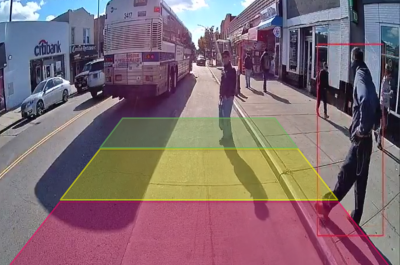 Meanwhile, the latest intelligent detection cameras can now eliminate blind spots around the vehicle and enable complete 360-degree visibility to better protect vulnerable road users (VRUs), such as pedestrians, cyclists or people on scooters.
With configurable safety zones, all angles can be covered, providing the precise location of nearby VRUs in relation to the vehicle. Footage is automatically displayed on an in-cab monitor, and supplemented with an audible, spoken warning. This provides the driver with increased reaction time, while warning other road users of the potential risk.
Traditional proximity sensors warn of a nearby road user, but typically alerts can be triggered by lamp posts, bollards, road signs and bins, which risks the driver becoming complacent and taking less notice of alarms.
Intelligent and high-precision AI detection cameras are suitable for the front, side or rear using deep learning technology to detect VRUs, while disregarding street furniture. They represent a highly effective way of avoiding alert fatigue, by keeping the driver engaged with accurate and useful information.
AI-powered post-analysis
Intelligent vehicle camera systems have proven safety benefits, but they will always be limited by the processing capacity of the device, so it is in the cloud where further gains are being realised using AI. The challenge for many transport operators is simply the volume of video and data that is captured, which makes timely and efficient manual review almost impossible.
Transport operators can use the added insight provided by video telematics to not only respond when a collision occurs, but better understand risk within their vehicle operations and take steps to address issues before they result in a driving incident.
Effective analysis is therefore crucial for any connected vehicle camera solution, yet a manual process – whether delivered in-house or through a third-party service – rarely provides the accuracy or responsiveness to take full advantage.
Due to the size and weight of commercial fleet vehicles, the g-force settings for cameras are highly sensitive to ensure collisions or near misses are picked up. As a result, triggered video can exceed hundreds per day, many of which are false positives caused by speed bumps, potholes and other harsh driving events.
With cloud-based AI analysis, using computer vision algorithms, it is possible to cut through all the noise, so transport operators are presented with the information that requires immediate attention.
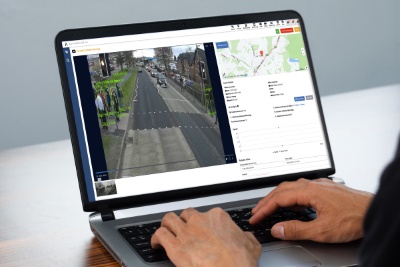 Downloaded footage can be automatically validated in seconds to determine whether a collision occurred – alongside a measurement of the forces experienced within the vehicle to calculate the percentage probability of injury – so fleets can immediately identify if action is required and if a driver needs support.
The ability to quickly evaluate collisions, near misses and harsh driving, without human intervention, supports data-driven safety decision-making and problem-solving.
Using this insight into driver behaviour, transport operators can achieve proactive risk intervention that makes it possible to improve driver performance, reduce collisions and most importantly save lives.
Furthermore, AI analysis can be trained to review any aspect of a transport operation, so can it monitor compliance safety, further supporting the wellbeing of drivers. For example, it could detect where PPE is not being worn; loading and unloading guidelines are not being followed; or where someone is not entering or exiting a vehicle correctly.
The AI evolution
Emerging AI video telematics innovation is going to ensure that operators and drivers can access the right information at the right time. By bringing together complementary AI technologies there is an opportunity to achieve unrivalled, real-time driver engagement, alongside the most accurate, timely and insightful risk monitoring and analysis. This integrated approach will help to mitigate the impact of road, driver and fleet risk.
The ultimate goal is where no one is killed or injured as a result of a transport operator’s vehicle. Currently, work-related road safety accounts for a third of all traffic collisions each year, so there is still a long way to go and AI fleet technology has a significant role to play.