
Tackling disruptions, delays and fines with eLearning
 Laura Nelson, managing director at RTITB, explains how ‘bitesize’ eLearning modules can drive operational benefits
Road transport operations require meticulous planning. Timings are crucial for keeping operations on schedule, and for meeting customer expectations. Transport, haulage, and logistics operators must do what they can to avoid disruption to these plans.
One way to do this is to reduce the likelihood of roadside inspections or incidents that result in delays. This starts with ensuring that drivers have the knowledge and skills they need to navigate the roads correctly, every day. And that is where delivering the right type of training is key.
What type of training has impact?
To train LGV/HGV drivers on certain topics, most organisations will head to the classroom. It is well known that some drivers do not enjoy this learning environment.
Delivering training in the traditional way often means a PowerPoint slide show. This typically includes a lot of information, sometimes too much. Some of it irrelevant. Sessions may be long, leading to boredom, loss of attention, and a lack of engagement. This breeds contempt for training among drivers and continues a cycle of disengagement.
The result? Training fails to make an impact where it matters. Just because drivers have ‘sat through’ a course, it doesn’t positively impact their behaviour.
For example, drivers’ hours and speeding are two of the most commonly delivered topics in Driver CPC Periodic Training. Yet five per cent of drivers are still committing drivers’ hours infringements; on 30mph roads, 42 per cent of rigid LGVs/HGVs, and 46 per ent of articulated LGVs/HGVs exceed the speed limit. 17 per cent of road accidents are caused by drivers/riders being in a hurry or reckless.
These statistics show how important it is to continue to raise awareness of key safety issues through training, and why organisations must look at why their current approach may not be working.
The benefits of bitesize eLearning
Following the pandemic, many more organisations are familiar with eLearning or self-paced online training as an alternative to classroom-based courses. But bitesize eLearning is a little different.
It includes a series of very short, highly focused learning interactions. Sessions of 2-10 minutes cover the core information only. Though, there is often optional additional information for the learner if they want it.
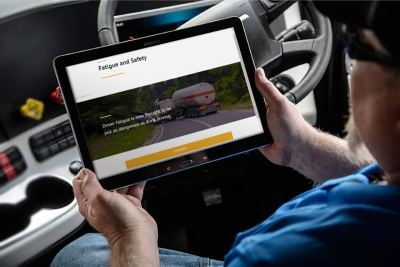
These short sessions are standalone, and can be completed in any order, as and when required, at the speed determined by the learner. They can be accessed via any online device, such as a computer, tablet, or smartphone, making them ideal for mobile learners, such as LGV/HGV drivers.
Engaging drivers differently
With a self-paced bitesize approach to training, learners get just the information they need. When information is delivered in small bites, research suggests that retention rates can improve by 50 per cent. As there is less information overload, learners may also be 50 per cent more engaged in training.
This suggests that the way people learn is changing. It is reported that only 58 per cent of what is learned in a traditional training session is retained 30 minutes after the course ends. As attention spans seem set to decrease year on year, could a ‘bitesize’ approach to eLearning therefore be better for LGV/HGV drivers?
 eLearning brings business benefits
A big benefit of eLearning is that it can take place anywhere, anytime. This means drivers do not have to be in a training room for hours or days. For the employer, this offers the benefit that training can be fit around operational needs, and drivers can be on the road, doing what they do best.
With flexible eLearning, there is no excuse to overlook focused training interventions during busy times. There is an efficient way to help drivers improve. And as drivers develop their skills and knowledge, it can also help your business go from strength to strength. Where drivers are more receptive to learning, you may see productivity increases because your driver’s performance improves.
Addressing driver compliance
When driver knowledge and compliance is improved through eLearning, this can help to reduce the risk of incidents. This has a number of positives. As well as protecting people and preventing delays, it enables businesses to significantly reduce costs. For instance, fleet maintenance costs are lower and insurance premiums are driven down.
Businesses also need to retain customers and keep them happy. Every delayed delivery due to a driver compliance issue can be damaging to the customer relationship. Better driver knowledge and skills can lead to fewer incidents and fewer delays.
This can give your business the confidence that deliveries will be made on time, helping keep your customers happy. Excellent drivers reflect well on your business, and they also show you are a reliable and responsible logistics provider.
To help logistics, haulage, and transport businesses to put the benefits of bitesize eLearning into practice, RTITB recently launched a new Driver Compliance eLearning programme. It is designed to help businesses deliver engaging, time-efficient training to drivers around key safety and compliance issues.
Investing in training such as RTITB Driver Compliance eLearning can also impress the relevant regulatory bodies. Better driver compliance can have a positive impact on your operator compliance risk score (OCRS). This shows you and your drivers follow the rules on both roadworthiness and traffic.
So, when your business is next considering how to prevent roadside disruptions, make a positive impression on regulatory bodies, and improve your customer service, be sure to consider the role that LGV/HGV driver training should play. And the potential benefits you and your drivers could gain with a bitesize eLearning approach.