
Electric truck makes first international delivery via Eurotunnel
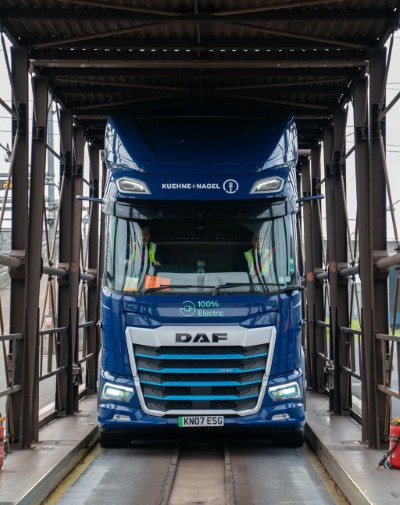 The first commercial electric truck Channel crossing via Eurotunnel marks a significant milestone in the development of zero-emissions transport, but also indicates that there is significant progress still required before it could become economically viable.
A DAF XF Electric, supplied to Kuehne+Nagel under the Zero Emission HGV and Infrastructure Demonstrator Programme, took two days to carry 12,000 kg of groupage from the East Midlands Gateway (junction 24 of the M1) 566 miles to the operator’s depot at Haiger, near Koln in Germany. Like many such groupage loads, the trailer ‘cubed out’ before it ‘weighed out’.
The truck was double-manned and required four charging stops to complete the journey. Having left the East Midlands Gateway fully charged, the truck replenished its batteries with a 25-minute ‘snack charge’ at Gridserve’s premises in Stevenage, then an hour-and-a-half at the Milence facility at Dunkirk after a Channel Tunnel crossing that involved media photocalls but was otherwise uneventful.
It then set out on the longest leg of the journey: 170 miles to another Milence facility in Maasmechelen, Belgium, where it charged for about an hour and a half before driving 61 miles to an Autohof in Koln for the overnight stop 100 miles from its destination.
The next morning, the truck stopped 40 miles into the journey to replenish its batteries at Aral Bad Honnef: a strategic recharge that would give it enough power to complete the 40-mile journey to Haiger, then travel 140 miles of the return journey to Milence Maasmechelen.
The return journey, again via the Channel Tunnel, was uneventful. It is estimated that in normal circumstances (without the photocalls) this journey will be achievable in a single 21-hour double-manned shift.
Taking an electric truck on Eurotunnel confirms a significant improvement in the perception of the safety of battery-electric trucks. Indeed, it can be argued that the DAF’s LFP batteries present less of an environmental and safety hazard than 1,000 litres of diesel. There is also the obvious advantage of zero tailpipe emissions from the truck.
However, the times spent charging and the consequent need to double-man the truck to complete the journey in a realistic timeframe add significantly to the cost of the journey, and the price of electricity from public chargers can be significantly more than that at home depots, eroding the price differential from diesel. The much higher front-end price of the truck also must be taken into account, although this can be offset by lower servicing costs.
The journey makes a convincing case for the practicalities of using an electric truck for international haulage, but the economics still require considerable work. Greater availability of chargers, so the truck could be charged during its overnight stop rather than making the additional stop at Bad Honnef, would improve journey times.