
The Handbook Group: how transport training is changing
 The Handbook Group has outlined its perspective on how shifting expectations around access to key information are changing the way transport sector employees learn.
“For many years, transport training has followed a familiar pattern: a classroom, a trainer, a PowerPoint slide deck, paper handouts and a long list of rules telling drivers and managers what they should or shouldn’t do,” said the company.
“While traditional classroom training has an important role to play, particularly for practical skills or to meet regulatory requirements such as Driver CPC, the way people consume information has changed significantly. Today’s drivers expect information to be accessible, relevant and available when they need it. As a result, the sector is moving away from one-off training events towards continuous learning delivered through digital platforms.”
The challenge facing operators is that compliance expectations are increasing while available time is becoming more limited, says The Handbook Group.
“Drivers, technicians, warehouse staff and managers are all expected to keep up with changing legislation, industry best practice, company procedures and customer requirements. Trying to deliver all of this through occasional classroom sessions is no longer practical.
“Instead, a more flexible approach is being adopted based around shorter, more digestible learning.
“Toolbox talks are a good example. Rather than requiring staff to absorb large chunks of information in a single session, toolbox talks provide regular, focused awareness on specific topics as they’re needed. Subjects such as vehicle checks, load security, vulnerable road user safety, speed management, fatigue, and mental wellbeing can be delivered in bite-sized chunks that are easier to understand and retain. The programme can flex throughout the year depending on operational challenges, incident trends or regulatory changes.
“At The Handbook Group, we see this first-hand through our annual toolbox talk campaign programme, where operators deliver our monthly safety and compliance briefings, ensuring key messages are reinforced throughout the year.
“This approach reflects what we know about adult learning. People are far more likely to remember information that is relevant to their role, delivered regularly and reinforced over time.”
The content itself is changing too, the firm adds.
“Historically, transport training often relied heavily on lists of instructions and rules. While compliance remains essential, modern training increasingly focuses on attitudes, behaviours and decision-making. Rather than simply telling people what they must do, effective training helps them understand why it matters.
“Most drivers know the rules around mobile phone use, speed limits and impairment through drugs and alcohol. However, the challenge is influencing the attitudes and behaviours that determine decision making. Today’s training needs to place greater emphasis on risk awareness, personal responsibility and understanding the consequences of poor decisions.”
Online learning platforms allow organisations to provide self-paced training that is accessible and fully traceable, says the company.
“New starters can complete induction programmes in the early stages of their employment. Existing employees can access refresher training when required. Managers can track completion, monitor progress and maintain a clear audit trail for compliance purposes.
“Importantly, digital learning also allows organisations to deliver training that is specific to their operation, rather than relying solely on generic content. Every transport business faces different risks, works with different customers, operates under different procedures and serves different routes. The ability to tailor training to reflect those realities can significantly improve engagement and effectiveness.
“This has led to the growth of learning management systems that combine ready-made content with tools that allow organisations to develop their own material. Managers and trainers can create training modules covering company procedures, customer requirements, incident learning and operational changes, ensuring that knowledge remains current and relevant. A toolbox talk can be created in minutes, published in seconds and distributed instantly, wherever staff are located.”
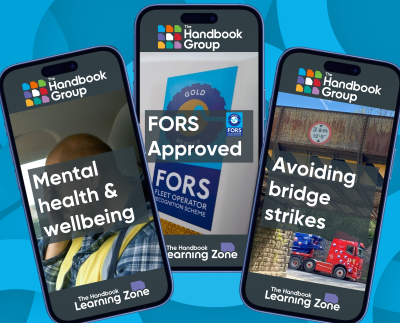
This approach sits at the heart of The Handbook Group’s Learning Zone, a facility that combines a growing library of transport and logistics training modules with the ability for operators to create and publish their own company-specific eLearning content. It enables organisations to move beyond generic training, says the firm, and build learning programmes that are relevant to their operation.
“Operators are increasingly using digital platforms to deliver ongoing compliance training and complement formal qualifications such as Driver CPC. Drivers can now complete up to 12 hours of their 35-hour periodic training requirement through approved online courses, allowing learning to take place at a time and location that suits both the driver and the business.
“Operators are now using eLearning alongside their Driver CPC programmes, allowing drivers to complete approved online modules in advance and arrive better prepared for classroom discussion and practical learning activities.
“Abbey Logistics has successfully integrated digital learning into its wider Driver CPC programme, helping reinforce key messages beyond the classroom environment. The approach enables underpinning knowledge to be covered before the course takes place, allowing classroom sessions to focus more on interaction, discussion and practical application.”
The Handbook Group emphasises the importance of considering accessibility.
“The transport sector employs a diverse workforce, with many organisations relying on employees whose first language is not English. If training is to be effective, it must be understood by everyone who receives it. Digital learning platforms can incorporate accessibility features such as translation, text-to-speech and flexible content formats to remove barriers to learning…
“The recent launch of The Handbook Group Web App has further expanded access to learning by incorporating features such as text-to-speech and on-screen translation, helping organisations communicate more effectively with diverse workforces and ensuring important messages are understood by all employees…
“The Handbook Group’s experience in developing training programmes that cover work-related road safety, decarbonisation, health and wellbeing, alongside its growing library of FORS Approved eLearning modules, has shown that organisations increasingly value training that is relevant, accessible and tailored to their operation.”