
Total Compliance: why awareness training cannot wait for the regulator
 Training and consultancy provider Total Compliance has warned that Operator Licence Awareness Training is a practice best conducted at the start of a fleet operator’s journey, rather than at the end of a public inquiry.
The company cites last year’s annual report by the traffic commissioners to the transport secretary, which made a pointed intervention on a group of operators that rarely features in enforcement headlines.
“Among over a thousand public inquiries determined during the reporting year, the commissioners drew attention to restricted goods vehicle licence holders, pressing them to take active steps to understand and meet the obligations attached to their licences,” observed Michelle Scott, director of Total Compliance.
“The reason was structural: unlike their standard-licence counterparts, restricted operators are not required to appoint a transport manager holding a Certificate of Professional Competence. The professional knowledge that a CPC holder brings to a standard operation has no equivalent on a restricted licence, and the report’s recurring themes – weak maintenance regimes and a widespread misunderstanding of periods of grace – reflect precisely the gap that absence creates.
“The operators who get into trouble are very rarely cutting corners on purpose. They simply don’t know what good looks like, because nobody has ever shown them. On a restricted licence there is no transport manager carrying that knowledge, so if the operator hasn’t been trained, it simply isn’t there.”
Operator Licence Awareness Training exists to close that gap, says Michelle.
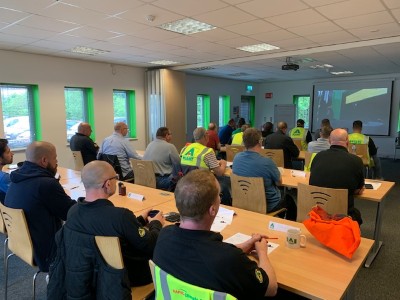
“The course is designed for the people who hold and administer the licence rather than for the drivers who operate under it, and it grounds the undertakings an operator signs at the point of grant in practical, operational terms. Participants work through the maintenance standards the traffic commissioner will expect to see evidenced at inquiry: how inspection intervals should be calculated against the age and usage profile of the fleet, why a walkaround defect check is only as valuable as the reporting and rectification process behind it, and where responsibility for roadworthiness sits when maintenance is outsourced. The aim is not regulatory literacy in the abstract but the ability to run systems that withstand scrutiny.

Michelle Scott of Total Compliance
“The distinction between training drivers and training the operation is one the sector has been slow to draw. Drivers hold their own vocational qualifications and complete periodic training on their own cycle. The compliance gap more commonly sits with the people around them: the licence holder whose name appears on the undertakings, the operations manager who books maintenance intervals, and whoever is responsible for record retention. On a standard licence, the transport manager fills that role by requirement. On a restricted licence, these responsibilities are distributed informally, and the individuals carrying them may have received no structured training in what the role demands.
“I had an operator on a course last year who had been inspecting his vehicles on the same fixed interval for years, without ever realising it was too long for the work those vehicles were actually doing. He wasn’t being negligent. He’d simply never been told. That is exactly the sort of thing a day in a classroom catches, and it catches it long before a DVSA examiner does.”
The cost of delaying that training is well documented in the commissioners’ own caseload, Michelle adds; traffic commissioners regularly direct operators to undertake awareness training as a formal condition following a public inquiry, at which point it is completed under the pressure of regulatory sanction and with the future of the licence already in question.
She concluded: “The operators I never see at a public inquiry are, almost without exception, the ones who invested in training their people early. A day in a classroom is not a grand gesture. It is simply a great deal less expensive than a day in front of a traffic commissioner.”
Total Compliance is a nationwide specialist in operator licence compliance for the HGV and PSV sectors. Its services include Operator Licence Awareness Training and FORS accreditation support.