
Steertrak turns the spotlight on misalignment
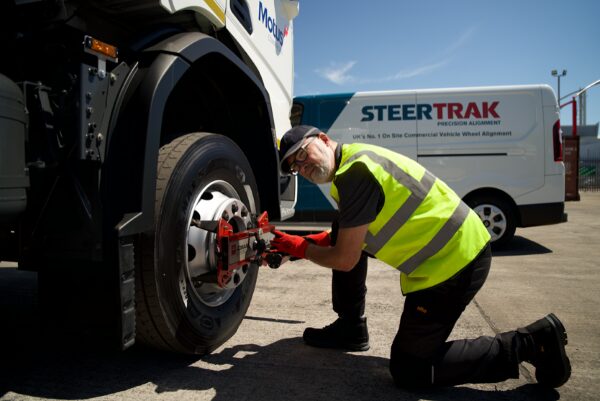 Mobile CV wheel alignment specialist Steertrak UK has highlighted the opportunities for fleet optimisation that the procedure can present.
Many fleet operators view wheel alignment as an expense, which is understandable, says Jeremy Krantz, Steertrak UK managing director.
“Unlike a fuel invoice or a tyre replacement bill, the waste caused by misalignment never appears as a single, identifiable cost. Instead, it accumulates quietly – through increased rolling resistance, higher fuel consumption, accelerated tyre wear, premature component failure, and unnecessary emissions,” he said.
“If a commercial vehicle had a visible hole in its diesel tank, no fleet manager would allow it to leave the depot. Misalignment is essentially a mechanical leak. Because the money drops out of the bottom of the budget slowly over thousands of miles, the financial damage is often done before the symptoms become obvious.”
Alignment is most commonly encountered as a reactive repair cost, says Jeremy – something addressed after a driver complains or an inspection reveals advanced tyre feathering or rapid shoulder wear.
“In reality, it is a major cost-recovery opportunity. Carrying out thousands of commercial vehicle alignments every year across HGV, PSV, and LCV fleets throughout the UK, we notice a clear pattern: operators invest significant resources into analysing fuel telematics and managing tyre contracts, but it is easy to treat vehicle geometry as a standalone mechanical issue rather than a core variable that directly influences both.
“Commercial vehicle alignment is not a simple wheel-to-wheel tracking check. It is the precise measurement and correction of every axle’s geometry relative to the chassis centreline – the fixed reference point for the entire vehicle. When any axle deviates from that centreline, vehicle efficiency is compromised.
“When geometry is incorrect, tyres no longer roll cleanly. Instead, they scrub, generating a continuous lateral force against the road surface. This increases rolling resistance, forcing the engine – or motor – to work harder.
“The consequences extend across the whole vehicle. In severe cases, when drive axles are not square, or trailer axles drift, the vehicle will crab – running at a slight angle to its direction of travel. Even at minor, less visible levels of deviation, the driver must constantly make small steering corrections. Tyres scrub, and unnecessary stress accumulates across kingpins, tie rods, wheel bearings, and suspension components. The vehicle may still feel acceptable to drive, but every mile can quietly build costs across tyres, parts, and fuel simultaneously.”
One of the most consistent observations Steertrak makes in the field, says Jeremy, is that alignment is frequently treated as an afterthought, simply because it is easy to assume it is being handled elsewhere.
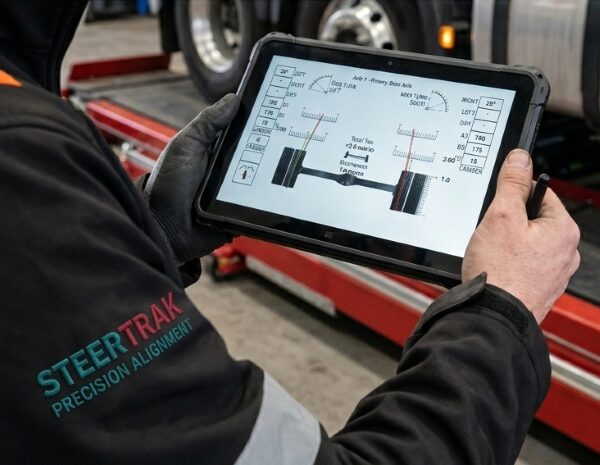 “Operators might assume it is checked during routine servicing. However, standard commercial inspection schedules do not include precision, multi-axle geometry measurement. Others might assume it forms part of an MOT. It does not. Many might assume that when a workshop fits a new ball joint or track rod end, the vehicle is automatically realigned. In practice, this is a separate task that is sometimes overlooked.”
Another common myth, he adds, is that factory-new vehicles do not need checking.
“While manufacturers set alignment to certain tolerances during production, final body configuration, operating conditions and component settling during the first few weeks on the road can alter those angles. Our work verifying new fleet deliveries shows that a surprising percentage of brand-new vehicles can benefit significantly from early correction.”
He added: “Whether a vehicle runs on diesel, HVO, or electricity, the laws of physics remain identical. Misaligned wheels create energy-wasting resistance. For operators facing intense pressure to reduce their environmental footprint right now, optimising the existing fleet is an immediately accessible lever. It requires zero capital expenditure on new assets, no infrastructure investment, and minimal operational disruption.
“Furthermore, as heavy electric CVs enter fleets, their increased unladen weight and high torque characteristics mean that incorrect alignment has the potential to accelerate tyre degradation even faster than on a diesel equivalent.”
Increasingly, forward-thinking fleets are moving away from reactive tracking fixes and implementing scheduled, fleet-wide alignment policies as a standard maintenance tier, says Jeremy.
“With the current state of UK road infrastructure, vehicle geometry is under constant pressure. Potholes, kerb strikes, heavy loading cycles, and routine component wear all take their toll… The question isn’t whether geometry will drift, but whether it is caught on a scheduled basis before the costs accumulate.
“When operators weigh the modest cost of a structured, proactive alignment programme against the cumulative waste in tyres, parts, and fuel, the financial case makes itself.”