
Stability by design with Sampa
 As part of the Sampa Otomotiv Group, Sampa UK & Ireland says it can supply OE-equivalent chassis components designed for high-load endurance, dimensional stability and predictable wear behaviour. The engineering focus is consistent, says the firm: maintain geometry under stress, control unwanted movement, and extend service intervals without compromising safety margins.
“In UK haulage, chassis systems are not judged in controlled conditions; they are judged over kerb strikes, overloaded axles, constant braking input and millions of load cycles,” said the company.
“Axles, steering and suspension do not just support the vehicle; they define tyre wear, driver fatigue, stability and ultimately cost per mile.
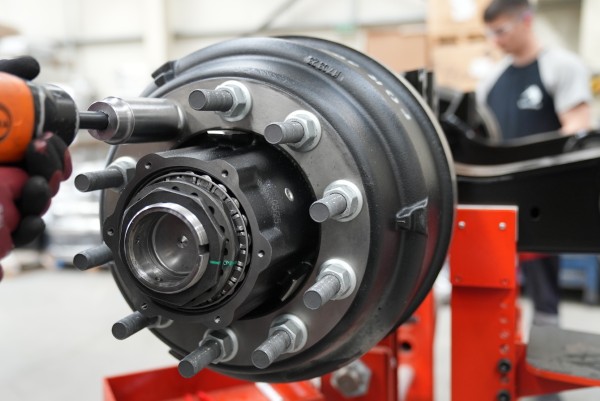
“Axle assemblies act as primary load carriers, managing vertical mass transfer, braking torque and longitudinal forces simultaneously. Sampa axle components use high-strength steels with controlled heat treatment to maintain yield stability under repeated peak loading.
“A key failure driver in heavy-duty operation is micro-deflection at load points, which gradually alters geometry and accelerates uneven tyre wear. Sampa designs focus on alignment retention under cyclic stress, reducing progressive camber and toe deviation across service life.
“Improved corrosion resistance at load interfaces is critical in UK conditions, where salt and moisture accelerate fatigue initiation. The result is reduced structural drift, helping fleets maintain predictable tyre wear and reduce premature alignment correction cycles.”
Steering systems in heavy commercial vehicles are exposed to constant oscillation from axle movement, braking transfer and road feedback, says the firm.
“Sampa tie rod ends and drag links use precision-machined ball studs and hardened seating interfaces to reduce radial play under load.
“Sealing systems retain lubrication while excluding abrasive contamination, a major cause of joint degradation in fleet use. This delivers more consistent steering response, reduced drift and fewer corrective alignments over longer service intervals.
“Torque rods and V-arms manage longitudinal axle movement under acceleration and braking. Without control, these forces transfer into chassis flex, driveline misalignment and accelerated bush wear. Sampa components use bonded rubber-metal interfaces engineered to absorb torsional load while maintaining positional stability. This reduces wind-up, improves axle tracking consistency and supports stable handling in multi-axle and articulated applications.”
The Sampa 250T and 300T air suspension systems are designed for sustained heavy-duty operation where fatigue and bushing wear define service life, says the company.
“The focus is controlled stiffness and predictable damping rather than soft compliance that deteriorates under repeated cycling.
“Lower spring rates combined with high-capacity air springs operating at reduced pressures improve load absorption while maintaining stability under variable payloads. A rigid trailing arm with solid axle connection reduces wind-up, preserving geometry under braking, acceleration and cornering. This limits stress transfer into the wider chassis over high-mileage cycles.
“Large-diameter dampers provide controlled energy dissipation during high articulation events, reducing oscillation transfer into chassis and load body. Premium bonded bushes improve resistance to deformation and thermal stress, slowing wear that typically drives early suspension refurbishment.”
Manufactured using robotic welding and controlled assembly processes, the 250T and 300T platforms are engineered to exceed typical OE fatigue thresholds, it adds.
“Reinforced air spring top plates distribute load more evenly, reducing peak stress during maximum axle loading and repeated cycling. Integrated ABS compatibility ensures consistent interaction between braking and suspension under dynamic load transfer. This improves stability during emergency braking, uneven surfaces and rapid directional changes, supporting predictable handling in real-world fleet conditions.”