
Electrification in the spotlight at annual Fleet Engineer conference
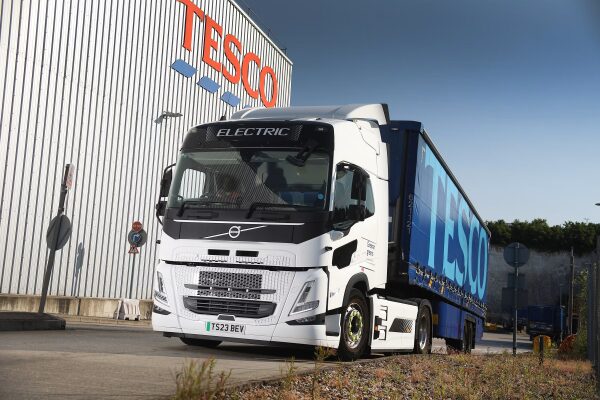
Tesco was among the major fleets represented at the panel discussion on electrification. Image: Volvo Trucks
The practical realities facing fleet engineers tasked with transitioning their operations to zero-emission vehicles were a recurring theme at Logistics UK’s recent 2026 Fleet Engineer conference, hosted at the British Motor Museum in Warwickshire.
Lamech Solomon, the head of decarbonisation policy at Logistics UK, chaired a discussion between representatives from three very different organisations: the AA, Tesco, and Welch Group.
Tesco fleet engineering manager Cliff Smith said his company was committed to converting its entire light commercial fleet to zero emissions by 2030, with heavy trucks to follow five years later.
Currently over 2,000 of its 5,500 home delivery vans were zero-emissions.
Tesco had a long history of alternative fuel trials, starting with the dual-fuel trucks of the 2000s which had proved unreliable. It has since used B50, LNG, CNG and HVO fuels, and is now trialling electric trucks with the support of a government grant.
“We have a big intake of rigid electric trucks and are looking at ground vs overhead charging at our RDCs,” Cliff Smith reported.
Jamie Sands is head of solutions at family-owned haulier Welch Group, founder of the TwentyForty organisation (Transport Operator, June) and a prominent protagonist for electric trucks.
He said that Welch Group had already purchased its last diesel-powered rigid.
“We will use HVO fuel in diesel trucks if the customer wants it; biofuels are a way to start on decarbonisation now.
‘Hydrogen is a complete non-starter, but EVs are the path of the future,” he opined.
“Most EV issues are operational rather than technical and it is the direction of travel now. Rigid EVs are doable now: the low-hanging fruit. Long-haul and heavy loads are more difficult.”
AA fleet manager Samantha Biggs said she had 80 trucks running on HVO, but was committed to EVs.
“We have to put the customer first,” she cautioned.
Electric vans had been put into the AA’s patrol fleet, but payload was an issue for vans carrying the AA’s compact recovery trailers. They took advice from Ford on how the vehicles were best operated and asked for volunteers to try the vans from their pool of patrol drivers.
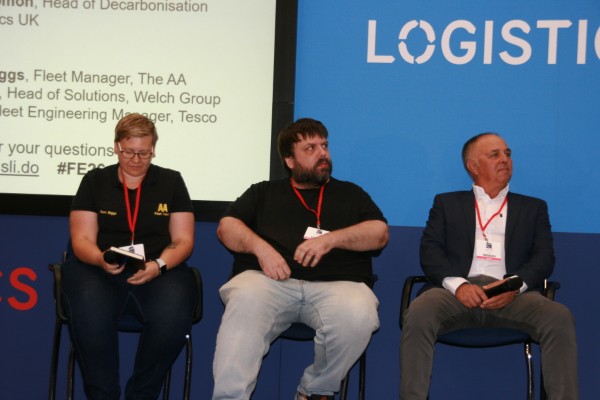
From left to right: Samantha Biggs of the AA, Welch Group’s Jamie Sands and Cliff Smith of Tesco
Jamie Sands said once drivers had tried an electric truck they were reluctant to switch back to diesel, but there were huge differences in driver performance. Trained drivers could get 30 per cent more range out of their vehicles than the untrained.
Cliff Smith reported that Tesco drivers were originally sceptical “just as they were with the first mirrorless trucks”.
But once they have tried electrics, drivers are completely on-board with them, he said.
Driver training from manufacturers is required: “at very least they must ‘train the [Tesco] trainers’.”
The biggest hurdles to overcome were in infrastructure. Tesco had employed experts to deal with planning issues.
“We are focusing on distribution centres where electricity will work on all routes and there is adequate grid power. Ground chargers will take parking spaces away, so we have looked at the bus industry for charging solutions that do not involve working with ground chargers. You need to talk to the distribution network operator to find out if power is available.
“We may eventually use hydrogen in locations where it is not, but this may be hydrogen combustion engines rather than fuel cells.”
Choosing the right charger was vital, said Jamie Sands.
“A megawatt charging system can charge an artic in 30 minutes. Voltempo offers a 1MW charger with six outlets and dynamic power output, so you can charge a single truck fast or multiple vans slowly.”
But he emphasised that operators seeking to electrify faced a massive postcode lottery with connections.
“The issue isn’t the vehicles, it’s the infrastructure. Not everyone will get a decent connection to their depot.
“Engagement with landowners can also be difficult.”
Cliff Smith said that Tesco had originally been quoted an eight-figure price for a connection by its DNO to one site, but one year later paid a six-figure sum.
Samantha Biggs said the AA had put van chargers into its patrol drivers’ homes so their vans could be charged while they were off-duty, but had to make sure the drivers were not left out of pocket.
Both Tesco and Welch Group were looking at ‘growing their own’ electricity.
“It’s a dynamic situation,” Jamie Sands reported. “We are in the process of installing batteries, expanding renewables and turning depots into energy centres. We are starting to look at selling energy back into the grid. Transport companies will start having energy managers alongside HR managers etc.
Cliff Smith added that Tesco was looking at ways of transferring energy from one vehicle to another, and already had batteries to store electricity at two sites with insufficient energy supply.
“Systems must ensure that vehicles are charged when needed.”
Jamie Sands discussed the case for trucks having detachable batteries. “You will need more batteries than you have trucks,” he pointed out.
“The OEMs are resistant: you can’t even get them to agree to put charger sockets in the same place, let alone share battery designs.
“But detachable batteries would be great if your site had energy constraints. Octopus Energy is working with CATL on this [page 11], and it will work if you have a one-make fleet.”
He argued that pioneering electric trucks had been a win for Welch Group. “Revenue is up 30 per cent in 10 months because we are sustainable. We are winning business from larger rival companies. But this won’t last for ever, because electrics are going to become the norm,” he warned.
Cliff Smith said that Tesco purchased its vehicles outright. The capital requirement was higher for EVs, but the premium was less than it had been.
“If you don’t include the chargers, vehicle prices are now quite close.
“Chinese electric trucks are coming. Will that force the Europeans to go cheaper?” he asked.
He was concerned that there was a gap as far as electric 6×2 tractor units were concerned.
“Electric power may fail here unless there are legislative changes, and hydrogen combustion won’t come until after 2030,” he warned.
Jamie Sands dismissed hydrogen. “Electricity is the future for all industries. The technology is only going to get better. Anything other than electric is purely a transition. We are close to getting electric as the solution for everything.”
Samantha Biggs agreed that: “All roads lead to EV, but we need a mix of fuel types to get the range to attend breakdowns. Infrastructure is important. Our heavier recovery trucks are double-shifted and so are difficult to charge, while the vans are charged when the drivers are off-duty.”
Looking at the politics, Jamie Sands wanted a government body appointed to oversee the transition and get all the players pointing in the right direction.
Cliff Smith said that Tesco had to plan 10 years ahead, and needed political certainty to enable decision-making.
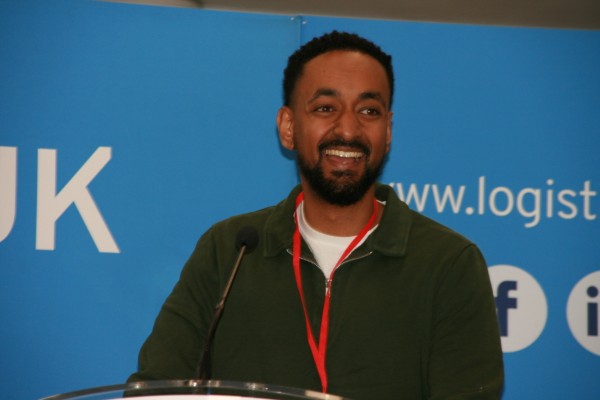
Logistics UK’s Lamech Solomon chaired the discussion
Discussion chairman Lamech Solomon pointed out that 10 years might seem a long time in politics, but was only two-and-a-half vehicle replacement cycles for operators.
Cliff Smith urged operators to make their own decisions: “Look at all options. What works for Tesco might not work for you.”
Jamie Sands’ advice was to the point: “Just start. Get an electric vehicle. A rigid on short-haul.”
Samantha Biggs said: “Start with the data, understand what the operation has to deliver, look at vehicle use, then find a vehicle to fit.”
Lamech Solomon asked about the engineering experience of going EV. Jamie Sands said that battery degradation was lower than expected, while Cliff Smith said that while some franchised dealers were “fantastic with EVs, others are not quite there”.
Welch Group did not distinguish EVs from diesels when it came to routine maintenance such as PMIs, Jamie Sands said. “But they need less work. Thirty per cent savings in maintenance costs are possible, but we don’t see this in the manufacturers’ pricing for R&M.”
Tesco’s oldest electric truck was four years old, and it had been maintained as a diesel, said Cliff Smith.
“The electric vans don’t wear out brakes, but we do see driveline components failing because of their increased torque,” he warned.
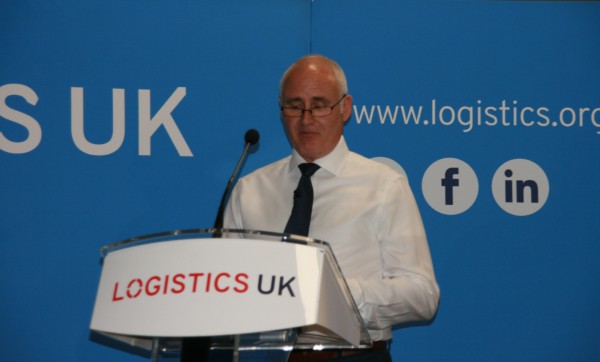
Logistics UK’s Arthur Gribbin
The successful electrification of the road transport sector will require a drastic revision of UK weights and dimensions regulations, according to Arthur Gribbin, the engineering policy lead at Logistics UK.
Speaking at the conference, he pointed out that the technology was now moving from the trial phase to deployment, but from a UK perspective payload loss remained a significant barrier.
“The two-tonne increase in permitted gross weights helps some, but unchanged axle weights, particularly on the drive axle, stops many,” he said.
“The drive axle tops out at 11.5 tonnes irrespective of the increase in GCW. The batteries rob between four and 10 per cent of a truck’s payload and the battery weight sits mainly on the drive axle.”
Using bulk milk collection as an example, he pointed out that 34.5 tonnes GVW was the maximum for a 4×2 tractor and tri-axle trailer irrespective of the theoretical limit of 42 tonnes. This would mean more trips would be needed to do the same work.
“So operators delay switching, and more vehicles will need to be purchased and more trips made when they do.”
He added that e-axles, which incorporate the motors and transmission within the drive axle, would help as they were lighter and freed up more space so batteries could be moved further forward, will help but their introduction was itself an engineering challenge.
Adding his voice to the call was Matt Barlow, strategy and development director at heavy building material supplier Heidelberg Materials.
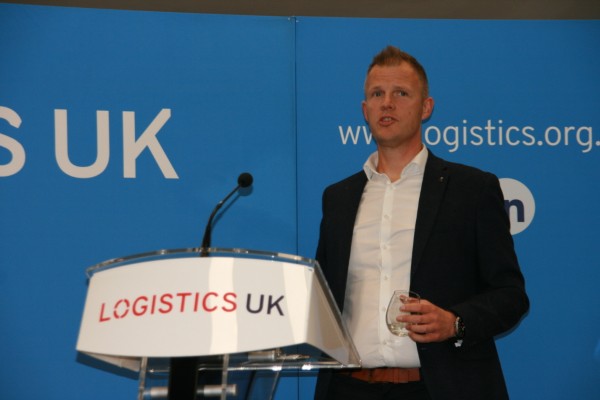
Matt Barlow of Heidelberg Materials
He opened by pointing out that “35 per cent of the material we move is for the government,” so greater efficiency was in the public interest, and that his company operated to the limits of current weights and dimensions regulations to this end.
“We want to electrify, we are a CO2-heavy industry,” he admitted.
But electrification would come at a price: “We are talking 15 – 25 per cent capacity loss on an 8×4 mixer truck,” he said. “Five-axle chassis would be a solution, but they are not UK legal.”
On tippers, the industry was pretty much stuck with the 8×4 rigid: “Clients don’t want articulated trucks on site because of the roll-over risk when tipping,” he explained, pointing out the dangers inherent in a long, and therefore flexible, body and chassis.
Short artic tippers, as used on the continent, fall foul of the obscure 1945 Bridge Formula which was introduced to prevent damage to road bridges from excessive vehicle weights. This is the reason why UK 44-tonne artics require a minimum of eight metres between the kingpin and the rear axle while short artics were operating safely at 44 tonnes on the continent.
“It’s a stumbling block and we need an assessment into its relevance and accuracy. We need to think about where we need to improve bridges and infrastructure.”
Reforming the Bridge Formula would allow a four-tonne (rather than the current two-tonne) allowance for GVW, as was permitted on the continent, and the weight limit for drive axles should be increased to 13 tonnes. It would also allow the government to shorten the 8m gap between kingpin and rear axle, enabling the construction industries to switch from using 32-tonne rigids to 44-tonne artics.
“The UK is currently the most expensive country in the world to deliver construction projects in,” he claimed, citing HS2 “built with 8×4 trucks” as a glaring example.
He asked: “Surely we can operate on selected routes with heavier drive axles?” adding that the industry needed to lobby government.
“We won’t be able to decarbonise without these changes,” he cautioned.