
Allison integrated retarders earn their keep on Ubico’s Cotswold rounds
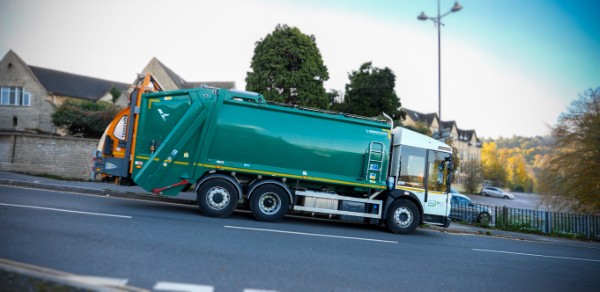
The integrated retarder cuts heat and wear on long descents. Image © Allison Transmission
Operating 26-tonne refuse vehicles on some of the steepest collection routes in England, frontline services provider Ubico has standardised on the integrated retarder in its Allison fully automatic transmissions – cutting brake wear, fuel use and particulate emissions across a 1,300-vehicle fleet.
Ubico is owned by eight partner councils across Gloucestershire and beyond, and collects waste and recycling from 369,000 domestic properties across 1,300 square miles. Its most demanding territory is Stroud, where gradients put sustained pressure on braking systems and drivers alike.
“Stroud and Gloucestershire is one of our most difficult areas, mainly to do with the geographical area,” said Alexander Walsh, fleet maintenance and workshop manager at Ubico.
“The hills are very, very steep. These trucks are put under great pressure going up the hills – but especially coming down them. They can gain speed quickly, and many of these vehicles weigh 26 tonnes.”
Ubico’s answer has been the integrated retarder in the Allison fully automatic transmissions fitted to its refuse collection vehicles. By slowing the vehicle through transmission resistance rather than friction braking, the retarder reduces the heat and wear generated by the service brakes on long descents.
“The retarder reduces the amount the driver needs to use the foot brake,” said Walsh.
“That stops the vehicle from overheating and prevents brake fade. On these vehicles it has five stages – one is very soft, five is quite severe.”
After testing, Ubico’s workshop fixed stage four as the fleet-wide standard. The result was a measurable reduction in brake wear and replacement costs.
“We analysed it through our software, and we’re saving money, and it’s made things a lot easier for the workshop,” Walsh confirmed.
Reduced friction braking also cuts the particulate matter generated by brake and tyre wear, supporting Ubico’s target of carbon neutrality by 2030.
“It’s an all-round system that’s helping us in many aspects,” added Walsh.

Ubico driver Gary Adams. Image © Allison Transmission
From the cab, driver Gary Adams described the effect on Stroud’s gradients: “It flows by itself, ever so gently. Retarding-wise, it’s just feather throttle and it loads itself. Nice and calm, very relaxed.”
The transmission also feeds into Ubico’s driver behaviour programme, which scores every driver from 1 to 100 on the Energy Efficiency Driver Index (EEDI) across acceleration, braking and cornering. Drivers falling below the national benchmark of 75 receive eco-coaching from driver liaison managers.
According to Walsh, the transmission works in the drivers’ favour: “With less braking, it reduces fuel consumption – but it also gives them time to think, plan, and observe. It gives them the safety aspect, improved braking, and a reduction in carbon.” Since Allison-equipped vehicles were introduced, Adams reports fewer fuel refills and a much-improved EEDI score.
Beyond the retarder, Ubico cites Allison’s FuelSense 2.0 software as a further contributor to fuel and emissions savings.
“It’s not just the slick gear changes that save on fuel,” said Ian Bourton, head of fleet operations at Ubico. “The fact that it automatically slips into neutral on stop is a great emission saver for us and our partner councils.” On refuse rounds involving hundreds of stops a day, the neutral-at-stop function removes unnecessary engine load whenever the vehicle is stationary.
Bourton, who oversees procurement across the partnership, added: “Our key drivers are value for money, reliability, and emissions reductions. That’s the type of partners we look for – and Allison Transmission is currently one of those.”
For Adams, the case is simpler still: “The transmission takes the distraction of a gearbox away from the driver, so you can concentrate on different situations on the road. Perfect.”