
Dayco: don’t overlook the auxiliary drive system
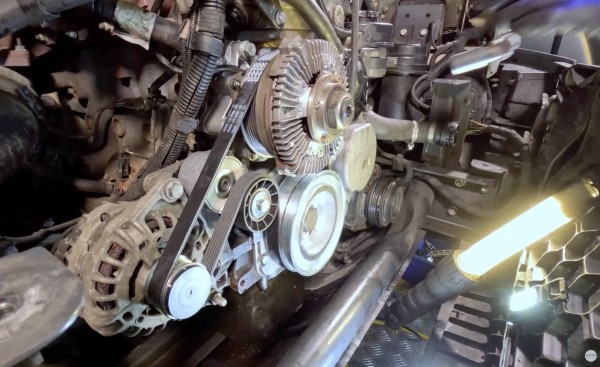 Drive systems and engine products supplier Dayco is encouraging commercial vehicle (CV) operators and workshops to check the auxiliary system every time a vehicle enters their premises – particularly as according to ADAC data, across Europe, auxiliary belt failure is the main reason for engine-related breakdowns.
“Although often forgotten, the harsh reality is that should an auxiliary belt fitted to a CV fail, alongside the need to replace the affected parts, the vehicle’s time off the road must also be factored into the potential cost of ignoring the condition of the belt,” said Dayco.
“This could easily exceed £500 per day for those fleets employed on a daily national delivery contract, in addition to the cost of roadside repair or recovery.”
Dayco estimates that in the UK, there are 100,000 systems that require maintenance annually, and says applying its ‘check and change’ principle will help operators mitigate these financial costs.
“In addition, as CVs generally have more than one belt system, it also provides business opportunities for workshops, especially as the market is estimated to be worth £7.5 million in belts alone.”
Although the check is fast, Dayco notes, typical EPDM belts wear gradually – like the tread wear of a tyre – so technicians need a simple tool to help them.
“The Dayco aWearness gauge provides them with three ways to check whether the belt needs to be replaced or is okay to be reinstalled. The two most relevant to an EPDM belt are the wear indicator bar, which highlights material loss and the profile indicator, which reveals whether the belt retains its correct form. Both reflect the level of wear and if the belt fails either check, it must be replaced.”
If regular inspection is not undertaken, Dayco recommends that for off-highway vehicles the belt should be checked every 28,000 miles and changed every 56,000 miles. When it comes to trucks and buses operating in an urban environment this can be extended to 37,000 miles and 74,000 miles respectively, and to 74,000 and 148,000 for those covering long distances.
“Wear on the belt could also indicate problems with the other components in the auxiliary drive system, which is why technicians also need to thoroughly assess the condition of these associated parts,” said the firm.
“Particular attention should be paid to the tensioner, because the wrong tension on the belt will accelerate wear and contribute to the potential failure of the drive system.
“Therefore, in order for technicians to carry out the best possible job and fleet managers to maximise the reliability of their vehicles, the auxiliary drive system should be considered as a single entity. So, instead of looking at the belt and drive components separately and potentially changing individual items, technicians should replace the complete system, which allows them to provide a thorough repair solution.”
Dayco says it can provide a one-stop shop for auxiliary system maintenance and replacement: as well as its OE designed belts, it also supplies tensioners and pulleys, which means that technicians have the assurance that they are installing fully compatible parts. Its aftermarket offering also includes water pumps.
As Dayco is a full system supplier to many vehicle manufacturers globally, it only produces vehicle-specific references, meaning its aftermarket programme does not follow a ‘one-size-fits-all’ policy.
“This means that technicians are able to install a like-for-like OE replacement, with the assurance that provides for them and their valued customers,” said the company.
Its OE pedigree flows through to its aftermarket offering, it adds, since the manufacturing facilities, engineering processes and finished products are identical for both its OE and aftermarket supply channels.
“Both, therefore, reflect the latest technology, so technicians can be assured of the correct installation when it comes to the components, which means the fitting time is minimised, alignment of the auxiliary system optimised and the correct function of the components in the auxiliary drive system is secured.”
More information regarding Dayco power transmission products is available at the website.