
VUE: putting safety first with AI
 Vehicle CCTV and video telematics provider VUE has outlined various means by which artificial intelligence (AI) can contribute to safer road transport operations.
“In its simplest terms, AI technology when it comes to vehicle safety is the process of using AI to take humans out of the equation as much as possible,” said Glen Mullins, VUE managing director.
“The software is set up to make sense of the environment surrounding the driver and help them to determine the best action to take in any situation.”
One useful application for AI is helping to prevent driver distraction, says Glen.
“Distracted driving can have catastrophic consequences, especially considering that this type of behaviour is twice as likely to result in a road traffic accident than drink-driving,” he continued.
“Similarly, driving while tired can also be extremely dangerous as a driver nodding off at the wheel while driving at 70mph could see them travelling 200m without even realising it. However, it’s extremely hard for an operator to know when one of their drivers are showing signs of potentially dangerous behaviour such as mobile phone usage, or extreme fatigue – not until the worst happens an accident occurs.
“This is where AI technology comes in. In-cab cameras that are powered by AI can monitor a driver’s behaviour in real-time and detect and alert a driver in-cab, helping them keep focused on the road.
“A driver hearing this as an audible alert is likely to correct their behaviour straight away and divert their attention back to their driving, which also acts as a preventative measure for future incidents.”
VUE has developed an AI-powered solution which it says can accurately detect when a driver is distracted or if they’re showing signs of fatigue.
“Driver Distraction AI is an intelligent device that ‘sees’ the driver and identifies behaviours such as using a mobile phone, smoking, looking beyond a specified angle for an extended amount of time, yawning, and eye closure,” Glen explained.
“It then sends audible alerts in-cab which can also be sent to fleet managers in real-time to be fed into driver training, and to help fleet managers proactively manage driver safety and vehicle safety.”
The evolution of AI technology can also minimise risk by gifting drivers with extra visibility, adds Glen, enabling them to spot vulnerable road users travelling around their vehicle that they would’ve otherwise missed.
“These systems provide fleet managers extra peace of mind that the drivers in their fleet have a good understanding of what’s happening on the roads around them at all times,” he continued.
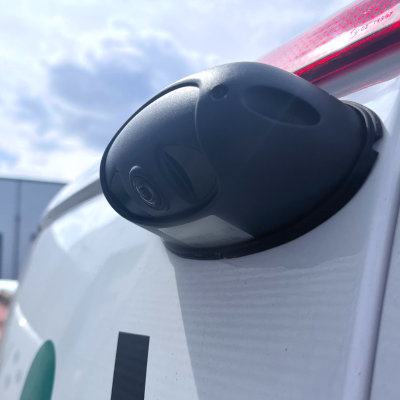 “VUE’s Pedestrian AI is a camera system that helps to prioritise vulnerable road users by detecting pedestrians, cyclists and motorcyclists. It can be situated around the rear and both sides of a vehicle for complete coverage.
“The solution sends an alert in-cab and displays the live footage on a monitor, making the driver aware of any potential danger. These alerts can also be sent to a fleet manager to review any near misses, and take steps to rectify these situations in the future.”
Finally, Glen highlights bridge strikes as a further safety concern that AI can help mitigate.
“The issue is so serious that drivers and fleet managers could even see their licences being revoked and face the possibility of prosecution if a crash was a result of careless or negligent behaviour,” he said.
“A leading cause of these types of collisions is an error in judgement by the driver’s perceived ability to fit under the bridge safely; however, AI technology appears to have provided a solution to this.
“Devices such as VUE’s Low Bridge Alerting System use an AI algorithm to detect if a bridge or other road height restriction lower than the height of the vehicle is nearby, based on the direction it is travelling, requiring no driver input whatsoever.
“This concept of lessening the reliance on a driver to minimise an accident is central to the purpose of AI road technology and is what makes it so beneficial for fleets.”