
Cummins: driving a tech neutral approach to HGV decarbonisation

Cummins’ William Lamb
Engine technology provider Cummins has welcomed the UK government’s recently announced £1bn package to support the uptake of electric trucks and vans – but says battery electric vehicles (BEVs) represent just one aspect of a wider alternative power strategy in the drive to decarbonise the industry.
“There are a range of power options available to manufacturers, including HVO, hybrid, biogas and hydrogen combustion engines, that all have important roles to play in the future of commercial vehicles,” said William Lamb, director, engine business platform strategy at Cummins.
“Meaningful CO₂ reductions can still be delivered at scale through more efficient powertrains and low and zero-carbon fuels, while zero-emission infrastructure continues to develop across the country. Understanding how these solutions can work alongside each other to support decarbonisation will be key for those working across the sector and to legislators looking to effect change.
“As a drop-in fuel for combustion engines, hydrotreated vegetable oil (HVO) offers short-term, real-world benefits. HVO is an easily stored, renewable fuel derived from biomass, with similar properties to diesel that can reduce well-to-wheel vehicle emissions by up to 90 per cent.
“HVO is increasingly available throughout Europe in different blend formulations, making it a useful tool for OEMs manufacturing vehicles for demanding applications. With many engines requiring minimal-to-no alterations to be HVO compatible, this fuel reduces well-to-wheels emissions while delivering diesel-like output and, with minimal impacts on vehicle design or maintenance cycles.”
He also highlights biomethane, often referred to as renewable natural gas (RNG), produced from captured methane emitted from the decomposition of biodegradable materials.
“With the same qualities as natural gas, RNG-ready engines can achieve nearly 100 per cent well-to-wheel CO2 emission reductions,” said Lamb.
“Cummins has produced natural gas engines for over 30 years, and whilst these power solutions have traditionally seen stronger adoption in locations with readily available natural gas fuel, like China, increased production of RNG in wider European markets could see this technology produce real emissions savings in commercial vehicle fleets.”
To use these fuels at meaningful scale, there needs to be the right balance between incentive and reduced barriers for adoption – and the Cummins HELM range has been designed to make investment decisions around this easier for OEMs, he says.
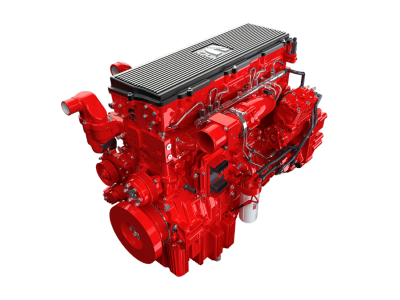
Cummins’ X10 Euro 7 engine
“Positioned as ‘higher efficiency, lower emissions, multiple fuels’, the Cummins HELM platform consists of a common base design engineered for use with different fuels. Cummins HELM engines, including the X15, X10 and B series, are designed to accommodate a range of fuels, such as advanced diesel, HVO, natural gas, RNG and hydrogen.
“The new HELM platforms are much more efficient than previous generations of engines and produce less CO2, even when running on diesel. In combination with OEMs advancements in vehicle technology, these platforms can produce real-world useful savings with conventional technology and different available fuels.
“The HELM approach provides OEMs with flexibility to make scalable and targeted choices for what can power certain applications for specific markets, with more streamlined development programs. With greater engine flexibility, OEMs can support the use of different fuels to produce emissions reductions in fleets. To enhance emissions savings further, alternative fuels can be utilised in tandem with hybrid capabilities.”
Whether in series or parallel formats, hybrids can improve fuel efficiency by up to 30 per cent, says Lamb, reducing operating costs as well as emissions.
“Hybrid vehicles carry fewer battery packs than BEV, making their payload impact smaller than that of BEVs. Enhanced output from hybrid engines also enables a smaller displacement engine to be selected. This can have lower fuel consumption, whilst partnering with the hybrid system to do the job of a larger engine.
“Hybrid capabilities, that can produce a high output using existing fueling infrastructure, will appeal to many operating fleets in the hardest conditions of the sector. In the near term, it’s essential that these demands, and the full range of power solutions available to meet them, are understood by manufacturers and legislators alike.”
He continued: “To decarbonise industries effectively, we need a diverse portfolio of power solutions that can meet varying power demands across different sectors. For commercial vehicles, variations in available infrastructure, output requirements of vehicles and total cost of ownership (TCO) impacts across different regions must be considered at a legislative level.”
Taking European CO2 reduction legislation for heavy duty vehicles as an example, Lamb points out that battery electric, hybrid and hydrogen power solutions are all recognised as having key roles to play in meeting the targets, but HVO and RNG are so far not, despite having clear well-to-wheel benefits.
“Looking more specifically at the UK, Cummins believes there is an opportunity to build a regulatory framework that accelerates decarbonisation while supporting innovation across the full range of powertrain technologies,” he said.
“By enabling multiple solutions, the UK can create a regulatory environment that supports investment, strengthens industrial capability, and delivers sustainable emissions reductions.”