
Driving down emissions with Eliminox fuel conditioner

Eliminox chair Prof. Tony Granger
Eliminox has explained how its fuel conditioner solution can help reduce fleets’ carbon footprints and save on fuel, as well as tackling a range of tailpipe pollutants.
“The general trend is movement away from the use of fossil fuels (which generates CO2) towards the use of alternative, mostly synthetic, fuels on the journey towards electrification,” said Professor Tony Granger, chairman of Eliminox.
“However, with supply chain issues in both battery manufacturing and rare earth metal mining, both still contribute to CO2.
“The problem now facing businesses (and governments) in their quest for CO2 reduction at all costs is the significant cost incurred in advocating a total sea change from carbon fuel combustion vehicles to electric or alternative fuels is using a sledgehammer to crack a nut.”
Oil will still be required for hundreds of years, Tony points out, due to its use in the manufacture of countless products.
“The oil itself is not the problem (although it is associated with it) – it is the use of the oil or the range of products it is refined into. When the oil is burned, or combusts, it gives off harmful emissions.
“The bottom line is that carbon-based or fossil fuels are here to stay. The problem then is how to limit the effect of greenhouse gases and harmful emissions on the breathing public and how to limit CO2 emissions from affecting increasing earth temperatures.”
Given the scale of the challenge to get to the long-term solution, it is important to find solutions that can make an immediate difference, says Tony.
“One of these is Eliminox Eco, a cost-neutral 100 per cent biodegradable green tech-based fuel conditioner. developed by multi award winner Eliminox.
“Used to treat carbon-based fuels at manufacture or in fuel tanks prior to being combusted, Eliminox Eco results in the reduction of many emissions including NOx, CO2, and importantly, the life-threatening sooty particles arising from highly concentrated transport emissions, particulate matter (PM 1, PM 2.5 and PM 10).”
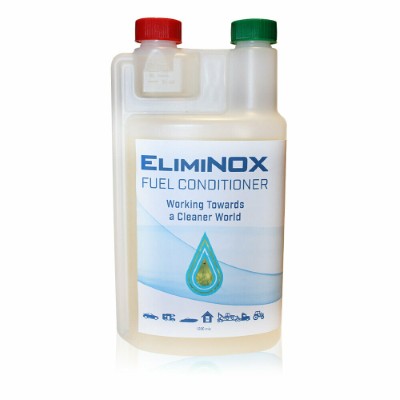 The right fuel conditioners (such as Eliminox Eco) can significantly reduce PM emissions by improving combustion efficiency and reducing fuel consumption, Tony says.
To achieve improved combustion, microscopic water droplets forming an emulsion that creates a stronger burn rate, he explains, while increased oxygen contact promotes more complete combustion, thereby reducing soot – and reduced unburned carbon lowers harmful particulate emissions.
To clean the fuel system, the detergent action cleans fuel lines, internal engine parts and injectors, and filters, Tony adds, while removal of deposits decarbonises and prevents build-up of carbon that can hinder engine efficiency.
Additional benefits are said to include lower emissions, Including NOx, SOx, CO2, and PMs, fuel savings of up to 8 per cent through more efficient combustion, and reduced maintenance, since cleaner engines require fewer repairs.
“We’ve seen emissions reduced by up to 97 per cent for PM and 30 per cent for CO2,” said Tony.
“Fuel efficiency improvements of 5–8 per cent are not uncommon, making the product cost-neutral in many cases.”
Applications across generators, vehicles, and marine engines have shown consistent results, he adds, helping clients reduce both environmental impact and operating costs.
“Using Eliminox Eco has many benefits for diesel and other carbon-based fuel users. Capex expenditure on new EV vehicles and machinery can be deferred as harmful emissions and particulate matter (PMs) are reduced through treating the fuel.
“Fuel savings at 6-8 per cent reduce increasingly expensive fuel bills, saving many thousands of pounds.
“Harmful emission reduction reduces CO2 and other noxious gases. Every litre of diesel used produces 2.65 kg of CO2 for cars and around 7 kg of CO2 for HGVs. Eliminox can issue a carbon reduction certificate for regular users of its product. This evidences reducing the carbon footprint for the company in its accounts where striving towards net zero emissions.”
In addition, cleaner engines and reduced maintenance costs produce considerable savings in filter replacement, says Tony, extending service intervals.
Further cited benefits include elimination of diesel bug and its damaging effect on engines, and cleaner air for communities where transport emissions are a major health problem, especially in confined spaces and urban areas.
Eliminox cites a number of successful test results for its product, including from a test conducted by Socotec at Millbrook Proving Ground with a Mercedes-Benz Euro VI HGV, where PMs were reduced by 14.8 per cent, NOx by 23.6 per cent and CO by 72.8 per cent.
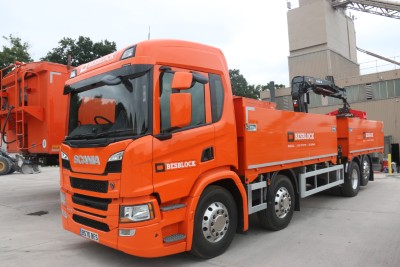 The company also highlights the example of building materials manufacturer Besblock’s fleet of 27 Euro VI HGVs, which reportedly demonstrated fuel savings of 8 per cent and emission reductions of 17 per cent (over 24 months and 2.5 million miles). Its PM filters were not changed for 13 months and the firm reported no issues with PM sensors and no limp mode.
“It should also be noted that with the significant reductions in NOx then there will be savings related to reduced AdBlue consumption, improved DPF filter life plus improvements to engine oil condition due to reduced particulate blow-back effects,” said Tony.
Eliminox additionally conducted a trial with road safety products specialist, Saferoad, which it reports was very successful. Over a six‑month trial period on mixed duty (HGVs and vans), Saferoad recorded measurable reductions in fuel consumption and tailpipe emissions, alongside smoother operation and fewer DPF interventions.
“I can confirm it does work and it has reduced our fuel use up to 8 per cent and more importantly, reduced our emissions,” said Peter Arthy of Saferoad.
Finally, a recent evaluation at Maritime Transport reportedly yielded 6 per cent fuel savings.
“Actual test and user results show significant fuel savings and reduced emissions across the sample of users of Eliminox,” said Tony.
“Eliminox is EN 590 compliant which means that no warranties are affected, and we have letters of no objection from Scania, DAF and MAN to using Eliminox.
“In conclusion it must be said that companies seeking sustainable and positive ESG results through net zero target objectives can benefit both financially and socially from a cleaner air environment. It causes them to focus on how to be more efficient, bearing in mind capex savings and reduced fuel costs with a reduction in emissions.
“Eliminox helps them with their decarbonisation objectives with added-value, no-hassle alternatives. Eliminox is a viable, cost-effective solution in the transition to net zero 2050.”